
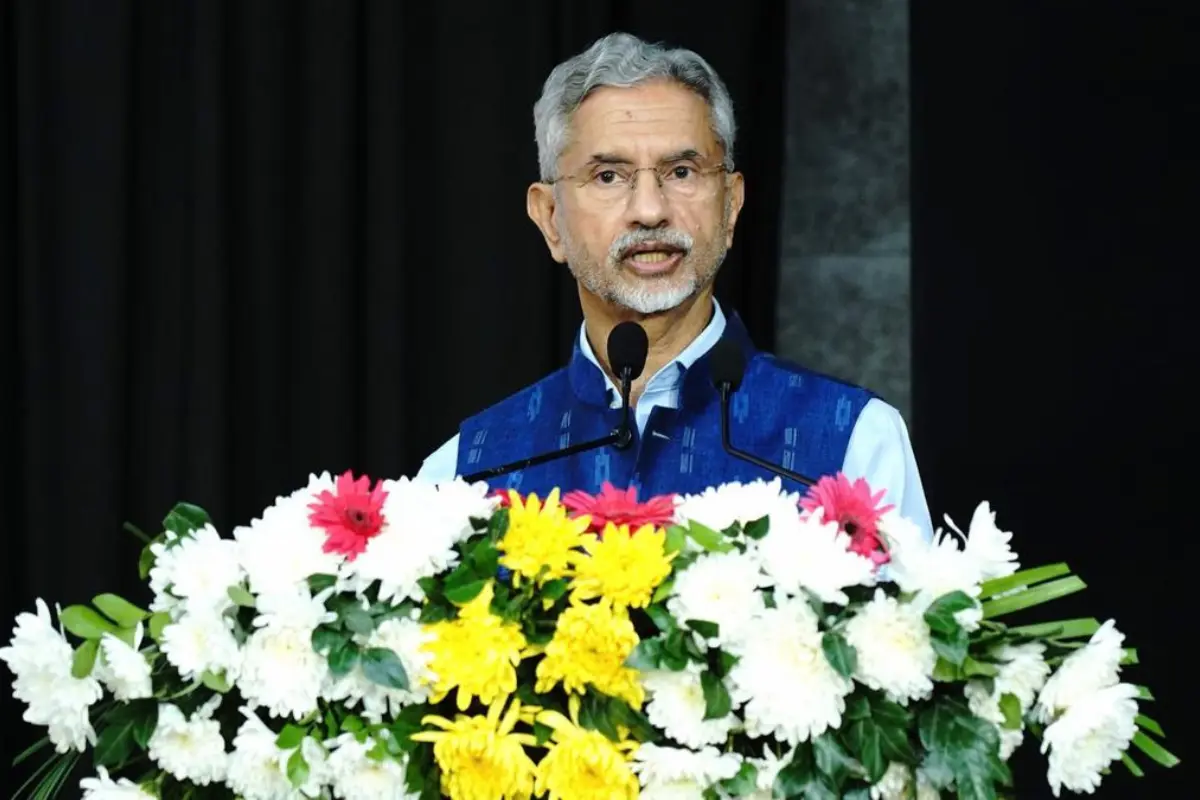
Jaishankar on India’s Strategic Autonomy in Global Affairs
India’s Strategic Autonomy Is Key to National Interest, Says S. Jaishankar at JNU Summit
External Affairs Minister S. Jaishankar reaffirmed that India’s strategic autonomy has always guided the nation’s foreign policy choices, recalling the landmark Indo-Soviet friendship treaty of 1971 as a “necessary” step taken during a time of intense global power rivalry.
Speaking at the Aravalli Summit organized by Jawaharlal Nehru University’s (JNU) School of International Studies to mark its 70th anniversary, Mr. Jaishankar emphasized that India’s diplomatic strength lies in “maximizing options and maintaining freedom of choice,” rather than aligning permanently with any single power.
“Imagine if India were not today adopting strategic autonomy,” he asked the audience. “Please tell me, which country in the world would you like to join up with and put our future in their hands? I can’t think of anybody. Our interest is best secured by preserving independence of action.”
Jaishankar: Lessons from 1971 – Strategic Autonomy in Action
Reflecting on history, the minister said that the Indo-Soviet Treaty of Peace, Friendship and Cooperation in 1971 was not just symbolic, but a critical safeguard when India faced a triangular challenge from the United States and China during the Bangladesh Liberation War.
“What we did was in our national interest,” Mr. Jaishankar said, answering questions from students. “We were dealing with a U.S.-China triangle and had to find a way out of it. The decision we took in the midst of an acute national security crisis was absolutely necessary.”
The event was co-hosted by the Ministry of External Affairs and the newly launched Chintan Research Foundation, backed by the Adani Group. Among the distinguished attendees were Russian Ambassador Denis Alipov and Bangladesh High Commissioner Riaz Hamidullah, underscoring the historical and contemporary relevance of the minister’s remarks.
Multi-Alignment and Multipolarity: The Road Ahead
Highlighting the turbulence in global trade and politics, including U.S.-imposed tariffs and shifting alliances, Mr. Jaishankar argued that the case for multi-alignment and multipolarity is stronger today than ever before. He added that students of foreign policy must prepare for a future where India balances relations with multiple global players simultaneously.
India’s recent handling of Russian oil imports, he noted, reflected the same philosophy of safeguarding national interests while navigating external pressures.
Jaishankar: Neighbourhood First – A Balancing Act
Addressing questions on India’s ties with its neighbours, Mr. Jaishankar said New Delhi must continue to “underwrite the infrastructure for cooperation” in South Asia and become the “go-to option” for regional partners.
“Every country has problematic neighbours, and every big country has more problematic neighbours,” he remarked, in a thinly veiled reference to Pakistan. While admitting that India cannot “wish away a difficult neighbour,” he asserted that the world no longer places India and Pakistan on the same footing.
Beyond Pakistan, he said India has achieved “transformational change” in its regional engagements, citing advances in cross-border energy projects, transport networks, and people-to-people exchanges with countries like Nepal, Bhutan, and Bangladesh.
Strategic Autonomy as India’s Compass
The External Affairs Minister concluded by stressing that India’s strategic autonomy is not about isolation, but about ensuring that no external power dictates India’s destiny. “Our future,” he said, “is best served by keeping our choices open, strengthening partnerships on our terms, and pursuing national interest without hesitation.”
Also Read : Rakesh Ehagaban: Indian-Origin Motel Owner Killed in the US