
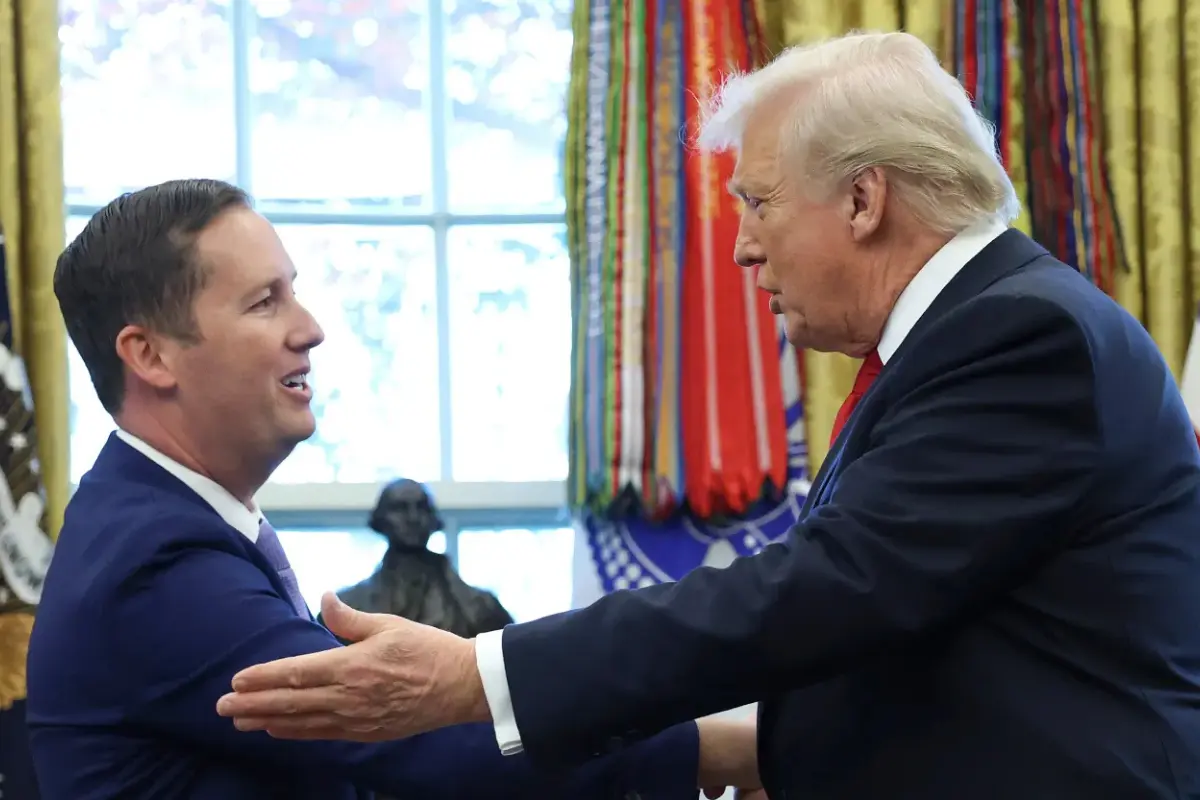
Trump hints at cutting tariffs on India, Sergio Gor Sworn in
Donald Trump Looks to Reset Relations with India as Sergio Gor Takes the Helm
U.S. President Donald Trump’s India diplomacy entered a defining chapter this week as longtime ally Sergio Gor officially took charge as the U.S. Ambassador to India. His appointment comes at a delicate moment, with Washington and New Delhi navigating through friction over trade policies, energy dependencies, and strategic realignments amid shifting global alliances.
At the swearing-in ceremony on Monday, Trump struck a notably conciliatory tone, hinting at a thaw in trade relations between the two nations. “The tariffs on India are really high because of the Russian oil [imports], but they have now substantially reduced Russian oil [imports], so we will be bringing the tariffs down,” Trump announced, signaling a possible breakthrough in months of tense negotiations.
However, data from energy analytics firm Kpler painted a more complex picture. According to its October report, India’s imports of Russian crude remained steady at 1.59 million barrels per day (mbd), nearly unchanged from September. Analysts suggest that while diplomatic rhetoric might lean toward optimism, ground realities in energy trade remain largely consistent.
Kpler further noted that 1.73 mbd of October’s Russian oil exports were already earmarked for India, with another 302 kbd still unassigned — a portion of which could also find its way to Indian refineries. “It’s still too early to draw a clear picture for November,” the report said, tempering expectations of a sharp decline in Russian energy inflows.
Trump: Sergio Gor’s Mandate – A Bridge Between Washington and New Delhi
President Trump described Gor as a “strategic envoy” whose mission would go beyond traditional diplomacy. “I am looking at Sergio to strengthen one of the most important relationships — the strategic partnership with the Republic of India,” Trump declared. He emphasized Gor’s role in promoting U.S. investment, enhancing energy cooperation, and broadening defense and technology partnerships.
Gor, whose appointment was confirmed by the Senate on October 7, wasted no time upon his arrival in New Delhi. Within days, he met Prime Minister Narendra Modi, where discussions centered on defense cooperation, critical mineral supply chains, and bilateral trade growth. “We also discussed the importance of critical minerals to both of our nations,” Gor stated, hinting at the strategic convergence around clean energy and advanced manufacturing.
According to Alexandra Hermann of Oxford Economics, Gor’s appointment represents a calculated shift in Donald Trump’s India diplomacy — favoring direct, high-level engagement over the slower machinery of bureaucratic diplomacy. “This suggests a desire to reach a trade deal sooner rather than later,” Hermann noted. “But appointing a political loyalist instead of a seasoned diplomat carries both opportunity and risk — it could accelerate progress or intensify volatility if relations sour.”
Tariffs, Visas, and the Shifting Sands of Strategic Ties
Despite the optimism, several unresolved issues continue to strain the U.S.-India relationship. Tariff disputes, a $100,000 fee for H1B visas, and Trump’s controversial remarks about “mediating” between India and Pakistan have contributed to an atmosphere of mistrust.
Former Reserve Bank of India Governor Raghuram Rajan, speaking at a Chicago Council on Global Affairs event on November 6, criticized the inconsistencies in Washington’s approach. “It can’t be that you are the most tariffed country in the world — more than even China — and then talk about military friendship and joint maneuvers,” Rajan said.
He drew historical parallels, warning that short-term political calculations could have lasting consequences. “The last time the U.S. tilted toward Pakistan during the 1971 war, it pushed India closer to the Soviet Union for the next 25 years,” Rajan cautioned.
Trump: Modi’s Diplomatic Balancing Act
After the U.S. imposed 50% tariffs on Indian exports in August, Prime Minister Modi appeared at the Shanghai Cooperation Organization Summit in Tianjin, where he was seen sharing a warm moment with Xi Jinping and Vladimir Putin. The New York Times described it as “a smiling manifestation of a troika that Moscow had recently said it hoped to revive,” underscoring India’s nuanced approach to balancing East and West.
India’s engagement with Russia has continued unabated. This week, a delegation of 20 Indian firms participated in the Moscow International Tool Expo, where the Federation of Indian Export Organizations (FIEO) announced a projected $1.75 billion in engineering exports to Russia this year. “The participation in the exhibition will deepen commercial ties and boost bilateral trade,” said FIEO President S. C. Ralhan.
Nonetheless, data from the Indian Brand Equity Foundation (IBEF) reveals the limited scale of India-Russia trade compared to that with the U.S. — India exported $4.88 billion to Russia and imported $63.84 billion in fiscal 2025, while the U.S. accounted for 18% of India’s total exports.