
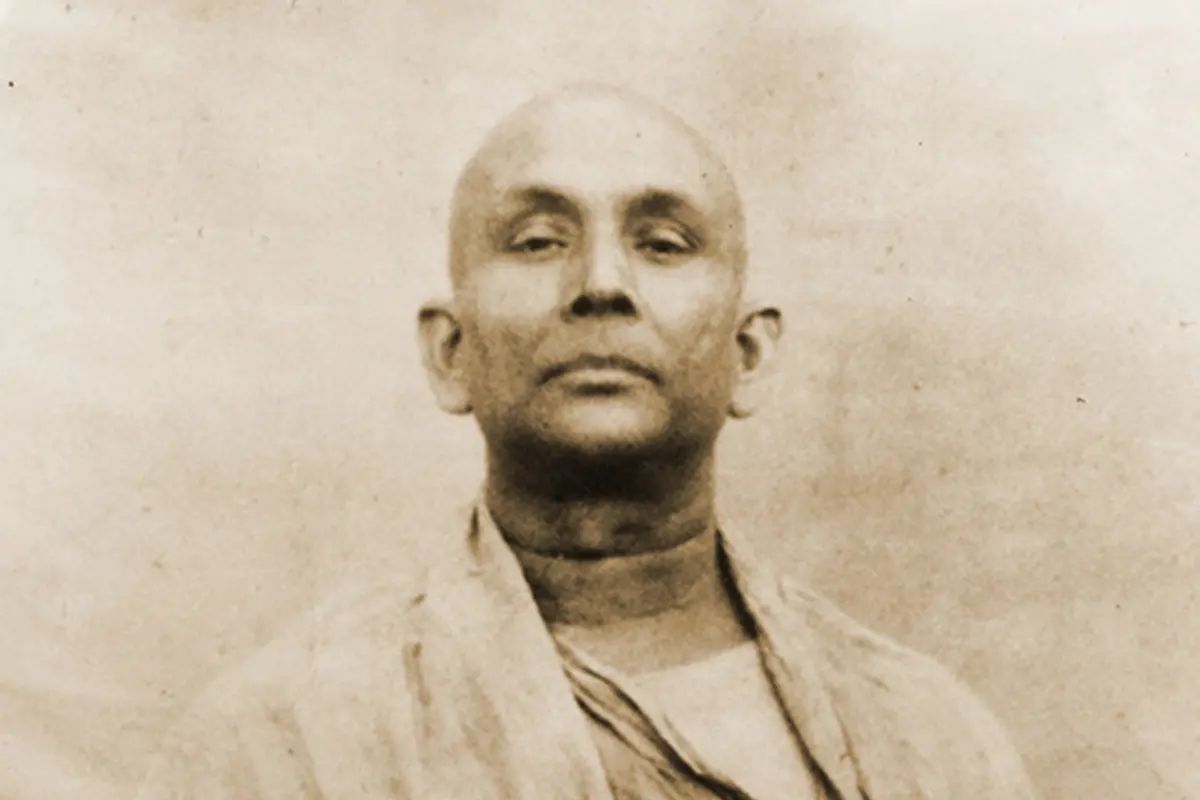
Swami Turiyananda, affectionately known as Hari Maharaj, was not just a saintly monk of the Ramakrishna Mission but a living embodiment of Vedanta’s timeless wisdom. A direct monastic disciple of the 19th-century mystic Sri Ramakrishna, Turiyananda’s life was a rare blend of intense spirituality, fearless devotion, and compassionate service.
Handpicked by Swami Vivekananda to spread Vedanta in the West, he became one of the earliest missionaries to America, where he left a deep impression on countless seekers before returning to India to live his final years as a contemplative ascetic.
Swami Turiyananda: Early Life of Swami Turiyananda
Born as Harinath Chattopadhyay on 3 January 1863 in Calcutta, Harinath grew up in an affluent Bengali Brahmin household. His father, Chandranath Chattopadhyay, was respected for his orthodox values, while his mother, Prasannamayi, was a woman of immense courage—once even sacrificing her life to save her young son from a wild jackal. Orphaned at a tender age, Harinath was raised by his elder brother, Mahendranath.
Even in his school days, his heart leaned toward religion and philosophy. He studied the Bhagavad Gita, the Upanishads, and the works of Adi Shankaracharya with deep reverence, showing an early attraction to Advaita Vedanta. An incident in his youth—when he calmly faced a crocodile in the Ganges—revealed the fearless conviction that would later define Swami Turiyananda.
Spiritual Transformation Under Sri Ramakrishna
Harinath first saw Sri Ramakrishna at the age of fourteen and met him again a few years later at the Dakshineswar temple. Drawn to the saint’s divine magnetism, Harinath became his disciple.
Sri Ramakrishna played a pivotal role in reshaping Harinath’s spiritual outlook. One profound teaching came when Harinath confessed his aversion to women—Ramakrishna rebuked him gently, teaching him to see every woman as the Divine Mother. This change in perspective was a turning point in his spiritual growth.
The Master saw great potential in Harinath, once remarking, “He comes from that transcendent region whence name and form are manufactured.” Under Ramakrishna’s guidance, Harinath’s devotion deepened, and his rigid monism softened into a more devotional approach.
Swami Turiyananda: Bond with Swami Vivekananda
Harinath’s friendship with Narendranath Dutta—later Swami Vivekananda—was one of deep respect and mutual admiration. Vivekananda affectionately called him “Haribhai,” and often drew strength from his friend’s unshakable renunciation and discipline.
When Vivekananda asked him to accompany him to America to preach Vedanta, Turiyananda initially declined, preferring a quiet, meditative life. Yet his devotion to Vivekananda prevailed, and in 1899, he set sail for the United States.
Missionary Work in America
Upon reaching New York in August 1899, Swami Turiyananda began teaching at the Vedanta Society, later traveling to Los Angeles and San Francisco. His most significant contribution in America was the establishment of Shanti Ashrama in the serene San Antonio Valley of California.
Living in isolation with a small group of students, Turiyananda focused on personal character-building rooted in Vedantic principles. Life at Shanti Ashrama was austere—students endured harsh conditions, yet the spiritual training they received left an indelible mark. One disciple wrote, “To think of Turiyananda is an act of purification of mind.”
However, the strenuous life affected his health, and he returned to India in 1902, shortly before hearing of Swami Vivekananda’s passing.
Life as an Ascetic
After Vivekananda’s death, Turiyananda withdrew from public life, living in Vrindavan, Almora, and various Himalayan retreats. Despite ill health and diabetes, his austerities remained intense. Remarkably, he once underwent surgery for a carbuncle without anesthesia, remaining calm and detached throughout.
In his final years at the Ramakrishna Mission Sevashram in Varanasi, he spent his days in deep contemplation. On 21 July 1922, moments before passing, he uttered the Upanishadic mantra “Satyam, Jnanam, Anantam Brahma”—God is Truth, Wisdom, and Infinity—and then made the extraordinary declaration: “Brahma Satya, Jagat Satya; Sab Satya” (God is Truth, the world is also Truth; everything is Truth). This vision reflected his ultimate realization—seeing God in all existence.
Teachings and Legacy
Swami Turiyananda was renowned for his fearlessness, once telling a British officer, “I do not even fear death, why should I fear any human being?” His method of teaching was intimate, personal, and experiential. He often said, “One can serve the sick and distressed in the right spirit, and in one single day attain the highest realization.”