
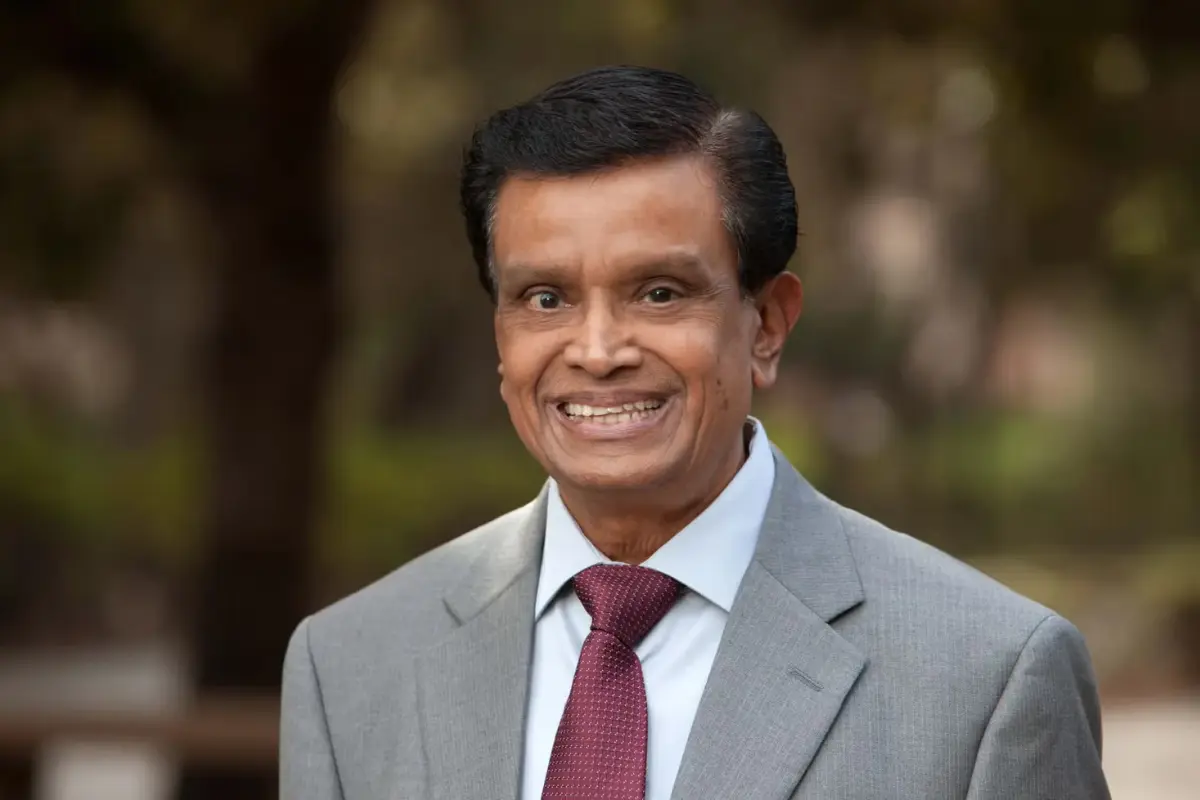
The story of Seenu Srinivasan begins with academic distinction. Graduating in 1966 with a Bachelor of Technology in Mechanical Engineering from the Indian Institute of Technology Madras, he earned the highest honor bestowed upon a student—the President of India Gold Medal. This achievement was not simply recognition of grades; it was acknowledgment of intellectual rigor, analytical depth, and extraordinary promise.
His early professional experience as a production-planning engineer at Larsen & Toubro provided him with practical exposure to industrial systems and operations. In those formative years, Srinivasan developed a deep appreciation for structured problem-solving—an approach that would later define his research philosophy.
Yet, his ambition extended beyond industry. Determined to explore the scientific principles behind decision-making and optimization, he moved to the United States to pursue graduate studies at Carnegie Mellon University. At its Graduate School of Industrial Administration, he completed both his MS and PhD in 1971, graduating at the top of his class and earning the prestigious GSIA Fellowship.
These years shaped his intellectual DNA—melding operations research with emerging marketing analytics.
Seenu Srinivasan: From Operations Research to Marketing Innovation
Seenu Srinivasan’s early research focused on operations research, particularly parametric programming of transportation problems. His work displayed mathematical sophistication and practical relevance. But it was his transition into marketing science that marked the beginning of a revolutionary chapter.
Marketing in the 1970s was evolving from art to science. Businesses sought structured methods to understand customer preferences. Srinivasan recognized that the future of marketing lay in quantification—measuring how customers make trade-offs among product attributes.
In 1978, alongside the late Professor Paul Green, Seenu Srinivasan introduced a concept that would permanently transform market research. In a landmark paper published in the Journal of Consumer Research, they coined the term conjoint analysis—a method to measure customer preference structures by analyzing trade-offs.
This was not merely a new tool. It was a new lens through which businesses could understand choice behavior.
The Birth of Conjoint Analysis and Quantitative Marketing
Today, conjoint analysis is a cornerstone of product development, pricing strategy, and service design worldwide. From automobiles and smartphones to healthcare services and digital subscriptions, companies use this method to determine which features customers value most and how much they are willing to pay.
Seenu Srinivasan co-developed influential estimation techniques such as LINMAP and ASEMAP, making conjoint analysis both rigorous and practical. His contributions enabled organizations to simulate markets before launching products—reducing uncertainty and improving strategic decision-making.
In addition to conjoint analysis, Srinivasan made profound contributions to:
-
The theory of salesforce compensation plans
-
Measurement of brand equity
-
Optimal product positioning
-
Market structuring and substitutability analysis
His research helped firms answer critical questions:
What truly differentiates one brand from another?
How should incentives be designed to motivate performance?
How can companies design products that align precisely with customer preferences?
These were not abstract academic inquiries—they were strategic challenges faced by global corporations.
Seenu Srinivasan: Leadership at Stanford – Scholar, Teacher, Mentor
As the Adams Distinguished Professor of Management at Stanford Graduate School of Business, Seenu Srinivasan shaped generations of leaders. Beyond research, he served as Director of the PhD Program, Chair of the Marketing Area, and Faculty Director of the Strategic Marketing Management Program in Executive Education.
In the Stanford MBA program, he taught the accelerated core course “Data and Decisions” and an elective on Customer-Focused Product Marketing. Students consistently praised his clarity, analytical precision, and ability to translate complex models into intuitive insights.
His excellence in teaching was recognized early in his career when he won Best Teacher Awards in consecutive years. Even more telling is his mentorship legacy—six of his doctoral advisees earned best dissertation-based paper awards, a reflection of his commitment to nurturing independent thinkers.
For Seenu Srinivasan, teaching was not separate from research. It was an extension of it.
Recognition at the Highest Level
The impact of Seenu Srinivasan’s scholarship has been widely recognized by the academic community.
He is a Fellow of:
-
The American Marketing Association
-
The Institute for Operations Research and the Management Sciences
-
The INFORMS Society for Marketing Science
His distinguished awards include:
-
The Parlin Award for outstanding contributions to marketing research
-
The Churchill Award for lifetime achievement in marketing research
-
The Converse Award for outstanding contributions to the development of marketing science
-
The Buck Weaver Award for lifetime contributions to theory and practice
-
Multiple John Little Awards
-
The O’Dell Awards
-
The Bass Award
-
The ISMS Long-Term Impact Award