
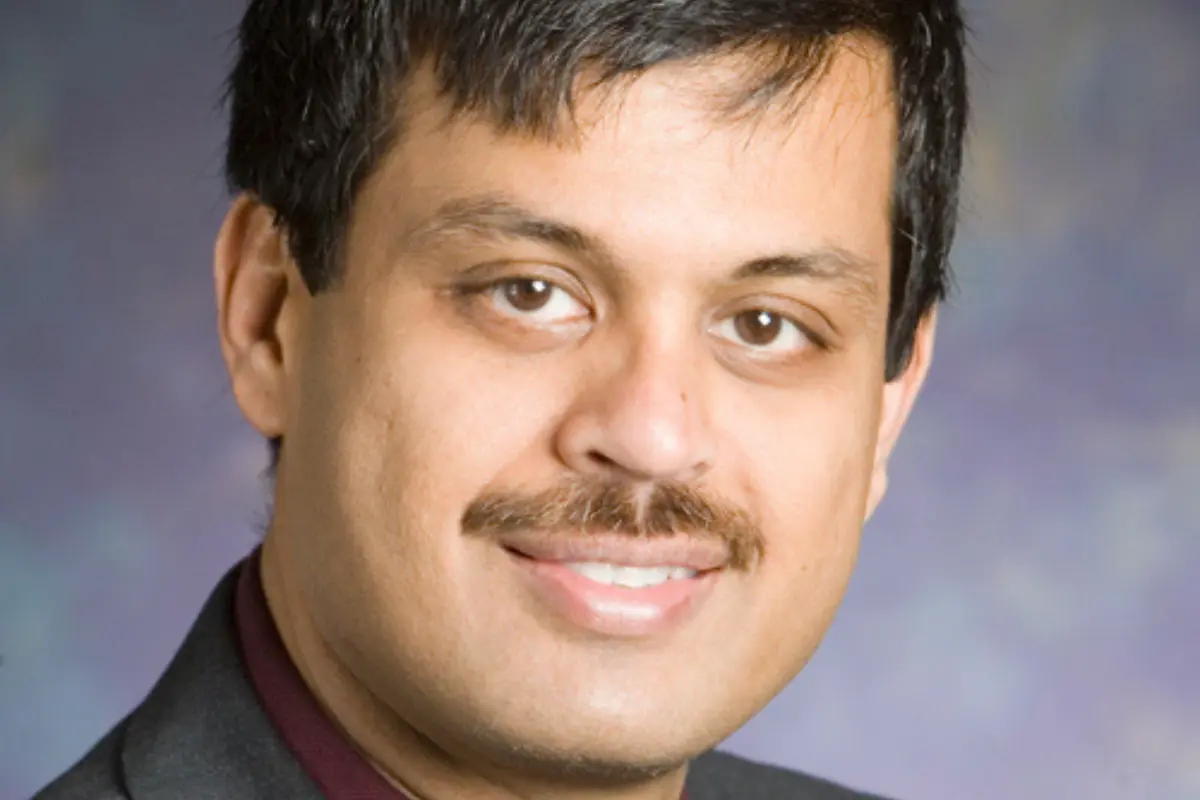
The journey of Rayadurgam Srikant began in India, where intellectual curiosity and a passion for engineering shaped his early years. In 1985, he graduated with a B.Tech. in Electrical Engineering from the Indian Institute of Technology (IIT) Madras, one of the world’s most competitive and prestigious technical institutions. This formative experience laid the groundwork for his analytical thinking, problem-solving discipline, and lifelong commitment to rigorous inquiry.
Driven by a desire to engage with the deepest questions in systems and control, Srikant moved to the United States to pursue advanced studies at the University of Illinois Urbana-Champaign. He earned his M.S. in 1988 and Ph.D. in 1991 in Electrical Engineering, studying under the legendary control theorist Tamer Başar. These years were pivotal, as Srikant developed a research philosophy centered on mathematical clarity, conceptual depth, and relevance to emerging technological challenges.
Rayadurgam Srikant: From Bell Labs to Academia – A Defining Transition
Following his doctoral studies, Rayadurgam Srikant joined AT&T Bell Laboratories as a Member of Technical Staff from 1991 to 1995. At Bell Labs—an institution synonymous with innovation—he gained invaluable exposure to real-world networking problems, industrial-scale systems, and the interplay between theory and implementation.
This experience sharpened his ability to translate abstract models into deployable solutions, a skill that would later define his academic career. In 1995, Srikant joined the faculty at UIUC, beginning a scholarly journey that would profoundly influence multiple disciplines over the next three decades.
Leadership Roles and Academic Distinction
Today, Rayadurgam Srikant holds several of the most respected academic and leadership positions in engineering:
-
Grainger Distinguished Chair in Engineering, an endowed position recognizing sustained excellence and global impact
-
Professor in the Department of Electrical and Computer Engineering and the Siebel School of Computing and Data Science
-
Research Professor in the Coordinated Science Laboratory and the Center for Autonomy
Through these roles, Rayadurgam Srikant operates at the intersection of research, leadership, and policy-relevant innovation.
Rayadurgam Srikant: Research Contributions That Shaped an Era
Few researchers have influenced as many areas of networking and intelligent systems as Rayadurgam Srikant. His work is unified by a single principle: the pursuit of rigorous quantitative answers to complex, real-world problems.
Revolutionizing Communication Networks
Srikant is widely recognized as a pioneer in the Lyapunov drift method, a mathematical framework that transformed the analysis of Internet switches, wireless networks, and cloud computing systems. This approach provided clarity on long-standing problems related to congestion, stability, and resource allocation.
His contributions span at least four major pillars of networking:
-
Scheduling in wireless networks
-
Performance analysis of cellular systems
-
Wireline Internet congestion control
-
Design and analysis of peer-to-peer networks
Across these domains, his work reshaped how engineers understand scalability, fairness, and efficiency.
The Mathematics of Internet Congestion Control
Among his most influential achievements is his seminal book, The Mathematics of Internet Congestion Control, which remains a foundational reference for researchers and practitioners alike. The book provided a unified mathematical treatment of congestion algorithms, bringing coherence to a rapidly evolving field.
Notably, Srikant’s research directly influenced real-world protocols. His design of TCP-Illinois, a congestion control algorithm, was incorporated into Linux releases, marking a rare and powerful example of theory shaping global infrastructure.
Machine Learning and Stochastic Control
In recent years, Rayadurgam Srikant has expanded his influence into machine learning, particularly the fundamental limits of neural networks and reinforcement learning. His work in this space applies stochastic control and applied probability to understand what learning systems can—and cannot—achieve.
By grounding machine learning in rigorous theory, Srikant has helped move the field beyond empirical experimentation toward deeper scientific understanding.
Awards, Honors, and Global Recognition
The world’s leading professional societies have recognized the sustained excellence of Rayadurgam Srikant:
-
ACM SIGMETRICS Achievement Award (2021) for fundamental contributions to stochastic modeling and networks
-
IEEE Koji Kobayashi Computers and Communications Award (2019) for leadership in Internet congestion control and wireless systems
-
IEEE INFOCOM Achievement Award (2015) honoring lifetime impact on the networking community
-
IEEE Fellow (2006), one of the highest distinctions in engineering
He has also received multiple Best Paper Awards, including at INFOCOM, WiOpt, and the Applied Probability Society.