
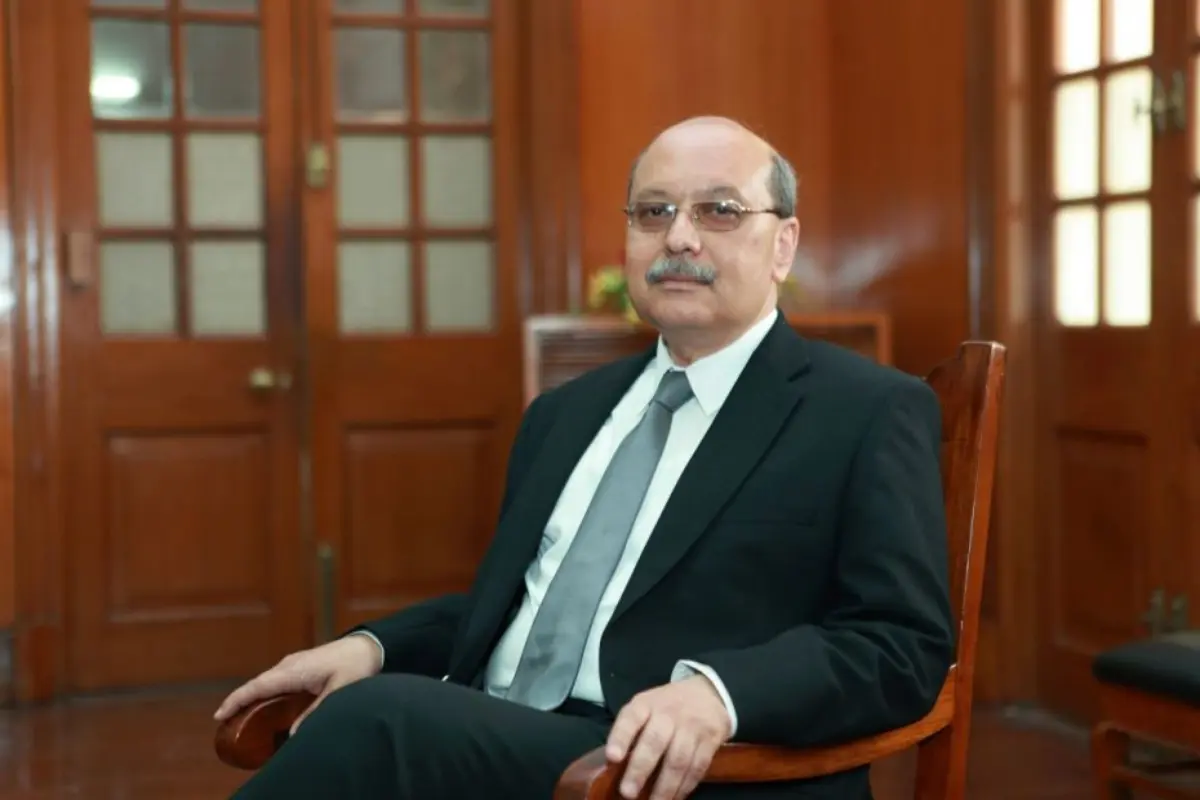
Rahul Pandit, a luminary in condensed matter physics, was born on 22 April 1956 in New Delhi. Rahul Pandit’s path into physics did not begin with privilege, shortcuts, or singular moments of luck. Instead, it began with relentless curiosity—an attribute he nurtured right from his days as a National Talent Search Scholar at IIT Delhi.
What began as an interest in the structure of matter soon grew into a lifelong pursuit of decoding the rhythms of nature: from how materials change their phases to how chaos emerges in systems once believed to be predictable.
Rahul Pandit: A Scholar Shaped by Global Excellence
Pandit’s academic journey reflects both intellectual rigor and global exposure. After earning his master’s degree from IIT Delhi in 1977, his quest for a deeper understanding led him to the University of Illinois at Urbana–Champaign, a cradle for pioneers in physics. There, he added another master’s degree, followed by a PhD in 1982 under the mentorship of the renowned physicist Michael Wortis.
The road ahead wasn’t about prestige—it was about purpose. A postdoctoral stint at Cornell University only sharpened his insight into the elegant complexities of physics. By 1984, Rahul Pandit made a landmark decision: he returned to India, choosing to contribute his brilliance to the nation’s scientific ecosystem.
A Lifetime at IISc: Building Knowledge, Inspiring Generations
Few scientists demonstrate a lifelong loyalty to a single institution the way Rahul Pandit has with the Indian Institute of Science (IISc). From joining as a research associate in 1984 to becoming a full professor in 2002 and eventually the Divisional Chair of Physical and Mathematical Sciences, Pandit has shaped not just research, but also leadership, collaboration, and global scientific dialogue.
His journey at IISc mirrors the very phenomena he studies: layered, dynamic, and transformative.
He has served in roles that stretched beyond theoretical physics—chairing the International Relations Cell, shaping programs at JNCASR, influencing international conferences, mentoring future scientists, and leading editorial boards of some of the world’s most respected journals.
His visiting professorships span continents—Ohio State University, University of Missouri, Côte d’Azur Observatory, ICTP, and École Normale Supérieure—affirming his global credibility.
Rahul Pandit: A Legacy Written in Equations, Breakthroughs, and Scientific Freedom
The legacy of Rahul Pandit lies not only in awards or appointments, but in the new ways he has helped the world see scientific problems.
Some of his most influential contributions include:
-
Pioneering research on phase transitions, the very phenomena that govern how matter evolves from one state to another.
-
Pathbreaking insights into spatiotemporal chaos, turbulence, and nonlinear dynamics—fields central to understanding unpredictable systems.
-
Theoretical elucidation of multilayer adsorption and wetting phenomena, vital for material sciences.
-
Revealing the scaling properties of quasiperiodic Schrödinger operators, a cornerstone in quantum physics.
-
Developing models for hysteresis loops in spin systems, influencing magnetic material studies.
-
Creating a mathematical model of cardiac arrhythmias, contributing to low-amplitude defibrillation research and medical innovation.
-
Significant work on soft condensed matter, interacting bosons, manganites, and complex fluids.
His research has been documented across dozens of high-impact publications, including 79 articles listed in the Indian Academy of Sciences’ repository. Equally powerful is his role as a mentor—guiding 15 PhD scholars, each a branch of the tree he planted.
Leadership that Reaches Across Borders and Disciplines
Pandit’s influence extends far beyond laboratories and journals.
He played a crucial role in organizing STATPHYS 22, one of the world’s premier statistical physics conferences, bringing global thought leaders to the IISc campus. He has also served:
-
As Secretary of the IUPAP C3 Commission on Statistical Physics
-
As Chair of the Indian IUPAP National Committee
-
On the editorial boards of Physical Review Letters, Physica A, and Cambridge IISc Series
-
As a guide in the INSPIRE program, encouraging scientific excellence among India’s youth
These roles underscore his belief that science is not just a discipline—it is a global community.
A Journey Decorated with Honors, Yet Grounded in Purpose
True to the spirit of a scientist, Pandit’s motivations were never awards—yet they followed him naturally, recognizing a lifetime of contribution.
Among the most notable:
-
Shanti Swarup Bhatnagar Prize (2001) – one of India’s highest scientific honors
-
Young Scientist Medal, INSA (1988)
-
Meghnad Saha Award (UGC, 2004)
-
Distinguished Alumnus Award, IIT Delhi (2010)
-
Fellowship of:
-
Indian Academy of Sciences (1996)
-
Indian National Science Academy (2006)
-
The World Academy of Sciences (2015)
-
-
Outstanding Referee Award (APS, 2012)
-
J.C. Bose National Fellowship (since 2007)