
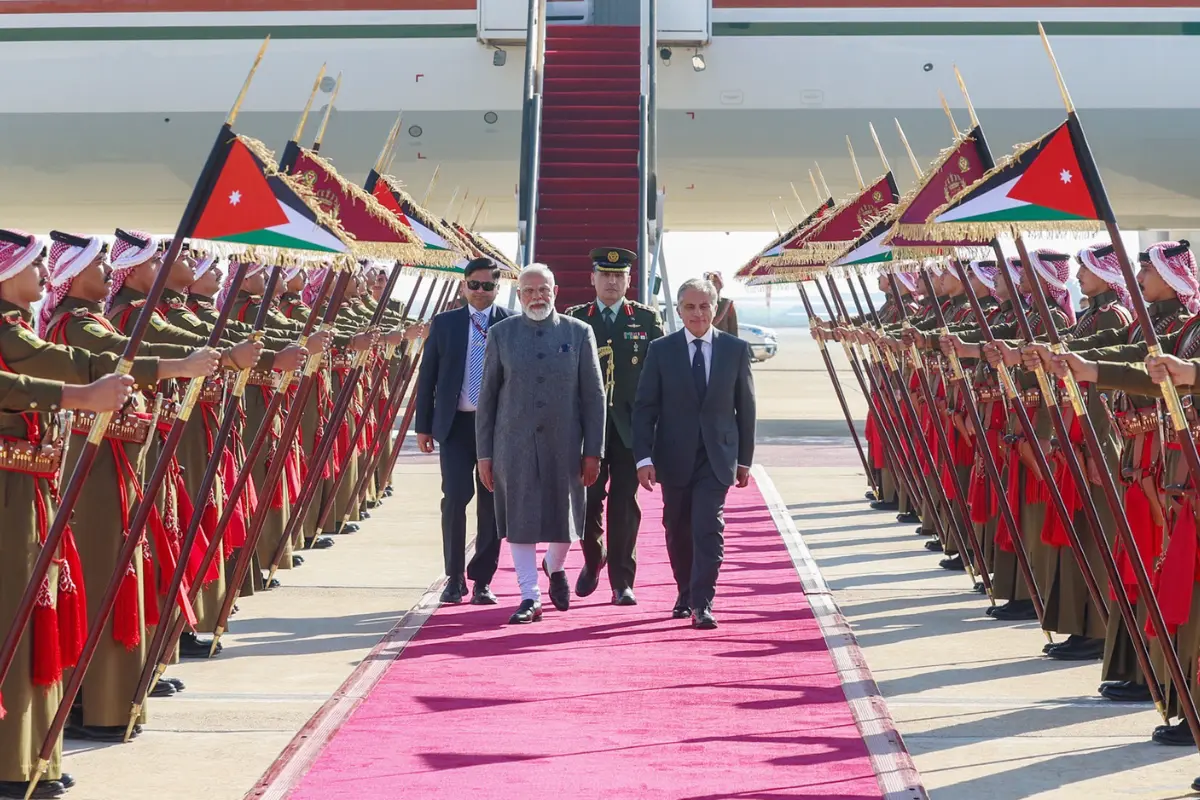
PM Modi Kicks Off 3-Nation Tour Across West Asia and Africa
PM Modi: Jordan Visit Opens New Chapter in Long-Standing India–Jordan Relations
Prime Minister Narendra Modi landed in Amman, the capital of Jordan, on Sunday, marking the first leg of his three-nation diplomatic tour that will also take him to Ethiopia and Oman. The PM Modi Jordan visit comes at a symbolic moment, coinciding with the 75th anniversary of diplomatic relations between India and Jordan, a milestone expected to inject fresh momentum into bilateral engagement.
PM Modi was received at the airport by Jordanian Prime Minister Jafar Hassan, reflecting the warmth and mutual respect that have long defined ties between the two nations. The Prime Minister’s visit to Jordan, scheduled from December 15 to 16, is at the invitation of King Abdullah II ibn Al Hussein.
PM Modi: High-Level Talks and Regional Dialogue
During his stay, Prime Minister Modi will hold comprehensive discussions with Jordan’s leadership to review the full spectrum of India-Jordan relations, including political cooperation, trade, investment, defence collaboration, and regional developments in West Asia. He is also expected to engage with members of the Indian diaspora in Jordan, strengthening people-to-people connections that form the backbone of bilateral ties.
India and Jordan share a relationship rooted in history and trust. Their first cooperation agreement was signed in 1947, even before India’s independence, with full diplomatic relations established in 1950. Over the decades, consistent leadership-level interactions have helped the partnership evolve in step with regional and global realities.
Growing Economic and Strategic Partnership
Economic cooperation has emerged as a central pillar of the relationship. Bilateral trade reached USD 2.875 billion in 2023–24, making India Jordan’s fourth-largest trading partner. Indian exports accounted for USD 1.465 billion, underscoring India’s growing commercial footprint in the country.
Indian investments, estimated at around USD 1.5 billion, are concentrated in key sectors such as phosphates, fertilisers, textiles, and garments. Flagship joint ventures, including the IFFCO–Jordan Phosphate Mines Company and the Indo-Jordan Chemical Company, highlight the depth of industrial collaboration. Institutional frameworks like the Trade and Economic Joint Committee and sector-specific working groups continue to support structured economic engagement.
PM Modi: Education, Technology, and Cultural Ties
Beyond trade, India and Jordan cooperate closely in healthcare, education, skill development, science and technology, and capacity building. A major milestone was the inauguration of the India-Jordan Centre of Excellence in Information Technology in 2021, which trains Jordanian professionals in advanced IT skills.
Educational ties are further strengthened through scholarships under ITEC and ICCR programmes, with annual ITEC slots recently increased from 37 to 50. Cultural exchanges, tourism cooperation, yoga events, film collaborations, and academic partnerships continue to deepen mutual understanding.
The presence of a vibrant Indian diaspora of around 17,500 people in Jordan plays a vital role in reinforcing these people-centric connections.
Next Stops: Ethiopia and Oman
Following the PM Modi Jordan visit, the Prime Minister will travel to Ethiopia from December 16 to 17, marking his first-ever visit to the country. In Addis Ababa—home to the African Union headquarters—he will hold detailed talks with Prime Minister Abiy Ahmed Ali. According to the Ministry of External Affairs, the visit will reaffirm the shared commitment of both nations, as partners in the Global South, to expanding cooperation and friendship.
In the final leg of the tour, PM Modi will visit Oman from December 17 to 18 at the invitation of Sultan Haitham bin Tarik. This visit, coinciding with 70 years of India-Oman diplomatic relations, follows the Sultan’s state visit to India in December 2023. India and Oman are expected to conduct a comprehensive review of cooperation across trade, investment, energy, defence, security, technology, agriculture, and culture, while also exchanging views on regional and global issues.