
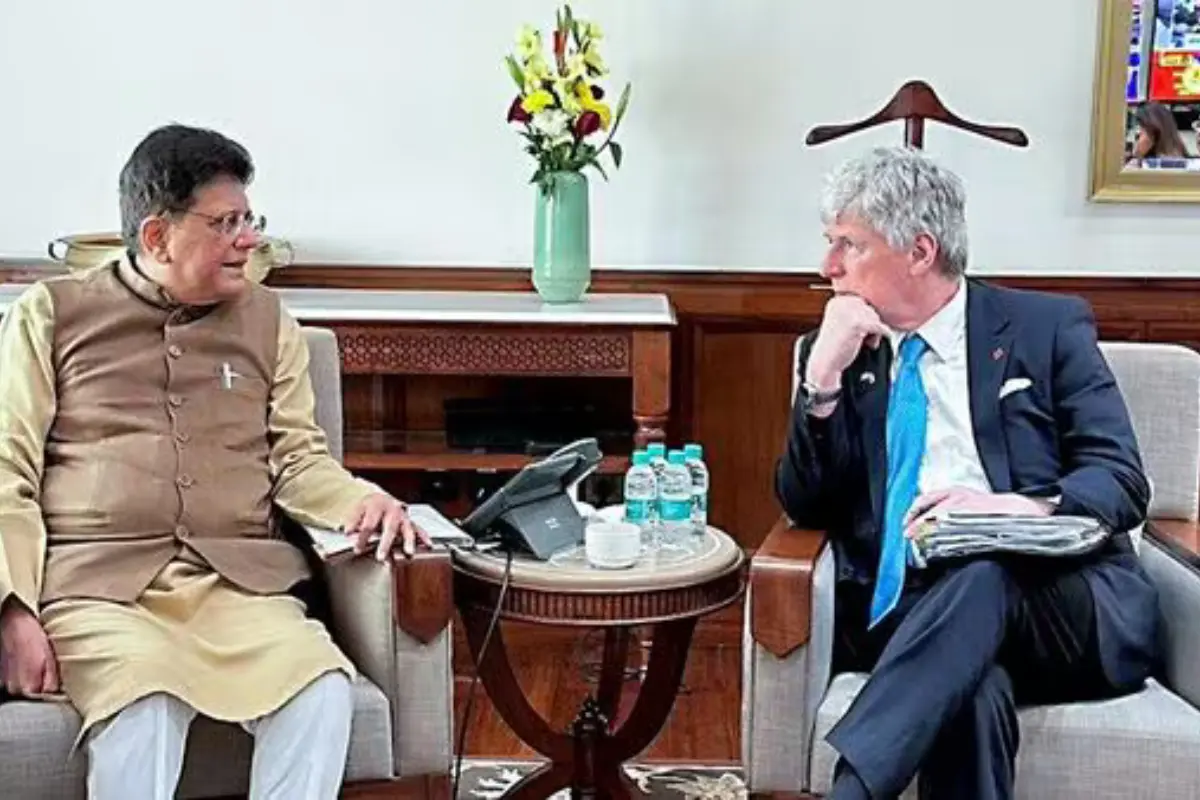
Piyush Goyal Hits Back at Congress Over India-EU Trade Deal
Piyush Goyal Calls Congress Criticism of India-EU FTA ‘Sour Grapes,’ Political Row Intensifies
A fresh political confrontation erupted over India’s proposed trade pact with the European Union after Union Commerce and Industry Minister Piyush Goyal sharply criticised the Congress party, likening its objections to the age-old tale of “sour grapes.” The remarks have added a new layer of political tension to what is already being viewed as one of India’s most consequential economic agreements in recent years.
Speaking to ANI on Thursday, Goyal accused the opposition of lacking both the resolve and vision to conclude the deal during its tenure. “It’s like angoor khatte hain,” he said, invoking the popular phrase to suggest that Congress was dismissing the agreement simply because it could not finalise one when it had the chance.
Piyush Goyal: War of Words Over a Landmark Trade Deal
“They didn’t even have the courage or the will to finalise an agreement. Out of fear, the UPA and Congress governments could never take decisive action,” Goyal said, adding that the party’s economic track record raised serious questions about its criticism today.
He also targeted senior Congress leader Jairam Ramesh, describing him as “anti-development” and alleging that policy decisions during his tenure as environment minister slowed the country’s growth trajectory.
Congress Raises Red Flags on Trade Imbalance
The sharp response came after Ramesh publicly questioned the implications of the India-EU agreement. In a post on X earlier this week, he described the pact as “the biggest trade opening India has given to any trade partner,” highlighting that tariff concessions could cover more than 96% of European exports entering India.
According to Ramesh, the agreement could potentially double India’s imports from the EU, making it essential for policymakers to closely monitor its impact on the nation’s trade deficit.
One of the Congress leader’s major concerns relates to the European Union’s Carbon Border Adjustment Mechanism (CBAM), a policy aimed at taxing carbon-intensive imports. He argued that the government had failed to secure exemptions for India’s aluminium and steel industries.
India’s exports in these sectors to the EU have already declined from about $7 billion to $5 billion, he noted, warning that the numbers could fall further once CBAM takes effect on January 1, 2026.
Ramesh also cautioned that the mechanism could expand to cover additional industrial categories over time, potentially offsetting any benefits India hopes to gain from the FTA. He further flagged strict EU health and product safety standards as possible non-tariff barriers and expressed concern about Europe seeking greater access to India’s services sector, including financial services and maritime transport.
Piyush Goyal Counters With China Pact Allegation
Turning the debate on its head, Goyal accused the Congress of previously pushing India toward trade frameworks that he claimed would have jeopardised domestic industries.
“Friends like Jairam Ramesh and parties like the Congress were pushing India to enter into an FTA with China,” he said, referring to the Regional Comprehensive Economic Partnership (RCEP).
Questioning the opposition’s judgment, he added, “How did you even think of letting India enter RCEP, which was effectively an FTA between China and India? How did you have the courage to put India at risk?”
Calling it a “grave mistake,” the minister asserted that Congress owed the public an explanation for what he described as policies that could have harmed India’s long-term economic interests.
Comparisons With Past FTAs
Goyal also contrasted the proposed India-EU pact with earlier agreements signed with Japan and South Korea under Congress-led governments.
“That FTA was so bad that our exports to those countries haven’t increased at all,” he claimed, alleging that while imports into India doubled, Indian products struggled to gain meaningful access to those markets.
Defending the current negotiations, the minister emphasised that nearly 99% of Indian exports would face zero duty under the new arrangement.
“We have negotiated balanced FTAs. We have even signed FTAs with developed countries on our own terms,” he said, stressing that the government avoids deals with nations that directly compete with Indian manufacturing or have significantly lower labour costs.
Economic Growth Becomes Another Flashpoint
The minister did not stop at trade policy. He also dismissed Congress leader Rahul Gandhi’s recent remark that the Indian economy was “dead,” calling it disconnected from reality.
“The world’s fastest-growing large economy — today, no other major economy is expanding at 7–8% except India,” Goyal said.
He cited poverty reduction, a booming startup ecosystem, and large-scale infrastructure development as indicators of economic momentum. According to him, around 25 crore people have moved out of poverty while young entrepreneurs are increasingly becoming job creators.
“People’s lives are improving, incomes are rising, and taxes are being reduced,” he added, arguing that what he termed Congress’s “negative mindset” could no longer hold back the country.
FTA Positioned as Strategic Breakthrough
Framing the agreement as more than just a trade arrangement, Goyal described the India-EU FTA as a geopolitical milestone.
“This FTA between the EU and India places India at the high table of international geopolitics,” he said, crediting Prime Minister Narendra Modi’s leadership for enhancing India’s global stature.
With access to a bloc of 27 nations, the pact is expected to create what the minister called “mutual complementarity,” allowing both sides to leverage each other’s strengths.
“Together, we become a force multiplier. That is the significance of this agreement,” he said.