
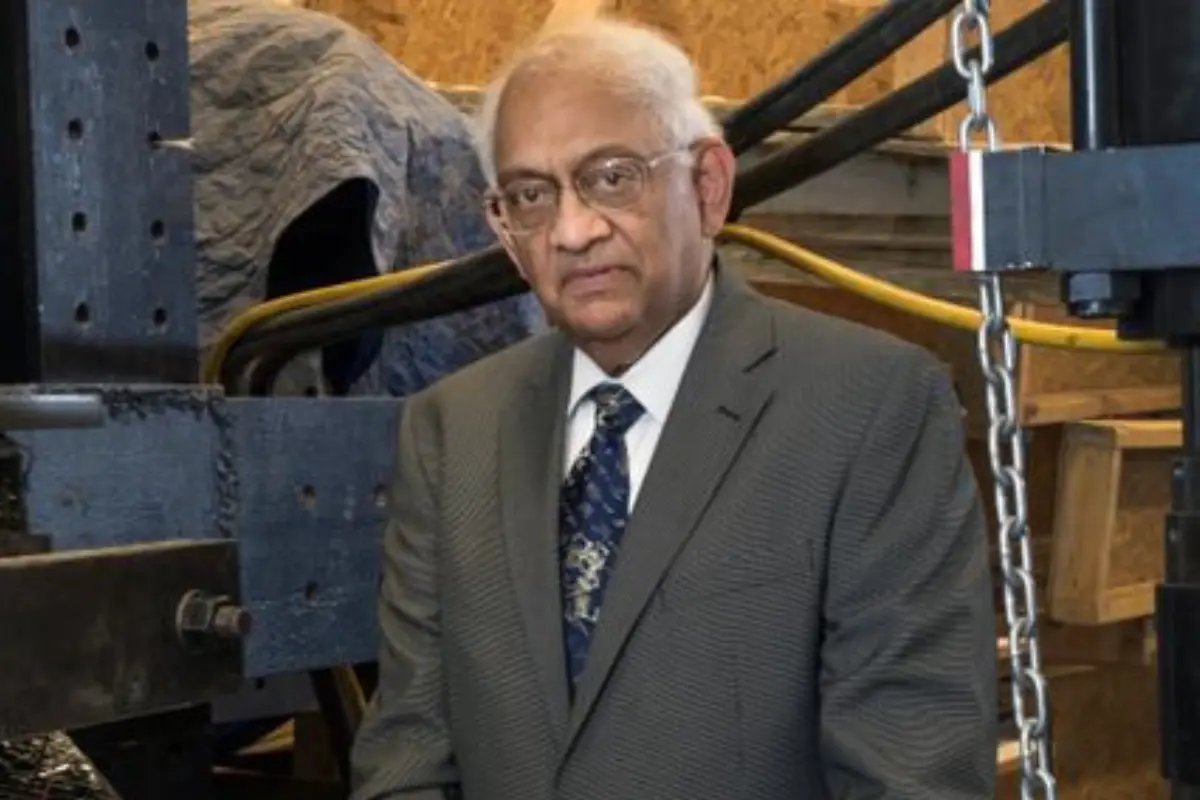
The intellectual journey of Ganga Rao began with academic excellence that was evident early in life. He earned his Bachelor of Technology in Civil Engineering from the Indian Institute of Technology Madras in 1965, one of the most competitive and prestigious engineering institutions in the world. His academic record at IIT Madras reflected not only brilliance, but a deep curiosity about how engineering principles could be harnessed to solve complex societal challenges.
Driven by a desire to explore advanced research frontiers, Ganga Rao pursued higher studies in the United States at North Carolina State University, Raleigh. In a remarkable demonstration of scholarly rigor and discipline, he completed both his Master’s degree and Doctorate in Civil Engineering within a span of just four years. This period laid the intellectual foundation for what would become a trailblazing career in infrastructure innovation.
Ganga Rao: A Lifelong Commitment to West Virginia University
In 1969, Ganga Rao joined West Virginia University (WVU) as an assistant professor—marking the beginning of a historic academic association that would span more than half a century. Through dedication, leadership, and relentless pursuit of excellence, he rose through the academic ranks to become the Maurice A. and Jo Ann Wadsworth Distinguished Professor in the Wadsworth Department of Civil and Environmental Engineering within the Statler College of Engineering and Mineral Resources.
Beyond his professorship, Ganga Rao has played an instrumental leadership role at WVU as:
-
Director of the Constructed Facilities Center (CFC)
-
Director of the Center for Integration of Composites into Infrastructure (CICI)
-
Managing Director at the West Virginia University Research Corporation (WVURC)
Under his leadership, these centers evolved into internationally recognized hubs for applied research, interdisciplinary collaboration, and technology transfer.
Pioneering Research in Fiber-Reinforced Polymer Composites
At the heart of Ganga Rao’s legacy lies his pioneering work in fiber-reinforced polymer (FRP) composites—advanced materials that have revolutionized civil infrastructure. Long before composites gained mainstream acceptance in construction, Ganga Rao recognized their potential to outperform traditional materials in strength, durability, corrosion resistance, and lifecycle cost efficiency.
His research spans the full spectrum of innovation:
-
Theory and design of FRP systems
-
Development and manufacturing of composite materials
-
Field implementation for bridges, highways, railroads, and buildings
-
Use of recycled polymers and natural fiber composites
-
Applications in utility poles, underground structures, and marine systems
Through decades of experimentation and field validation, Ganga Rao transformed composites from experimental concepts into trusted, deployable engineering solutions.
Ganga Rao: Infrastructure Resilience and National Impact
A defining hallmark of Ganga Rao’s work is its focus on infrastructure resilience. His patented systems are designed to protect critical structures from hurricanes, earthquakes, corrosion, blasts, and extreme environmental conditions. These innovations have been implemented across numerous U.S. states, including West Virginia, Ohio, Pennsylvania, and Alaska.
His credibility as a national authority led to multiple invitations to testify before the United States Congress, where he advocated for the adoption of advanced composite materials to modernize America’s aging infrastructure. His testimony emphasized not only engineering performance, but long-term economic and public safety benefits.
Real-World Innovation and Award-Winning Achievements
The success of Ganga Rao is measured not merely in publications, but in tangible engineering outcomes. Among his most celebrated innovations is the development of composite wicket gates for the U.S. Army Corps of Engineers—an achievement that earned the 2016 Innovation of the Year Award.
His contributions have been recognized through numerous honors, including:
-
2022 Academic Pioneer Award from the American Composites Manufacturers Association (ACMA)
-
Benedum Distinguished Scholar Award
-
Recognition as one of the Top Five Outstanding Leaders in engineering education
-
Udanis Best Concrete Engineer Prize for innovative design