
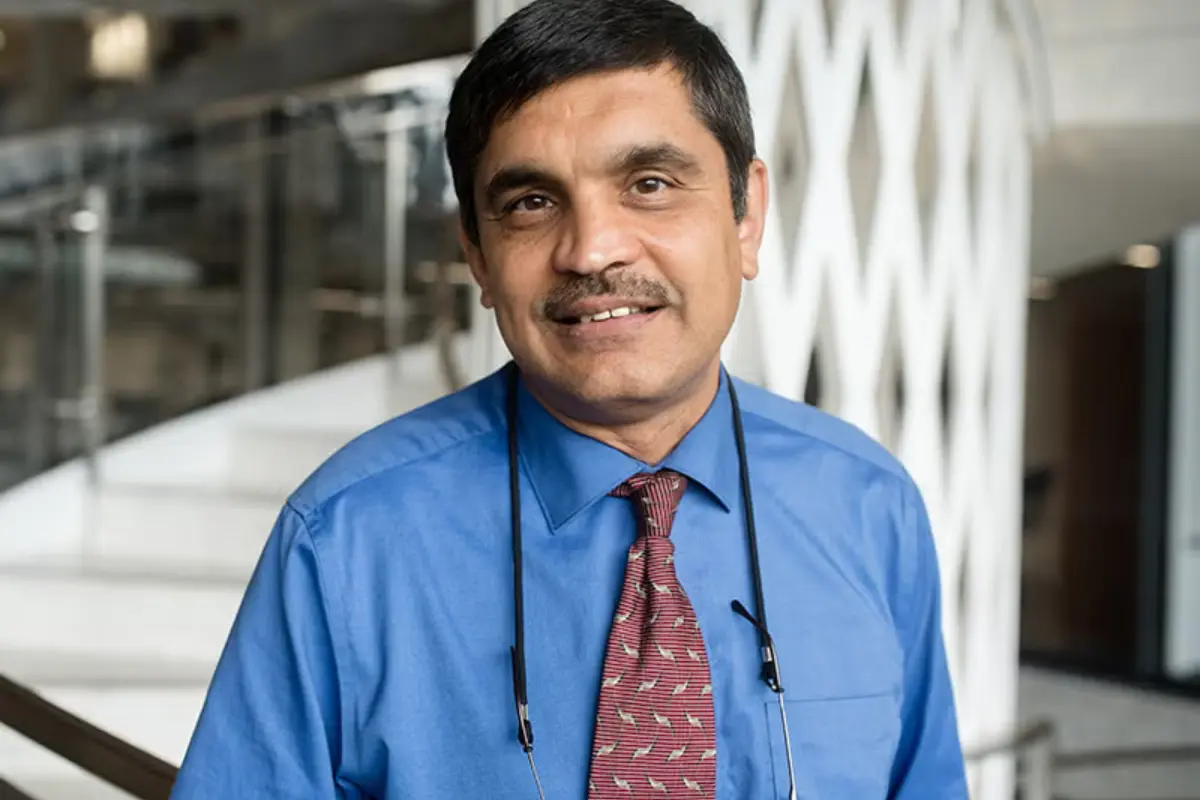
Born in Madras (now Chennai), India, in 1964, Chandra Bhat grew up in an academic environment that valued intellectual rigor and curiosity.
Chandra Bhat: Education – Building a Global Academic Identity
Chandra Bhat’s formal academic journey began at IIT Madras, where he earned a B.Tech. in Civil Engineering in 1985. At one of India’s most competitive institutions, he developed not only technical strength but also an appreciation for analytical depth and methodological precision.
Seeking broader horizons, Bhat moved to the United States, completing a Master’s degree in Transportation Engineering at Virginia Polytechnic Institute and State University in 1987. His exposure to advanced transportation systems and emerging modeling techniques deepened his interest in travel behavior analysis.
He earned his Ph.D. in Civil Engineering from Northwestern University in 1991, working under the mentorship of the renowned transportation scholar Frank Koppelman. During this period, Bhat began developing ideas that would later redefine discrete choice modeling and consumer behavior analysis across multiple disciplines.
Academic Career: From Scholar to Global Authority
After completing his doctorate, Chandra Bhat embarked on an academic career marked by steady growth and increasing influence. He began as a research assistant professor and lecturer at Northwestern University’s Transportation Center, contributing to cutting-edge research while honing his teaching skills.
Between 1993 and 1997, he served as an assistant professor at the University of Massachusetts Amherst, where his early publications began attracting attention within the transportation research community.
In 1997, Bhat joined The University of Texas at Austin, an institution that would become his professional home and global platform. Over the years, he held numerous leadership roles, including:
-
Associate Department Chair (2001–2007)
-
Professor (from 2005 onward)
-
Director, Center for Transportation Research (2012–2018)
In 2023, his leadership was further recognized when he was appointed Director of the USDOT National Center for Understanding Future Travel Behavior and Demand, a role that places him at the forefront of national transportation policy research.
Chandra Bhat: Research Contributions – Redefining Travel Behavior Modeling
The intellectual legacy of Chandra Bhat lies in his ability to combine econometric theory with real-world application. His research addresses a fundamental question: Why do people make the travel choices they do?
Agent-Based Simulation and Integrated Systems
Bhat led the development of two landmark simulation platforms:
-
CEMDAP (Comprehensive Econometric Microsimulator for Daily Activity Patterns)
-
CEMSELTS (Comprehensive Econometric Microsimulator for Socioeconomics, Land Use, and Transportation Systems)
These advanced agent-based models allow planners to simulate individual behavior across time and space, offering unprecedented realism in transportation forecasting. They have been applied in major metropolitan regions, including New York City, influencing large-scale mobility planning decisions.
Methodological Breakthroughs
Among his most influential theoretical contributions is the introduction of quasi-Monte Carlo (QMC) techniques for estimating discrete choice models. This innovation dramatically improved computational efficiency and accuracy, earning recognition from Nobel laureate Daniel McFadden, who cited Bhat’s work in his Nobel Prize Lecture.
Another defining achievement is the Multiple Discrete-Continuous Extreme Value (MDCEV) model, which allows researchers to analyze situations where individuals make multiple choices simultaneously—such as how people allocate time, money, or travel among competing alternatives. This model is now considered foundational in consumer choice analysis.
Publications and Scholarly Impact
Chandra Bhat has authored over 280 peer-reviewed journal articles, along with numerous book chapters and invited contributions. His work is cited across disciplines including:
-
Economics
-
Marketing
-
Geography
-
Statistics
-
Transportation engineering
His models are embedded in econometric textbooks and widely used software packages, making his influence both theoretical and practical. From 2019 to 2024, he was consistently listed among the most-cited researchers in transportation and logistics worldwide, confirming his enduring global impact.
Leadership, Service, and Professional Influence
Beyond research, Chandra Bhat has played a transformative role in shaping academic and professional institutions. He served as:
-
President, Council of University Transportation Centers (2020–2021)
-
President, ASCE Transportation and Development Institute
-
Editor-in-Chief, Transportation Research Part B: Methodological
Through these roles, he has guided research agendas, mentored emerging scholars, and strengthened the link between academia and public policy.
Chandra Bhat: Awards and Global Recognition
-
W.N. Carey Jr. Distinguished Service Award (2024)
-
Theodore M. Matson Memorial Award (2022)
-
Lifetime Achievement Award, CUTC (2017)
-
Distinguished Alumnus, IIT Madras (2016)
-
Frank M. Masters Transportation Engineering Award, ASCE (2015)
-
Humboldt Research Award (2013)
-
S.S. Steinberg Award (2009)