
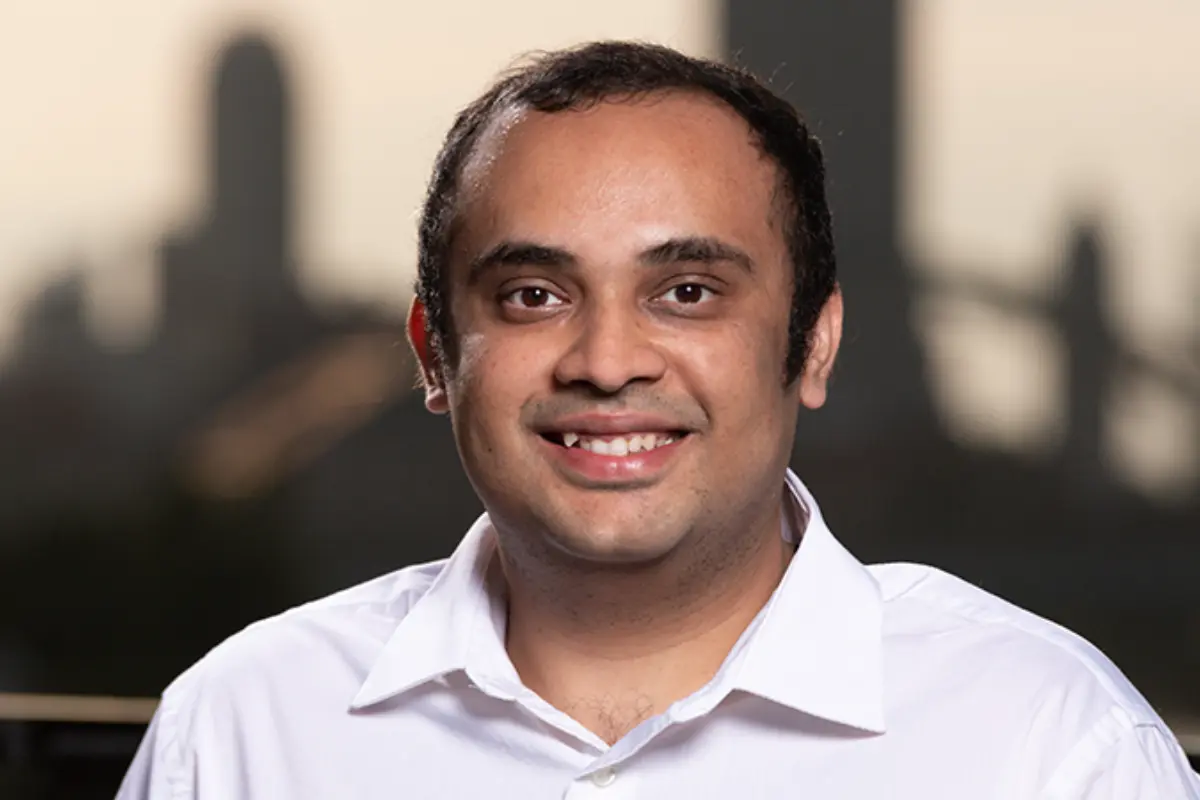
In the vast and complex universe of cryptography—where unsolved problems can endure for decades—only a rare few researchers leave a mark so deep that it reshapes the field itself. Aayush Jain, an Assistant Professor at Carnegie Mellon University (CMU), belongs unmistakably to that elite group.
Aayush Jain: A Mathematician Before a Computer Scientist
Long before Aayush Jain became a defining name in cryptography, he was simply a student fascinated by mathematics. Born and educated in India, Jain initially had no formal training in computer science. In fact, as a teenager, his ambitions lay elsewhere—until a sports injury forced him to step away from cricket. What could have been a setback became a turning point.
“I was mostly a mathematician interested in seeing math in action,” Jain would later reflect.
That curiosity guided him to the Indian Institute of Technology (IIT) Delhi, where he pursued a BTech in Electrical Engineering followed by an MTech in Information and Communication Technology. This interdisciplinary foundation—rooted in math, physics, and engineering—quietly prepared him for problems most researchers considered nearly impossible.
Discovering Cryptography as a Calling
Jain’s exposure to cryptography deepened during his time as a Research Fellow at Microsoft Research India. There, he encountered cryptography not as abstract theory, but as a living discipline—one that protects data, software, and digital trust itself.
Cryptography, he realized, was where mathematics met real-world impact.
Determined to push boundaries, Jain moved to the United States to pursue a PhD in Computer Science at UCLA, under the guidance of Professor Amit Sahai, one of the world’s most respected cryptographers. That mentor-student relationship would become pivotal—not only academically, but philosophically.
Sahai encouraged Jain to think fearlessly, to chase big questions rather than incremental results. That mindset would soon pay extraordinary dividends.
Aayush Jain: Solving the “Impossible” – Indistinguishability Obfuscation
For years, indistinguishability obfuscation (iO) stood as one of cryptography’s most elusive goals. The idea is deceptively simple: transform a program so its inner workings are completely unreadable, while its functionality remains perfectly intact.
In practice, it was considered so difficult that many researchers believed iO might not even exist.
In 2020, Aayush Jain—working alongside Amit Sahai and Huijia “Rachel” Lin—proved otherwise.
Their breakthrough demonstrated that software obfuscation could be built from well-studied, standard mathematical assumptions, rather than fragile or exotic ones. This result fundamentally changed how researchers think about software security.
The impact was immediate and global. The work was featured in Quanta Magazine under the headline “Scientists Achieve Crown Jewel of Cryptography”, and praised across academic and industry circles.
Why Aayush Jain Cryptography Matters
Indistinguishability obfuscation is not just a theoretical milestone—it is a master tool.
It enables:
-
Functional encryption
-
Advanced software protection
-
Secure cloud computing
-
New cryptographic primitives once thought unattainable
Perhaps most importantly, it bridges a long-standing gap between theoretical cryptography and real-world software security, expanding cryptography’s reach into domains traditionally handled only by software engineering.
Jain’s work has shown that rigorous mathematics can safeguard digital systems in ways previously unimaginable.
Awards That Reflect Global Impact
The significance of Aayush Jain’s contributions is reflected in the honors he has received:
-
ACM Doctoral Dissertation Award (2022)
Awarded for his thesis “Indistinguishability Obfuscation From Well-Studied Assumptions”, recognizing it as the best doctoral dissertation in computer science worldwide. -
STOC Best Paper Award (2021)
One of the highest distinctions in theoretical computer science. -
NSF CAREER Award (2025)
A $600,000 grant supporting his research into underexplored mathematical hardness assumptions for cryptography.