
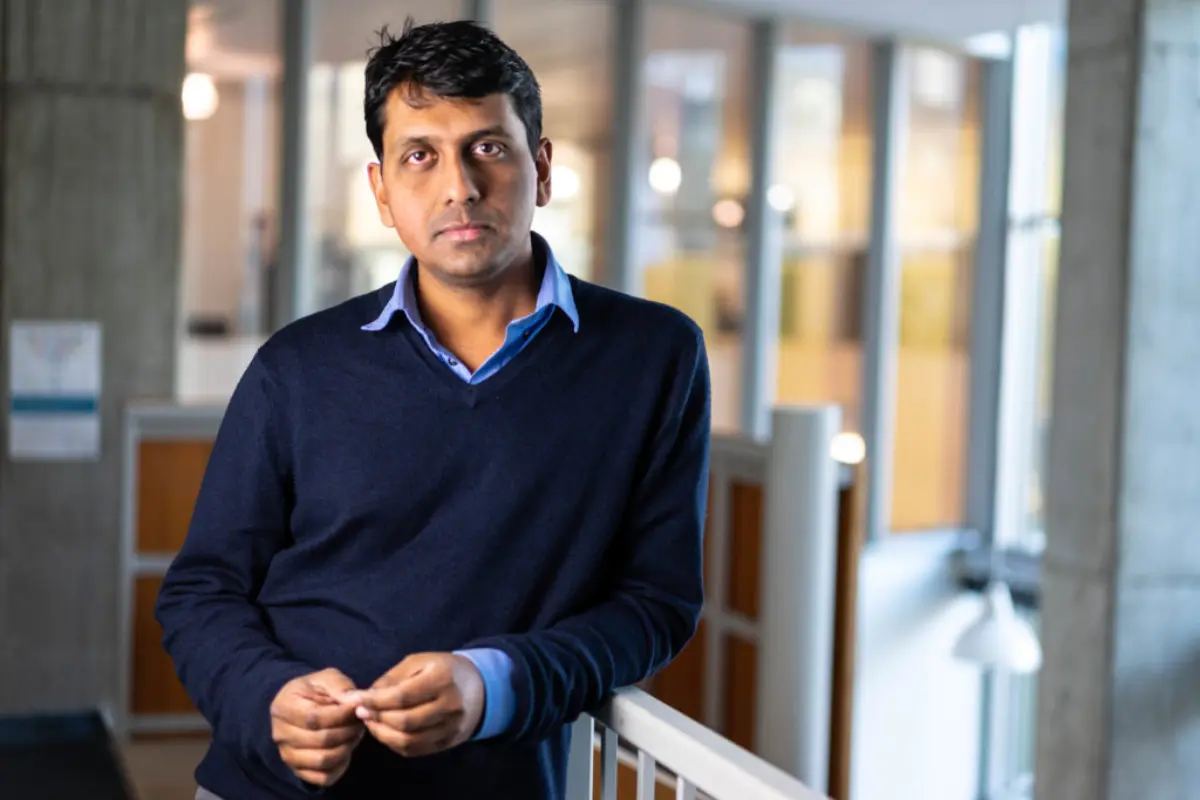
In the digital age, where privacy and security define the future of technology, Vinod Vaikuntanathan stands as one of the world’s foremost architects of modern cryptography. A name synonymous with innovation, integrity, and intellectual brilliance, he has become a guiding light for a generation of researchers and engineers striving to make the digital world safer.
Currently a Professor of Computer Science at the Massachusetts Institute of Technology (MIT) and a Principal Investigator at the MIT Computer Science and Artificial Intelligence Laboratory (CSAIL), Vaikuntanathan has redefined what it means to create technology that balances power with privacy.
Early Life and Education of Vinod Vaikuntanathan – The Foundations of a Brilliant Mind
Born and raised in India, Vinod Vaikuntanathan discovered his fascination with computation and logic early on. His journey of excellence began at the Indian Institute of Technology Madras (IIT Madras), where he graduated with a B.Tech in Computer Science and Engineering and a minor in Physics in 2003. IIT Madras, known for nurturing India’s most brilliant minds, became the launchpad for his lifelong pursuit of innovation and scientific inquiry.
His quest for deeper understanding led him to the Massachusetts Institute of Technology (MIT) for his graduate studies. Under the mentorship of the legendary Shafi Goldwasser, a Turing Award-winning cryptographer, Vaikuntanathan completed his Ph.D. in Computer Science in 2009. This phase marked the beginning of his groundbreaking contributions to the field of cryptography, where his ideas would soon challenge and transform long-standing paradigms.
A Journey Through Innovation – From IBM to MIT
After earning his doctorate, Vinod’s career path took him to some of the world’s leading research centers. As a Josef Raviv Postdoctoral Fellow at IBM’s T.J. Watson Research Center, and later as a researcher at Microsoft Research, he continued to refine his ideas in secure computation and encryption.
Between 2011 and 2013, he served as a Professor at the University of Toronto, where he inspired students with his vision of secure, efficient, and ethical computing. In 2013, he returned to MIT as a faculty member, cementing his place among the global elite of computer scientists.
At MIT, Vinod Vaikuntanathan not only leads research but also builds bridges between theory and practice—ensuring that the future of technology rests on a foundation of trust, transparency, and security.
Vinod Vaikuntanathan – The Genius Behind Homomorphic Encryption
One of Vaikuntanathan’s most significant contributions is in the field of homomorphic encryption—a revolutionary idea that allows computations to be performed directly on encrypted data without ever exposing the underlying information. This innovation has immense implications for data privacy, secure cloud computing, and artificial intelligence.
His work laid the foundation for post-quantum cryptography, which protects information from even the most powerful quantum computers of the future. Through his theoretical advancements in lattice-based cryptography, Vinod and his collaborators built tools that can resist attacks from emerging quantum technologies, ensuring the longevity of digital security for decades to come.
For this transformative research, he was honored with the Gödel Prize in 2022, alongside Zvika Brakerski and Craig Gentry—one of the most prestigious awards in theoretical computer science.
Bridging Academia and Industry – The Birth of Duality Technologies
While his academic achievements are extraordinary, Vinod Vaikuntanathan has also demonstrated that innovation must serve humanity beyond the lab. He co-founded Duality Technologies, a data security start-up that harnesses the power of homomorphic encryption to enable collaboration between organizations without compromising privacy.
As Chief Cryptographer of Duality, he ensures that real-world systems can adopt his cryptographic breakthroughs—empowering companies, governments, and researchers to share insights securely, responsibly, and ethically.
Honors and Recognition – A Trailblazer’s Achievements
Vinod’s work has been recognized worldwide through numerous accolades that reflect both his brilliance and his impact. His awards include:
-
Gödel Prize (2022) – For foundational work in fully homomorphic encryption.
-
Simons Investigator Award (2023) – For outstanding contributions to theoretical computer science.
-
MacVicar Faculty Fellowship (2024) – Celebrating his exceptional teaching and mentorship at MIT.
-
Harold E. Edgerton Faculty Award (2018) – For excellence in research, teaching, and service.
-
Alfred P. Sloan Research Fellowship (2013), NSF CAREER Award (2014), Microsoft Faculty Fellowship (2014), and DARPA Young Faculty Award (2018) – Recognizing his promise and performance as a leading innovator.
-
Distinguished Alumnus Award (2024) from IIT Madras – Honoring his global leadership in cryptography and education.
Also Read : Animashree Anandkumar: Merging Art, Science, and AI