
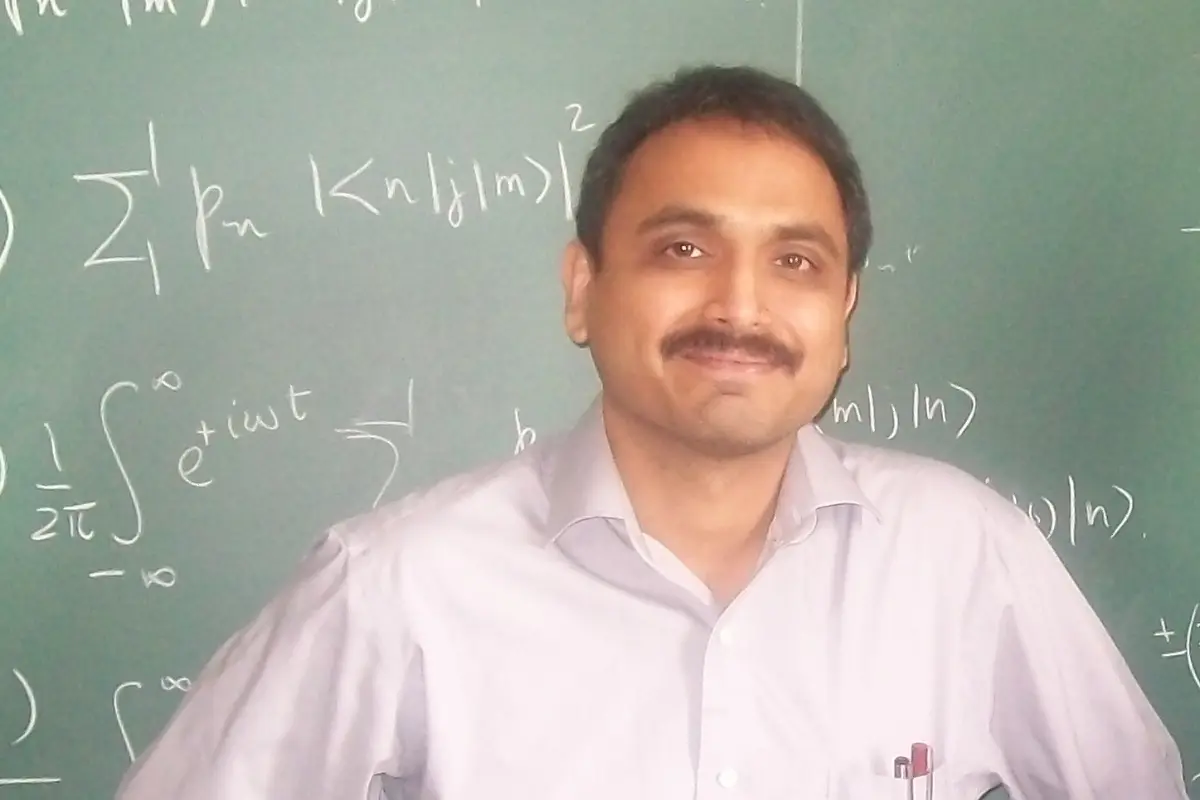
Born in 1971, Vijay Balakrishna Shenoy’s academic journey did not follow a conventional straight line. His early training began in Mechanical Engineering at IIT Madras, where he earned his B.Tech degree in 1992. While engineering honed his analytical instincts, it was the deeper philosophical questions of nature—how collective behavior emerges from microscopic laws—that increasingly drew his attention.
This intellectual pull led him beyond traditional disciplinary boundaries. Shenoy pursued a Master of Science at Georgia Institute of Technology, completing it in 1994, where his exposure to theoretical physics and advanced mathematics further crystallised his interests. His transformation from engineer to physicist was not a departure, but an evolution—one that enriched his theoretical work with structural clarity and physical intuition.
Vijay Balakrishna Shenoy: Doctoral Years and Global Academic Exposure
Shenoy’s pursuit of foundational understanding culminated in a Ph.D. from Brown University in 1998, one of the world’s leading centres for theoretical physics. At Brown, he immersed himself in the complexities of many-body systems, quantum field theory, and emergent phenomena—areas that would later define his scientific identity.
Following his doctorate, he briefly served as an Adjunct Assistant Professor at Brown University in 1999, gaining early experience as an independent researcher and mentor. Soon after, he returned to India to join the faculty at IIT Kanpur (1999–2002), where he began building a research program rooted in originality and depth.
Building a Legacy at the Indian Institute of Science
In 2002, Vijay Balakrishna Shenoy joined the Indian Institute of Science, Bangalore, marking the beginning of a long and impactful association. At IISc, he became a central figure in the Centre for Condensed Matter Theory within the Department of Physics, contributing not only groundbreaking research but also shaping generations of young physicists.
His teaching style—rigorous yet inspiring—reflects his belief that theoretical physics is not merely about equations, but about cultivating a way of thinking. Over the years, Shenoy has helped establish IISc as a globally respected hub for quantum condensed matter research.
Vijay Balakrishna Shenoy: Research Philosophy – Order from Complexity
At the heart of Vijay Balakrishna Shenoy’s work lies a fascination with how simple quantum rules give rise to complex, collective behavior. His research focuses on strongly interacting and correlated fermionic systems, where particles cannot be understood in isolation but only through their entangled relationships.
His interests span:
-
Quantum condensed matter physics
-
Topological phases of matter
-
Strong electronic correlations
-
Ultracold atomic systems
-
Superfluidity and superconductivity
-
Graphene and novel quantum materials
Each problem he tackles is unified by a central question: How does new physics emerge when many degrees of freedom interact?
The Rashbon Breakthrough: Opening New Directions
One of Shenoy’s most celebrated contributions is his theoretical work on the “rashbon”, a novel quantum entity predicted in systems of fermions subjected to synthetic non-Abelian gauge fields. This idea revealed entirely new possibilities for Bose–Einstein condensation in spin-orbit-coupled systems, fundamentally altering how physicists think about pairing mechanisms and quantum coherence.
The rashbon concept is widely regarded as opening new directions in quantum physics, influencing research in ultracold atoms, spin-orbit coupling, and topological matter. It exemplifies Shenoy’s ability to see beyond established frameworks and imagine entirely new quantum landscapes.
Topology, Quantum Matter, and the Future
In recent years, Shenoy’s work has deeply engaged with topological phases of matter, including the theoretical classification of many-fermion systems. His research connects abstract mathematical structures with physical observables—bridging theory and potential real-world applications.
These insights are not merely academic. They carry implications for:
-
Fault-tolerant quantum computing
-
Energy-efficient superconducting materials
-
Quantum devices operating at ambient conditions
By pushing theory forward, Vijay Balakrishna Shenoy helps lay the intellectual foundation for technologies that could transform computing, energy, and materials science.
Awards, Recognition, and National Impact
The excellence of Vijay Balakrishna Shenoy’s work has been acknowledged through numerous prestigious honours:
-
Shanti Swarup Bhatnagar Prize (2013) – India’s highest science award, Physical Sciences
-
Raja Ramanna Prize (2011)
-
J.C. Bose Fellowship (2023)
-
Fellow, Indian Academy of Sciences (2012)
-
Fellow, Indian National Science Academy (2019)
-
INSA Medal for Young Scientist (2002)
-
NASI–Scopus Young Scientist Award (2009)
-
INAE Young Engineer Award (2005)
-
Asian Scientist 100 (2024)