
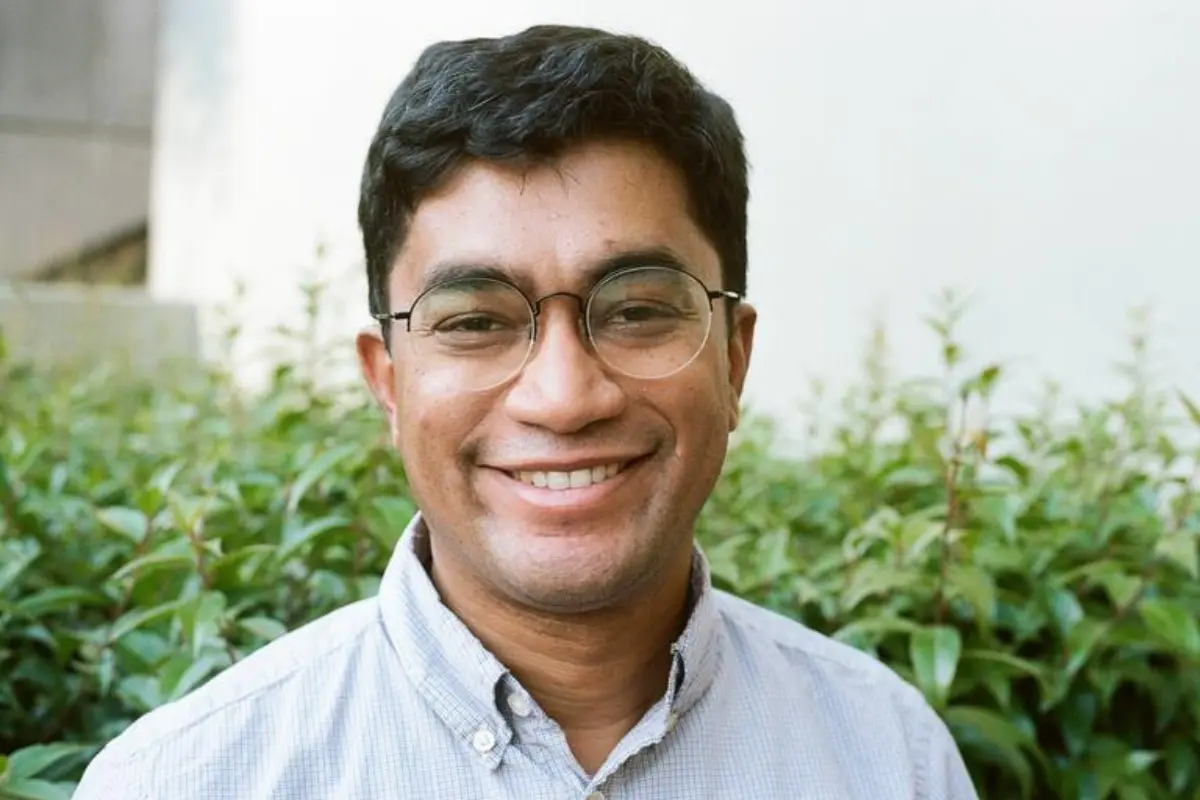
In the world of computer science—where ideas become engines that power the modern digital world—few names shine as brightly as Venkatesan Guruswami. Born in 1976 and raised in Chennai, India, he has carved a global legacy built on intellectual courage and mathematical brilliance.
Venkatesan Guruswami: A Journey Rooted in Curiosity and Excellence
The story of Venkatesan Guruswami begins in the classrooms of Padma Seshadri Bala Bhavan in Chennai, where a fascination with logical reasoning and mathematical elegance set him on a trajectory toward global academic distinction. He pursued computer science at IIT Madras, graduating with a B.Tech degree that would serve as the groundwork for a remarkable career in theoretical computing.
His next chapter unfolded at the Massachusetts Institute of Technology (MIT), where he completed his Ph.D. under the mentorship of renowned theoretician Madhu Sudan. His doctoral dissertation—later honored with the 2002 ACM Doctoral Dissertation Award—introduced groundbreaking ideas in list decoding, reshaping a critical domain of error-correcting codes. This work unlocked the ability to correct errors beyond traditional limits, a conceptual leap that has influenced secure communication, data storage, and modern coding theory.
Expanding the Boundaries of Error-Correcting Codes
From the earliest stages of his career, Venkatesan Guruswami displayed a rare blend of mathematical rigor and innovative intuition. His contributions to list decoding of Reed–Solomon and algebraic geometry codes set new industry and academic standards, enabling more efficient recovery of data even in the presence of large-scale corruption.
These foundational insights helped open the door for codes with near-optimal redundancy—an achievement long thought to be out of reach.
But Guruswami’s curiosity was never limited to a single niche. Over the years, his research broadened into:
-
Polar codes, offering new directions in near-capacity error correction
-
Deletion-correcting codes, enhancing digital resilience
-
Codes for distributed systems and cloud storage, strengthening modern infrastructure
-
Approximate optimization and randomness in computing
-
Computational complexity and combinatorics
-
Constraint satisfaction problems, a cornerstone of algorithmic theory
Each breakthrough carried the signature of a scientist who sees mathematics not as a barrier, but as a canvas for creativity.
Venkatesan Guruswami: A Global Influence on Research, Scholarship, and Academic Leadership
The story of Venkatesan Guruswami is not solely one of scientific feats. It is also the story of a leader who has shaped the direction of theoretical computer science worldwide.
He has held prestigious positions across top institutions:
-
Miller Research Fellow at UC Berkeley
-
Faculty at University of Washington
-
Over a decade at Carnegie Mellon University, one of the world’s most respected hubs for computing research
-
Leadership roles at the Simons Institute, an epicenter for collaboration in mathematics and computation
His editorial and community leadership is equally influential. Guruswami has served as:
-
Editor-in-Chief of the Journal of the ACM
-
Editor for TheoretiCS
-
Former Editor-in-Chief of ACM Transactions on Computation Theory
-
Board member for SIAM Journal on Computing, JACM, and IEEE Transactions on Information Theory
-
Vice Chair of the IEEE Technical Committee on Mathematical Foundations of Computing
-
Moderator for arXiv cs.IT
His guidance has shaped the evolution of major research conferences including CCC, FOCS, ISIT, FSTTCS, and ITCS. His service as President of the Computational Complexity Foundation further reflects a deep commitment to nurturing the scientific community that shaped him.
Recognitions That Celebrate a Lifetime of Breakthroughs
The brilliance of Venkatesan Guruswami has been honored through a constellation of awards and distinctions:
-
Simons Investigator Award
-
Presburger Award (2012)
-
Packard, Sloan, and Guggenheim Fellowships
-
IEEE Information Theory Society Paper Award
-
ACM Doctoral Dissertation Award
-
Invited Speaker, International Congress of Mathematicians 2010
-
Fellow of the ACM (2017)
-
Fellow of the IEEE (2019)
-
Fellow of the American Mathematical Society (2023)