
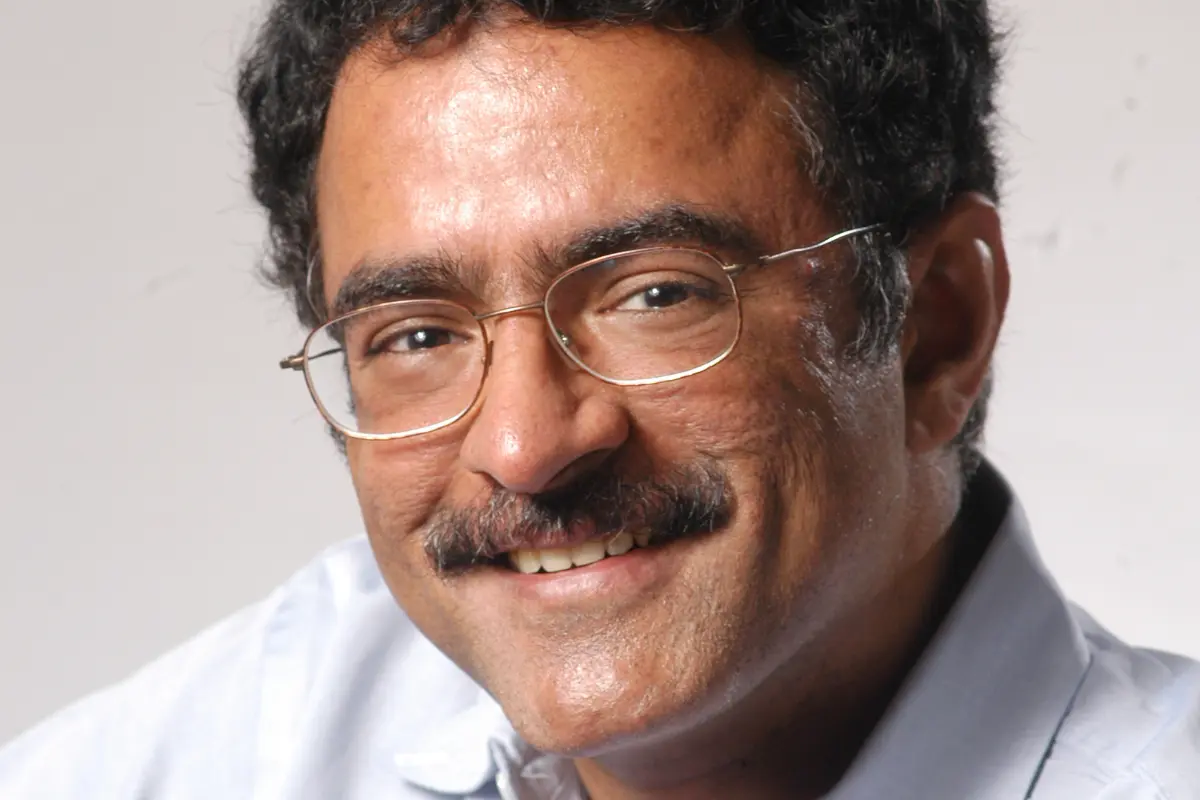
The academic path of Venkatachalam Anantharam began in India, where his exceptional talent became evident early on. At the prestigious Indian Institute of Technology Madras, he pursued a B.Tech in Electrical Engineering, graduating in 1980 with the President of India Gold Medal, awarded for the best academic record.
Such recognition was not merely ceremonial—it signaled the arrival of a scholar whose analytical clarity and discipline would soon influence an entire field.
Driven by an insatiable appetite for deeper understanding, he moved to the United States to study at the University of California, Berkeley—an institution renowned for nurturing intellectual trailblazers.
There, his academic ascent was nothing short of extraordinary:
-
M.S. in Electrical Engineering, 1982
-
M.A. in Mathematics, 1983
-
C.Phil in Mathematics, 1984
-
Ph.D. in Electrical Engineering, 1986
Few scholars successfully bridge engineering and advanced mathematics with such fluency. This rare interdisciplinary strength would later become a hallmark of Venkatachalam Anantharam’s research.
Venkatachalam Anantharam: Cornell Years – Refining a Scholar’s Voice
Before returning to Berkeley, Venkatachalam Anantharam spent eight formative years as a faculty member at Cornell University. These years were crucial—not only for sharpening his research vision but also for establishing his reputation as a serious and original thinker.
At Cornell, he began exploring complex questions surrounding communication systems, stochastic processes, and control theory. His work reflected a profound understanding: that modern communication networks are not just technological constructs but mathematical ecosystems governed by probability, optimization, and strategic interaction.
This perspective would later help shape the intellectual direction of communication theory itself.
Berkeley and Beyond: A Career of Influence
In 1994, Venkatachalam Anantharam returned to UC Berkeley, joining the faculty of the Electrical Engineering and Computer Sciences (EECS) department. Over the years, he has become one of the institution’s most respected academic voices.
His research spans an impressive spectrum, including:
-
Communication networks
-
Information theory
-
Stochastic control
-
Distributed systems
-
Queueing networks
-
Game theory
-
Applied probability
-
Wireless resource allocation
-
Error control coding
What distinguishes his work is not just technical depth but conceptual elegance. He has consistently approached engineering challenges with mathematical rigor, crafting frameworks that allow systems to operate more efficiently, reliably, and intelligently.
In addition to his Berkeley role, Venkatachalam Anantharam serves as an Adjunct Professor at the Tata Institute of Fundamental Research (TIFR), strengthening academic bridges between global research communities.
His influence extends further through visiting appointments at leading universities and research institutions across the United States, Europe, and India—evidence of a scholar whose expertise transcends borders.
Venkatachalam Anantharam: Research That Shapes the Invisible Infrastructure of Modern Life
Much of today’s digital world operates on principles that most people never see. Every wireless signal, every data packet, and every intelligent network relies on theoretical foundations built by researchers like Venkatachalam Anantharam.
His contributions have advanced understanding in areas such as:
-
Efficient data transmission
-
Network reliability
-
Optimal allocation of limited communication resources
-
Algorithmic resilience in uncertain environments
Importantly, some of his research has moved beyond theory into early real-world applications, leading to consultancy roles with premier technology development agencies.
This rare blend of theory and practicality underscores a powerful truth: great science does not remain confined to journals—it quietly reshapes everyday life.
A Scholar Honored by the World
Recognition has followed naturally.
Among the many honors received by Venkatachalam Anantharam are:
-
IEEE Fellow (1998) – One of the highest distinctions in engineering, awarded for extraordinary contributions to the field.
-
IEEE Information Theory Society Paper Awards (1998, 2023)
-
IEEE Communications Society Stephen O. Rice Prize (2000)
-
NSF Presidential Young Investigator Award (1988)
-
IIT Madras Distinguished Alumnus Award (2008)