
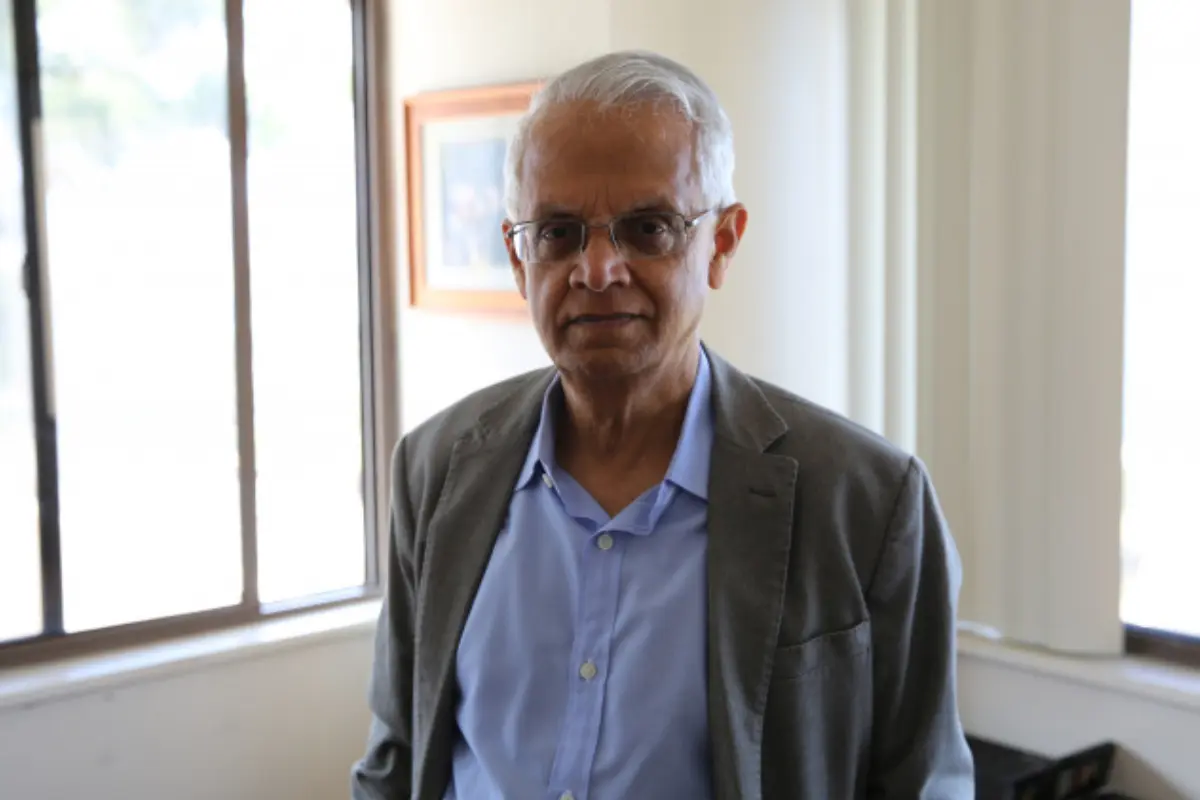
Veerabhadran Ramanathan was born in Chennai, India, and relocated with his family to Bangalore at the age of eleven. This transition marked an early test of resilience. Educated in English rather than his native Tamil, he struggled initially to follow classroom instruction. Instead of surrendering, he adapted—developing a habit of independent reasoning and self-learning that would later define his scientific career.
That formative experience instilled in Ramanathan an enduring trait: the ability to question assumptions and think beyond conventional boundaries.
He went on to earn a Bachelor of Engineering from Annamalai University and a Master’s degree from the Indian Institute of Science, institutions that laid the mathematical and physical foundations for his future breakthroughs.
In 1970, Ramanathan arrived in the United States to pursue doctoral studies at SUNY Stony Brook under atmospheric scientist Robert Cess. A sudden shift in his advisor’s research focus—from interferometry to planetary atmospheres—redirected Ramanathan’s path. What initially appeared as an obstacle became destiny.
Veerabhadran Ramanathan: Redefining the Greenhouse Effect
In the mid-1970s, Veerabhadran Ramanathan made discoveries that fundamentally altered climate science. Until then, carbon dioxide was considered the dominant driver of global warming. Ramanathan demonstrated that chlorofluorocarbons (CFCs) and other trace gases possessed powerful greenhouse properties.
This revelation expanded the very definition of climate forcing and reshaped environmental policy worldwide. It later played a crucial role in global agreements such as the Montreal Protocol, proving that scientific insight could directly prevent planetary harm.
His contributions extended into the development of general circulation models (GCMs) and the early detection and attribution of human-induced climate change, helping to convert theoretical warnings into measurable realities.
Clouds, Radiation, and the Energy Balance of Earth
Ramanathan’s scientific curiosity soon turned skyward—toward clouds. Through the Earth Radiation Budget Experiment (ERBE), he revealed that clouds exert a strong net cooling effect on the planet by reflecting solar radiation back into space.
ERBE achieved something revolutionary: it measured Earth’s greenhouse effect directly from space, without relying solely on climate models. This work sharpened scientific confidence in climate projections and provided an empirical foundation for understanding Earth’s delicate energy balance.
Veerabhadran Ramanathan: Atmospheric Aerosols and the Discovery of Brown Clouds
Among Veerabhadran Ramanathan’s most influential contributions is his work on atmospheric aerosols—microscopic particles suspended in the air that both cool and warm the planet in complex ways.
His research uncovered that aerosols cool Earth’s surface far more than they cool the atmosphere, disrupting rainfall patterns and weakening the hydrological cycle. These insights gained global significance during the Indian Ocean Experiment (INDOEX), which Ramanathan co-led with Nobel laureate Paul Crutzen.
The experiment revealed massive atmospheric brown clouds stretching across South Asia and the Indian Ocean—largely produced by human activity. These clouds were shown to:
-
Mask up to 50 percent of greenhouse warming
-
Reduce monsoon rainfall
-
Damage agriculture and human health
This discovery reframed pollution not merely as a local problem, but as a planetary force.
Climate Change, Tipping Points, and Moral Urgency
Veerabhadran Ramanathan has consistently warned that climate change is not linear—it is punctuated by tipping points. He demonstrated that while Earth has warmed by about 0.6°C, it is already committed to significantly higher warming due to delayed climate feedbacks.
His work emphasizes that different systems—Arctic sea ice, glaciers, monsoons—respond at different thresholds. Some may already be beyond recovery.
In a landmark 2014 study, Ramanathan showed that rapid mitigation of methane, black carbon, ozone, and hydrofluorocarbons could substantially slow sea-level rise—offering humanity a narrow but vital window for action.
Project Surya: Science Serving Humanity
Perhaps no initiative better captures Ramanathan’s philosophy than Project Surya. Conceived to address climate change and human suffering simultaneously, the project introduced solar cookers and clean stoves to rural India.
By reducing soot emissions, Project Surya targeted:
-
Climate warming
-
Respiratory disease
-
Gender inequality in household labor
For Ramanathan, climate solutions must be ethical, inclusive, and practical—science with a human face.
Science and Spiritual Leadership
Veerabhadran Ramanathan’s influence extends beyond academia. As a member of the Pontifical Academy of Sciences, he has personally advised Pope Francis on climate change and played a key role in shaping Laudato si’, one of the most influential environmental documents in history.
Through this work, Ramanathan helped frame climate change as not just a scientific crisis, but a moral responsibility.
Veerabhadran Ramanathan: Honors, Awards, and Global Recognition
Ramanathan’s contributions have earned him the highest honors in science:
-
Member, US National Academy of Sciences
-
Carl-Gustaf Rossby Research Medal
-
BBVA Frontiers of Knowledge Award
-
Tang Prize for Sustainable Development
-
Champions of the Earth – Lifetime Achievement Award
-
Grande Médaille of the Académie des Sciences (2024)
-
Crafoord Prize in Geosciences (2026)