
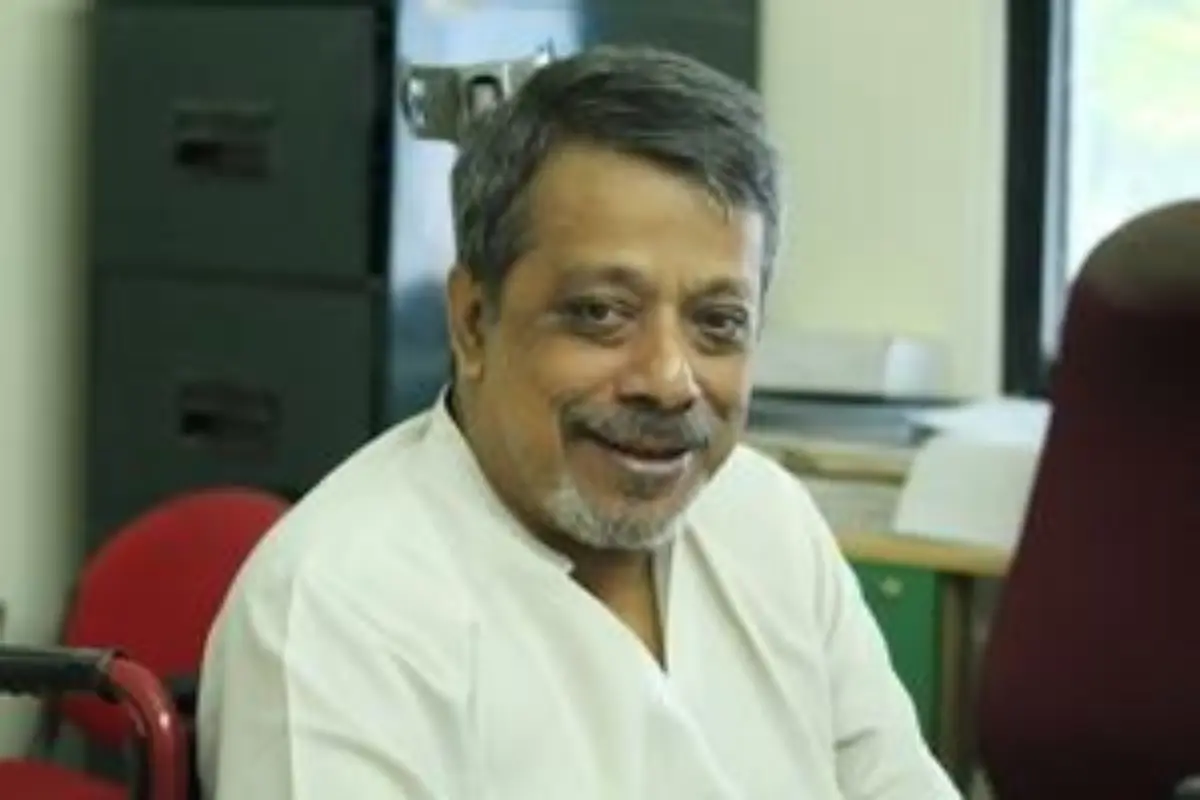
Born in India in the early years after independence, Vaikalathur Shankar Sunder grew up during a time when scientific research was rapidly becoming central to the nation’s intellectual ambitions. From an early age, he displayed an exceptional aptitude for abstract thinking and problem-solving—qualities that would later define his academic life.
His formal mathematical journey began at the Indian Institute of Technology Madras, where he earned his Master of Science in Mathematics in 1973. IIT Madras, already known for its rigorous academic environment, provided Sunder with a strong analytical foundation and exposure to advanced mathematical thought.
Driven by a desire to explore the frontiers of pure mathematics, he moved to the United States for doctoral studies. In 1977, he completed his Ph.D. in Mathematics at Indiana University Bloomington, working under the legendary mathematician Paul Halmos.
Vaikalathur Shankar Sunder: A Distinguished Academic Career Across the World
After completing his doctorate, Vaikalathur Shankar Sunder embarked on an academic career that spanned some of the world’s most prestigious institutions. He served as a faculty member at the Indian Statistical Institute (ISI) in both Bangalore and New Delhi, where he contributed to strengthening research culture in pure mathematics.
His international engagements included academic appointments and research collaborations at:
-
University of California, Berkeley
-
University of California, Los Angeles
-
Research Institute for Mathematical Sciences (RIMS), Kyoto, Japan
Eventually, he became a long-standing and central figure at the Institute of Mathematical Sciences (IMSc), Taramani, Chennai.
Pioneering Contributions to Operator Algebras and Subfactor Theory
The core of Vaikalathur Shankar Sunder’s scientific legacy lies in his profound contributions to functional analysis, particularly operator algebras and von Neumann algebras—structures originally introduced by John von Neumann and later revolutionised by developments in the late twentieth century.
Integral Hypergroups and a Major Theoretical Breakthrough
One of Sunder’s most celebrated achievements was the axiomatization of integral hypergroups, which provided a powerful framework for describing fusion rules of irreducible bimodules arising from subfactors. This work successfully resolved a well-known conjecture proposed by Ocneanu, marking a significant milestone in the theory of subfactors.
Innovations in Subfactor Theory
Vaikalathur Shankar Sunder also:
-
Formulated a path-model to study towers of algebras
-
Constructed new infinite series of irreducible subfactors
-
Advanced the understanding of algebraic structures connected to topology, quantum theory, statistical mechanics, and conformal field theory
His work helped bridge abstract mathematics with ideas that later became central to mathematical physics and quantum information theory.
Vaikalathur Shankar Sunder: Publications, Books, and Lasting Scholarly Impact
Few mathematicians combine deep originality with sustained productivity as effectively as Vaikalathur Shankar Sunder. Over the course of his career, he has:
-
Authored or co-authored over 60 research papers
-
Written six major textbooks and research monographs
-
Produced graduate-level and advanced references widely used by students and researchers
Among his most notable works is a co-authored book on subfactors with Vaughan Jones, the Fields Medalist whose discoveries transformed modern operator algebra theory. This collaboration stands as a testament to Sunder’s international standing and intellectual authority.
His other books—covering von Neumann algebras, topological quantum field theories, and advanced functional analysis—are valued for their precision, insight, and pedagogical excellence.
Mentorship, Teaching, and National Service
-
Supervised six Ph.D. scholars
-
Conducted numerous workshops, short courses, and training programs
-
Delivered lectures at universities and research institutes across India
He has been actively involved in national initiatives to strengthen mathematical education, including contributions to the Mathematics Training and Talent Search Programme of the National Board for Higher Mathematics.
Awards, Honors, and National Recognition
-
Shanti Swarup Bhatnagar Prize (1996) – India’s highest science award in Mathematical Sciences
-
J.C. Bose Fellowship (2008–2014) – Awarded for sustained excellence in research
-
Fellow of INSA, IASc, and NASI – A rare distinction reflecting national recognition across all major science academies