
US-India 10-Year Defence Framework: Unrivaled Military Ties
US-India 10-Year Defence Framework: A Historic Pact Strengthening Global Security and Strategic Partnership
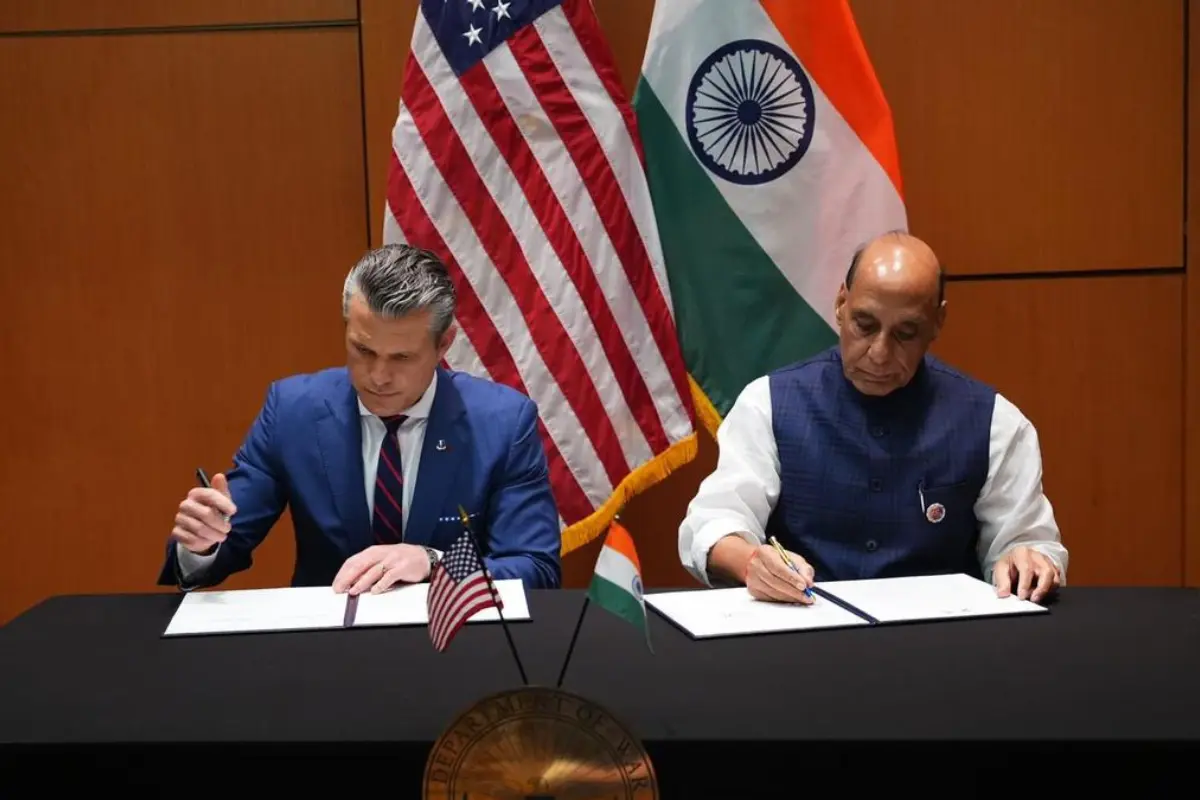
In a landmark development redefining the strategic landscape of the Indo-Pacific, the United States and India have officially signed a US-India 10-Year Defence Framework, signaling an era of unprecedented military and technological collaboration. The agreement, announced on Friday by U.S. Secretary of War Pete Hegseth, marks one of the most significant advancements in the nations’ bilateral defence ties to date.
Hegseth, who met India’s Defence Minister Rajnath Singh in Kuala Lumpur, confirmed the signing through a post on X, stating that “the defence ties between India and the United States have never been stronger.” The newly signed framework outlines a decade-long roadmap designed to enhance joint defence capabilities, intelligence sharing, and technological innovation between the two global powers.
US-India: A New Era of Strategic Defence Cooperation
Calling the pact “ambitious and forward-looking,” Secretary Hegseth emphasised that the US-India 10-Year Defence Framework is not merely a policy document but a tangible blueprint for the future.
“It underscores America’s long-term commitment to shared security and partnership,” he said. “We’re enhancing our coordination, information sharing, and technology cooperation — our defence ties have never been stronger.”
Rajnath Singh, in turn, expressed deep appreciation for the United States’ commitment to fostering strategic cooperation, describing the pact as a “testament to the mutual trust and shared values that define India-U.S. relations.”
Both leaders highlighted that the framework aligns with their mutual vision for a free, open, and secure Indo-Pacific region — an area increasingly central to global trade, security, and geopolitics.
Regional Context and Diplomatic Momentum
The signing of the US-India 10-Year Defence Framework took place on the sidelines of the ASEAN-India Defence Ministers’ Informal Meeting, held in Kuala Lumpur, Malaysia. The meeting coincided with the ASEAN Defence Ministers’ Meeting-Plus (ADMM-Plus), set for November 1, where major Indo-Pacific powers convene to discuss regional security cooperation.
India’s Defence Minister Rajnath Singh had earlier announced that his participation in these meetings aimed to strengthen defence and security cooperation among ASEAN member states under the banner of India’s ‘Act East Policy’.
The bilateral engagement between Singh and Hegseth comes just days after Indian External Affairs Minister S. Jaishankar met U.S. Secretary of State Marcon Rubio during the ASEAN East Asia Summit, also in Kuala Lumpur. Both sides reaffirmed their commitment to deepening strategic ties and addressing regional and global challenges, including maritime security and supply chain resilience.
US-India: Defence Partnership Amid Trade Negotiations and Global Tensions
The US-India 10-Year Defence Framework signing also comes at a time when both nations are navigating complex trade negotiations following heightened tensions over President Donald Trump’s recent move to double tariffs on Indian goods, citing concerns over India’s continued oil purchases from Russia.
During the East Asia Summit earlier this week, Jaishankar voiced India’s growing concerns over what he termed “constriction of energy trade and market access,” underscoring that selective application of trade principles was creating distortions in the global economy.
“Energy trade is increasingly constricted, with resulting market distortions. Principles are applied selectively, and what is preached is not necessarily practiced,” he said — a pointed remark seen as referencing U.S. tariff policies.
Meanwhile, Union Commerce Minister Piyush Goyal reiterated India’s stance that it will not rush into any trade deal or accept terms that restrict its sovereign trading decisions.
“Trade deals are not just about tariffs or market access,” Goyal stated. “They are about trust, long-term partnerships, and creating sustainable frameworks for cooperation.”
Despite the friction, both nations maintain that discussions are ongoing and constructive. Goyal confirmed that negotiation teams from both sides are actively working toward a “fair and equitable agreement in the near future.”
Strategic Implications of the 10-Year Defence Pact
The US-India 10-Year Defence Framework is expected to elevate joint military exercises, expand maritime domain awareness, and enhance collaboration in advanced technologies such as artificial intelligence, cybersecurity, and space defence. Analysts view the agreement as a powerful counterbalance to growing regional assertiveness by other powers, particularly in the South China Sea and the broader Indo-Pacific.
The pact also reaffirms Washington’s recognition of India as a key partner in maintaining global peace and deterrence. In Hegseth’s words, “This framework marks a critical step forward, a roadmap for deeper and more meaningful cooperation ahead.”
Also Read : Karan Sher Singh: IITM to Hollywood’s Digital Revolution