
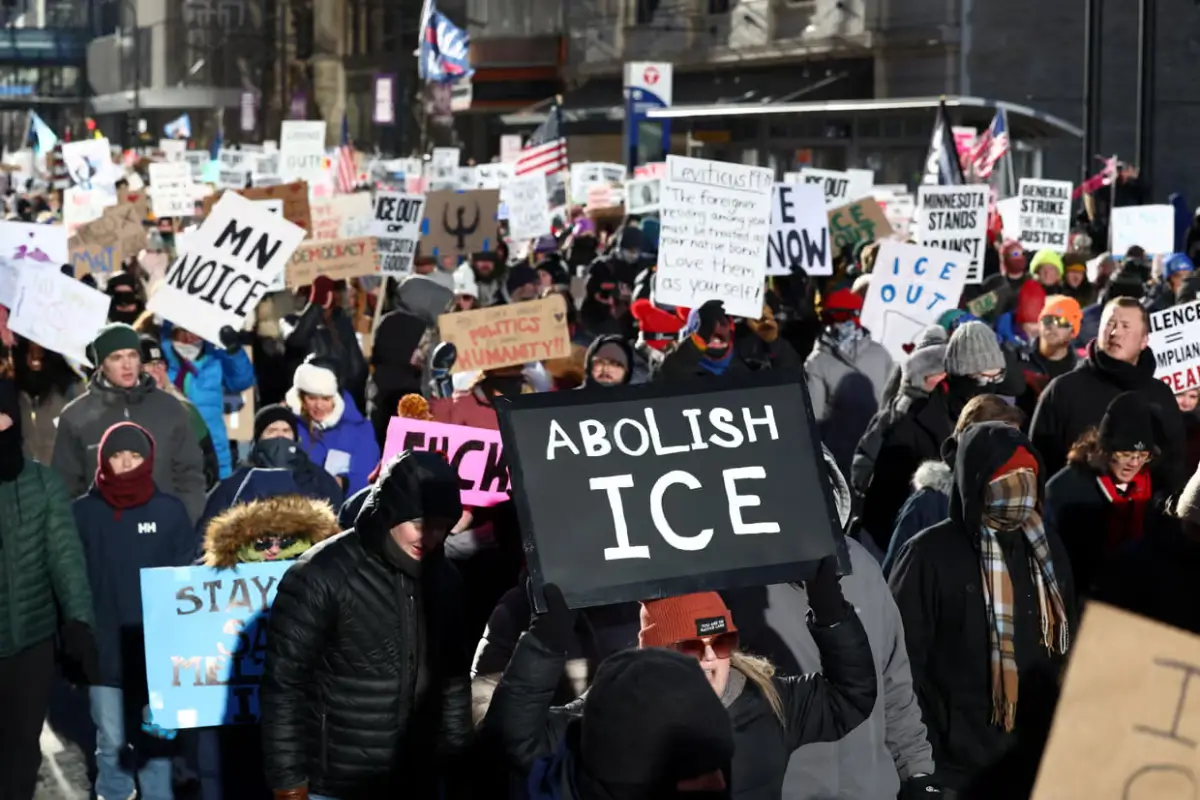
US Immigration Protests Sweep Cities: No Work, No School
US Immigration Protests Sweep Cities After Fatal Enforcement Shootings
A wave of coordinated protests swept across the United States on Friday as demonstrators launched a sweeping “no work, no school, no shopping” strike to challenge the Trump administration’s aggressive immigration enforcement, transforming city centres, classrooms and workplaces into hubs of resistance.
From major metropolitan areas to small towns, Americans walked off jobs, skipped classes, shut businesses and poured into the streets, demanding an end to federal immigration raids and accountability for recent deadly encounters involving enforcement officers. The protests gained momentum amid growing anger over the killings of two civilians during immigration operations, incidents that many demonstrators say symbolise a dangerous escalation in federal tactics.
US Immigration: Killings spark nationwide outrage
The protests were fuelled by the death of Alex Pretti, an intensive care nurse in Minneapolis who was shot multiple times after attempting to record Border Patrol officers on his cellphone during an immigration enforcement action. His killing followed the January 7 death of Renee Good, who was fatally shot by a US Immigration and Customs Enforcement (ICE) officer while seated in her vehicle.
Together, the two incidents ignited nationwide scrutiny of ICE and Border Patrol operations, with critics accusing federal agencies of excessive force and erosion of civil liberties.
Organisers called for a coordinated shutdown of daily life, urging Americans to withdraw labour, education and consumer spending for a day. Messages circulating online framed the strike as a moral stand rather than a traditional protest.
“The people of the Twin Cities have shown the way for the whole country to stop ICE’s reign of terror,” one widely shared call to action read. “We need to shut it down.”
Protests spread coast to coast
Demonstrations unfolded across the country, from Boise, Idaho, to Gainesville, Florida, with rallies forming outside statehouses, churches, schools and federal buildings. In Philadelphia, workers abandoned offices, while protesters in Los Angeles blocked traffic and demonstrators in New York City shuttered businesses in solidarity with Minneapolis.
Several school districts preemptively cancelled classes, anticipating mass staff and student absences. In Tucson, Arizona, 21 schools closed after a large number of employees took personal leave. In Michigan, students braved freezing temperatures to march from Groves High School to a nearby business district.
“We’re here to protest ICE and what they’re doing all over the country, especially in Minnesota,” said Logan Albritton, a 17-year-old student protester.
Similar student-led walkouts were reported in Georgia, where teenagers organised demonstrations after years of feeling politically powerless.
US Immigration: Minneapolis emerges as the epicentre
Minneapolis remained the emotional centre of the movement. Hundreds gathered early Friday outside the Bishop Henry Whipple Federal Building, a focal point of earlier demonstrations. After speeches by faith leaders, protesters marched toward restricted areas, confronting Department of Homeland Security agents and demanding their departure from the state.
Despite sub-zero temperatures, thousands continued to rally across the city, temporarily halting traffic and business activity.
“Everyone in this country has rights, and the federal government seems to have forgotten that,” said Michelle Pasko, a retired communications worker who joined after witnessing federal agents stopping immigrants near her neighbourhood.
Tense scenes in Los Angeles
In Los Angeles, where federal immigration operations intensified last summer, crowds gathered outside City Hall before marching to a federal detention facility. As night fell, the atmosphere turned tense when federal agents deployed chemical sprays to disperse demonstrators.
Democratic Congresswoman Maxine Waters joined the protest, chanting alongside demonstrators calling for ICE to leave the city.
“What I see are people exercising their constitutional rights,” Waters said, criticising the use of crowd-control chemicals as protesters refused to retreat.
While the majority of demonstrations nationwide remained peaceful, isolated confrontations were reported as crowds grew larger and emotions ran high.
Businesses close, communities mobilise
Across several cities, businesses either closed their doors or pledged financial support to immigrant advocacy groups. In New York, a popular restaurant and bakery announced that half of their day’s proceeds would be donated to immigrant support organisations.
In Portland, Maine, residents rallied after ICE announced the end of its enforcement surge in the state. Protesters held signs rejecting any future presence of federal immigration agents.
“Schools are meant to be places of safety and belonging,” said Grace Valenzuela, an administrator with Portland Public Schools. “ICE actions create daily trauma that undermines that mission.”