
Union Budget 2026: India to Counter Trump’s Tariff Impact
Union Budget 2026 Export Relief: Sitharaman Rolls Out Tariff Cuts to Shield Indian Exporters from US Duties
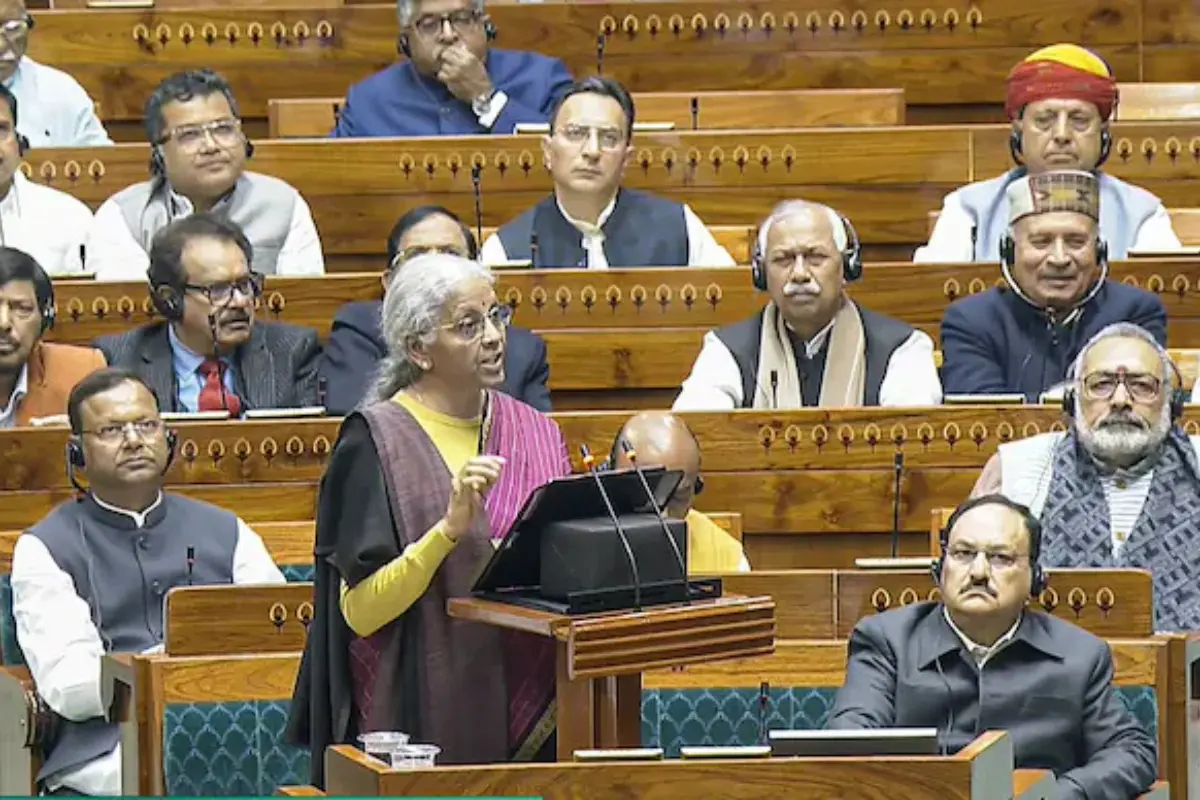
Union Budget 2026: Seeking to shield India’s key export sectors from the impact of steep United States tariffs, Finance Minister Nirmala Sitharaman on Sunday announced a series of targeted customs duty reductions and manufacturing incentives in the Union Budget 2026. The measures come amid growing concern over duties of up to 50% imposed by US President Donald Trump on select Indian goods, a move that has unsettled exporters across labour-intensive industries.
Positioning the steps as a calibrated response to rising global trade risks, Sitharaman said the Budget’s focus was on preserving export competitiveness while strengthening domestic manufacturing. Among the headline proposals was a cut in the tariff rate on all dutiable goods imported for personal use, reduced from 20% to 10%, signalling a broader effort to rebalance India’s trade posture.
Union Budget 2026: Relief for exporters hit by US duties
Sectors such as textiles, seafood and leather—heavily dependent on the US market—have borne the brunt of the tariff shock. Under the Union Budget 2026 export relief package, the government moved to ease cost pressures on exporters by expanding access to duty-free imports of critical inputs.
To support seafood exporters, Sitharaman announced a threefold increase in the duty-free import limit for specified processing inputs. The ceiling has been raised from 1% to 3% of the free-on-board (FOB) value of the previous year’s export turnover.
“I propose to increase the limit for duty-free imports of specified inputs used for processing seafood for export from the current one per cent to three per cent of the FOB value of the previous year’s export turnover,” the finance minister said during her Budget speech.
The leather and footwear sector also received targeted relief. Duty-free imports of specified inputs—earlier limited to leather or synthetic footwear exports—will now be extended to exports of shoe uppers, a move expected to help manufacturers retain overseas orders.
These interventions come at a time when Indian leather exports have shown signs of strain. Shipments of leather and leather products dipped marginally by 0.23% to $3.3 billion during April–December 2025-26. Seafood exports, however, grew 15.53% to $6.5 billion in the same period, underscoring the need to sustain momentum in a tariff-constrained environment.
Duty exemptions to push manufacturing
Beyond exports, the Budget placed strong emphasis on boosting domestic manufacturing through wide-ranging basic customs duty (BCD) exemptions. In a significant push for the defence ecosystem, Sitharaman announced that raw materials imported for manufacturing aircraft parts used in maintenance, repair and overhaul (MRO) operations by defence units would be fully exempt from BCD.
The exemptions were extended to components and parts required for the manufacture of civilian training aircraft, while specified parts used in manufacturing microwave ovens were also brought under the duty-free ambit.
In line with India’s clean energy and battery ambitions, the finance minister proposed extending existing duty exemptions on capital goods used for manufacturing lithium-ion cells to include those used for battery energy storage systems. Additional exemptions were announced for capital goods required for processing critical minerals, as well as for the import of sodium antimonate used in solar glass manufacturing.
The nuclear power sector received long-term support, with the government extending the BCD exemption on imports required for nuclear power projects until 2035. Notably, the benefit will now apply to all nuclear plants, irrespective of capacity.
Union Budget 2026: Rare earth corridors for mineral-rich states
Highlighting the strategic importance of critical minerals, Sitharaman announced government support for mineral-rich states such as Odisha, Kerala, Andhra Pradesh and Tamil Nadu to develop dedicated rare earth corridors. The initiative is aimed at strengthening supply chains for advanced manufacturing and reducing dependence on imports.
Spending push with fiscal discipline
While addressing external headwinds, the Budget also delivered a measured spending push. Capital expenditure for the next financial year has been raised by 9% to ₹12.2 trillion, with investments directed towards railways, small enterprises and healthcare.
At the same time, Sitharaman reaffirmed the government’s commitment to fiscal consolidation. The fiscal deficit is projected to narrow to 4.3% of GDP in the coming year, down from an estimated 4.4% in the current fiscal, while government debt is expected to decline to 55.6% of GDP.
“Our first duty is to accelerate and sustain economic growth by enhancing productivity and competitiveness, while building resilience to volatile global dynamics,” the finance minister said.