
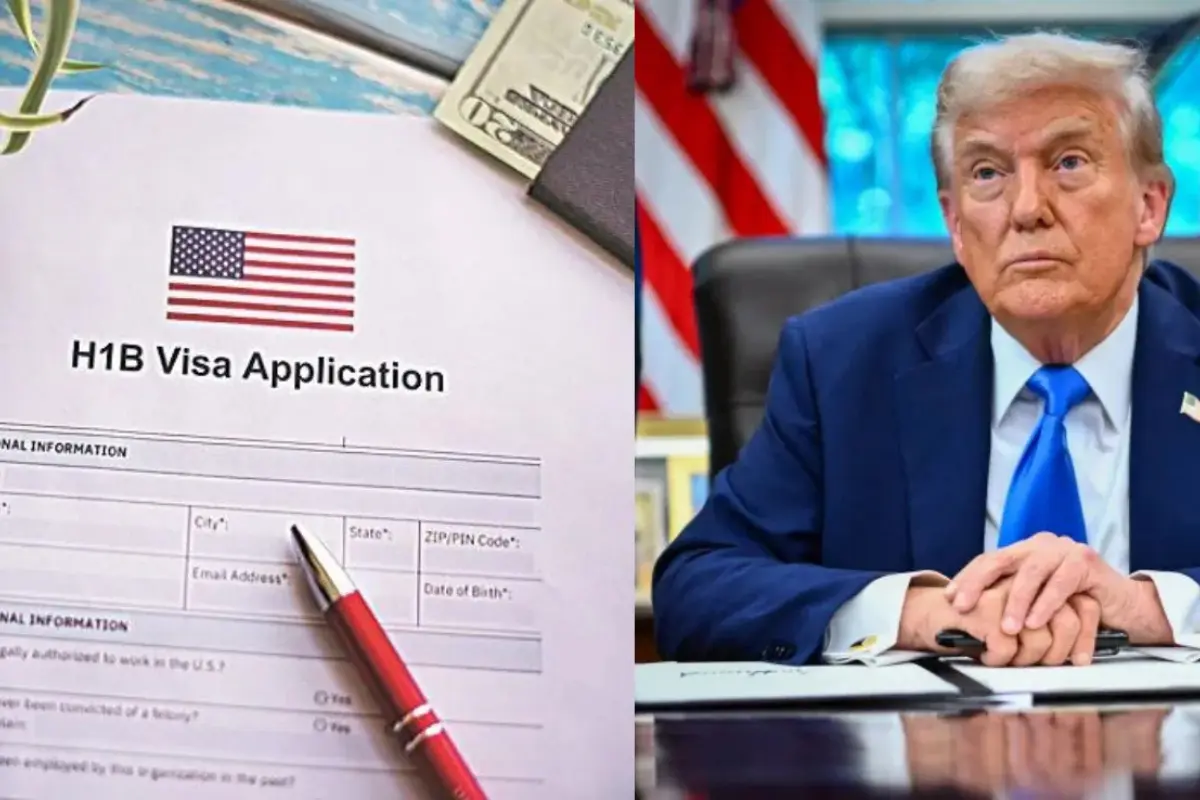
Trump Admits US Needs Foreign Talent Amid H-1B Crackdown
Donald Trump Defends Skilled Immigration Despite Visa Fee Hike
In what appears to be a striking departure from his earlier hardline approach, US President Donald Trump has softened his position on H-1B visa reforms, acknowledging the importance of importing skilled talent to maintain America’s global competitiveness.
During an exclusive interview with Fox News host Laura Ingraham on Tuesday, President Trump openly defended the role of foreign professionals in sectors that demand advanced expertise. His comments mark a notable change in tone, especially after months of tough rhetoric and policy tightening on the H-1B visa programme—a scheme widely used by tech companies and global professionals, especially from India.
Trump: “You Have to Bring This Talent”
When asked if H-1B visa reform remains a top priority for his administration, Trump responded, “I agree, but you also have to bring this talent.”
Ingraham countered by suggesting that the US already has a wealth of local talent, to which Trump bluntly replied, “No, you don’t. There are certain skills you don’t have, and people have to learn them. You can’t take people off the unemployment line and say, ‘I’m going to put you into a factory where we’re going to make missiles.’”
Trump further clarified that while he continues to advocate for higher wages for American workers, the United States must still attract skilled immigrants to fill highly technical and specialized roles—especially in defense, manufacturing, and advanced technology sectors.
A Shift in Rhetoric Amid H-1B Crackdown
The softened tone from Trump contrasts sharply with his administration’s earlier aggressive measures against the H-1B visa programme. In September 2025, the White House announced a sweeping policy overhaul, introducing a USD 100,000 fee for all new H-1B visa applications filed after September 21, 2025.
The “Restriction on Entry of Certain Nonimmigrant Workers” Proclamation, signed by Trump, was widely viewed as one of the toughest measures targeting skilled immigration in recent history. However, the President’s latest remarks suggest a more pragmatic view—acknowledging that restricting skilled immigration too harshly could harm US industries that rely on global talent.
According to the US State Department, the new fee applies only to fresh H-1B petitions or entries in the 2026 lottery, leaving existing visa holders unaffected.
Trump: The Hyundai Example – A Lesson in Skill Dependency
In the same interview, Trump referenced the US Immigration and Customs Enforcement (ICE) raid on an under-construction Hyundai plant in Georgia to highlight America’s reliance on specialized foreign expertise.
He explained that when ICE detained and deported hundreds of South Korean workers, the plant’s operations suffered. “They had people from South Korea who had made batteries all their life. Making batteries is very complicated and dangerous—a lot of explosions, a lot of problems. They had like 500 or 600 people in the early stages to make batteries and teach people how to do it,” Trump said.
The example underscores the complexity of modern manufacturing and the gap between available local labor skills and the demands of advanced industries.
India’s Stake in the H-1B Debate
Indian professionals, particularly in technology and healthcare, form the largest share of H-1B visa holders in the US. Any policy change in this arena carries significant implications for the Indian IT sector, as well as for US companies dependent on highly trained Indian engineers, scientists, and software developers.
While Trump’s earlier visa reforms were seen as deterrents, his latest comments may offer cautious optimism to Indian talent and global firms that rely heavily on transnational expertise.