
Trump Administration Faces Backlash Over Aggressive ICE
Confusion and Crackdowns: Inside the Trump Administration’s Immigration Enforcement Push
Trump Administration: The Trump administration’s immigration raids controversy is fast becoming one of the most politically damaging challenges facing the White House, as it sends mixed signals about its enforcement posture while quietly doubling down on some of the most aggressive tactics in modern immigration history.
President Donald Trump and Vice President JD Vance have recently acknowledged that “mistakes” may have occurred during Immigration and Customs Enforcement (ICE) operations. Polling suggests these gestures are not coincidental: nearly six in ten Americans now believe ICE has gone too far. Yet beyond careful phrasing and rhetorical recalibration, there is scant evidence of meaningful change on the ground.
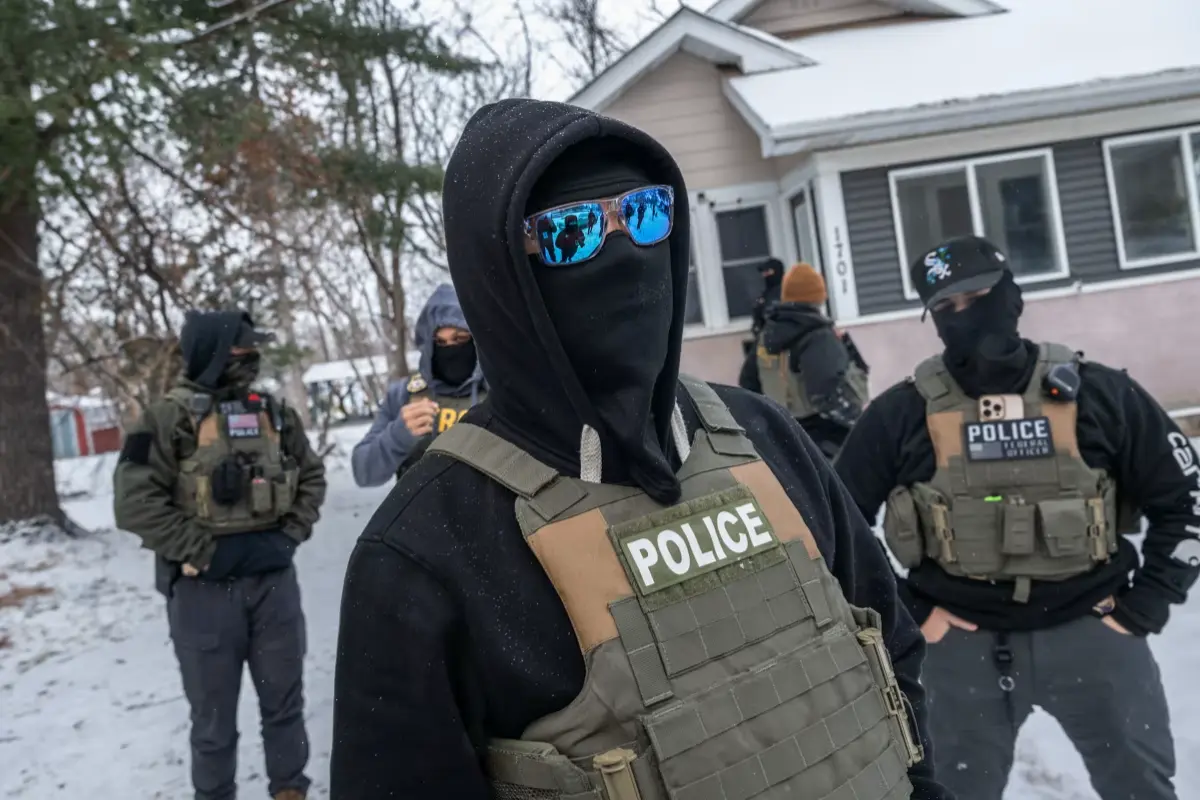
Instead, the Trump administration appears committed to an enforcement-first approach that continues to generate disturbing images, legal questions, and deepening public distrust. This accumulation is shaping a powerful narrative of overreach.
Trump Administration: An Administration Caught Between Politics and Policy
At the heart of the Trump immigration raids controversy is a striking contradiction. The White House seems aware that aggressive raids are costing political capital, yet continues to defend or expand the very practices driving public disapproval.
That tension was underscored this week with revelations from a May 2025 ICE memo asserting that agents may enter private homes without a judicial warrant. The disclosure reinforced a growing sense that the administration is willing to stretch legal boundaries to sustain its mass deportation agenda, even as voter unease grows louder.
What is increasingly clear is that this is no longer a debate confined to immigration policy. It is now about civil liberties, executive power, and trust in federal law enforcement.
The Renee Good Shooting: A Defining Moment
No single episode has crystallized the Trump immigration raids controversy more sharply than the killing of Renee Good in Minneapolis.
ICE agent Jonathan Ross shot and killed Good during an attempted enforcement action, claiming he feared being run over. Video footage and eyewitness accounts, however, have raised serious questions about that narrative. Critics point to tactical decisions—standing in front of Good’s vehicle and continuing to fire from the side—that appear to violate standard ICE guidance.
Public opinion has been unforgiving. Surveys show a clear majority of Americans view the use of force as inappropriate, and more than half believe the shooting reflects broader systemic problems within ICE. The incident’s visibility has only amplified its impact, with an overwhelming share of voters reporting they have seen the footage.
For many Americans, the case has become symbolic—not of isolated error, but of an agency perceived to be operating without adequate restraint.
Trump Administration: Warrantless Home Entries and Constitutional Alarm Bells
Fueling the controversy further is ICE’s claim that administrative warrants—signed internally by ICE officers—are sufficient to enter private homes.
Legal experts warn that this interpretation effectively bypasses the Fourth Amendment, which requires judicial oversight to protect citizens from unreasonable searches. Unlike court-issued warrants, administrative warrants involve no independent review, leaving the executive branch to act as both enforcer and judge.
Even Vice President Vance’s defense of the policy appeared cautious, acknowledging that courts may ultimately reject the administration’s reading of the law. For a public already uneasy about government overreach, the idea of federal agents entering homes without a judge’s approval has proven deeply unsettling.
Children in Custody: The Human Cost of Enforcement
Images of children caught in immigration operations have long shaped public opinion, and recent cases have only intensified scrutiny.
The detention of five-year-old Liam Conejo Ramos alongside his father in Texas has sparked widespread outrage. While officials insist the child was treated humanely and that circumstances left them no alternative, family attorneys dispute the administration’s account, asserting the family was legally pursuing asylum.
Separately, reports emerged of a two-year-old girl briefly taken into ICE custody despite a court order mandating her immediate release. Though she was later returned to her mother, the episode added to concerns that enforcement zeal is overriding safeguards for minors.
Polling consistently shows that family separation and child detention sharply reduce public support for deportation efforts. These images, more than any policy paper, have undermined the administration’s claim that enforcement is narrowly focused on dangerous criminals.
US Citizens Caught in the Net
Another damaging dimension of the Trump immigration raids controversy is the growing number of US citizens mistakenly detained.
Investigations have documented cases in which citizens were held for hours or days, sometimes under harsh conditions. This week, the wrongful detention of ChongLy Scott Thao—a naturalized US citizen in Minnesota—drew national attention. Escorted from his home in freezing weather, Thao was released after authorities acknowledged a mistake.
The incident raised troubling questions about verification procedures and accountability, particularly after state officials confirmed that at least one individual ICE claimed to be seeking was already in custody.
Mounting Allegations of Racial Profiling
Concerns about profiling have further eroded confidence in ICE operations. Law enforcement leaders in Minnesota report multiple complaints of individuals being stopped solely based on appearance or accent, including off-duty police officers of color.
Video evidence showing a Border Patrol agent citing a man’s accent as justification for questioning has intensified the debate. While federal officials deny racial profiling, local authorities say allegations are widespread and persistent.
These claims strike at the core of public trust, reinforcing fears that immigration enforcement is blurring into discriminatory policing.