
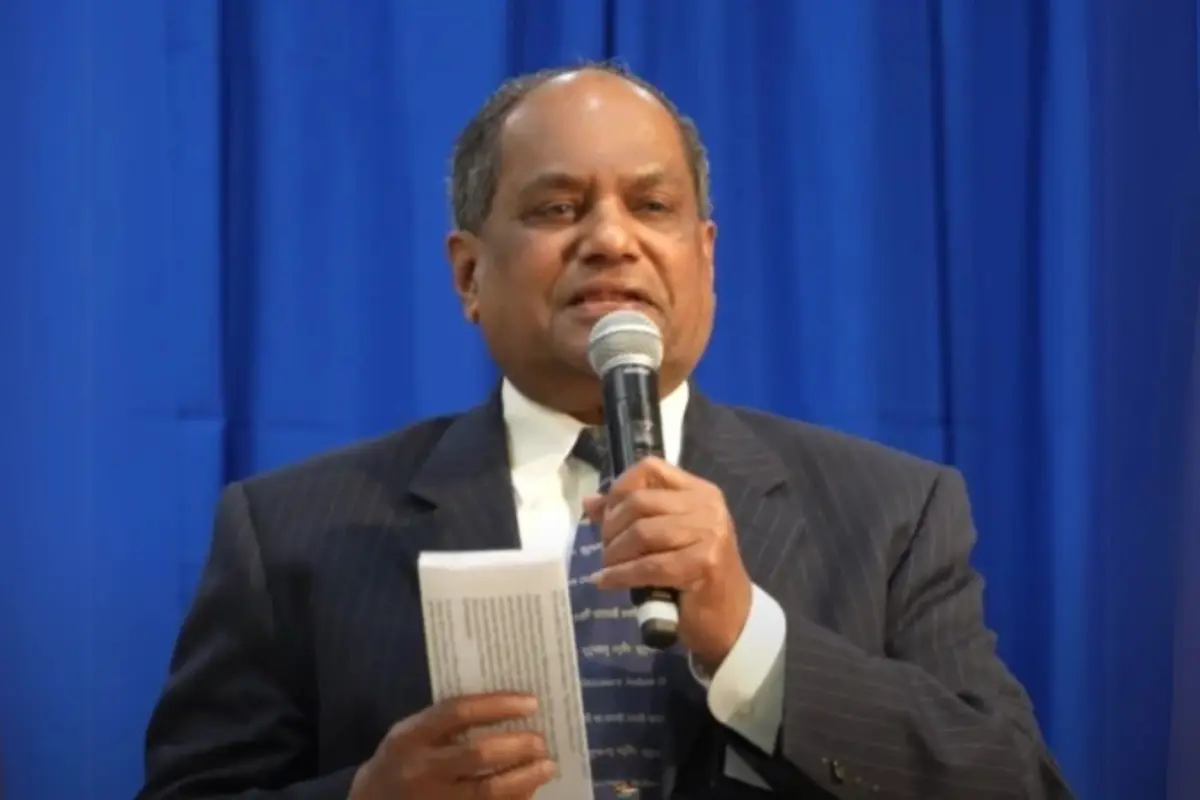
When the winds of migration scattered millions of Indians across the globe, a quiet force began to stir—one that would unite, inspire, and empower a diverse people under a singular identity. That force was Dr. Thomas Abraham, an unrelenting visionary who transformed scattered stories of migration into a global movement. The name Thomas Abraham GOPIO is not just a historical footnote—it’s a living legacy that continues to shape the identity, voice, and influence of the People of Indian Origin (PIO) worldwide.
Born on September 11, 1948, in India and now a proud resident of Stamford, Connecticut, Dr. Thomas Abraham has worn many hats throughout his extraordinary life—scientist, activist, convener, researcher, husband, father, and most importantly, a builder of community. With an extraordinary vision and passion rooted in his Indian heritage, he has dedicated over 40 years to building bridges between India and its global diaspora.
Thomas Abraham: The Birth of a Global Identity
In 1989, when Dr. Thomas Abraham convened the First Global Convention of People of Indian Origin in New York City, he did more than organize a conference—he created a movement. It was at this defining moment that he coined the term People of Indian Origin (PIO), a term now deeply ingrained in international discourse. Out of this monumental event was born the Global Organization of People of Indian Origin (GOPIO)—an international platform to represent the interests and aspirations of over 30 million Indians living abroad.
The establishment of Thomas Abraham GOPIO was not just symbolic; it was systemic. It gave identity, voice, and dignity to those who often felt invisible despite their contributions to the countries they inhabited.
Building Institutions That Last
Dr. Abraham’s legacy isn’t measured by awards or titles—it’s written in the institutions he helped create. His leadership in founding some of the most prominent Indian diaspora organizations reflects a lifetime dedicated to service:
-
Federation of Indian Association (FIA) of New York, New Jersey, and Connecticut (1977): A powerful umbrella group that helped organize the largest India Day parade outside India.
-
National Federation of Indian-American Associations (NFIA) (1980): A political and cultural advocacy group for Indian Americans, giving them a seat at the American political table.
-
Global Organization for People of Indian Origin (GOPIO) (1989): A global force in diaspora policy and development.
-
Indian American Kerala Cultural and Civic Center (1993): Preserving cultural roots while advocating civic engagement.
-
The Jagdish Bhagwati Chair at Columbia University (1992–2000): A $4 million endowment focused on Indian political economy.
-
National Indian American Association for Senior Citizens (NIAASC) (1998) and South Asian Council for Social Services (SACSS) (2000): Serving the underrepresented.
-
Indus Nanotechnology Association (TINA) (2007): Uniting science and innovation in the Indian community.
From Science to Service
Despite his deep involvement in community work, Dr. Thomas Abraham is no stranger to cutting-edge science and innovation. As President of Innovative Research and Products (iRAP), Inc., a Stamford-based firm specializing in advanced technologies like nanotech, energy storage, and materials science, he has contributed significantly to the fields of future tech and industrial research.
His ability to straddle both community activism and scientific inquiry is rare—and perhaps it is this duality that makes his journey so inspiring. Thomas Abraham proves that one can be both a dreamer and a doer, a scientist and a social architect.
Recognition of a Life of Impact
Dr. Thomas Abraham’s unwavering service has earned him prestigious accolades, including:
-
Bharatvanshi Gaurav Award (2008): Presented by former Vice President Bhairon Singh Shekhawat.
-
Pravasi Bharatiya Samman Award (2008): The highest honor for overseas Indians, conferred by the President of India.
-
Distinguished Alumni Award by Malaviya National Institute of Technology (MNIT), Jaipur (2008).
-
Lifetime Achievement Award for Public Service by India Abroad (2011).
These recognitions do not merely honor a man—they celebrate a movement.
Champion of Dual Identity
One of Dr. Thomas Abraham’s most notable contributions was initiating the PIO Card and Dual Citizenship Resolution. These policies were revolutionary for millions of Indians abroad who longed to maintain ties with their motherland. Though it took over a decade, his persistence bore fruit when the Government of India introduced the PIO card in 2001, followed by Overseas Citizenship of India (OCI) in 2006.
As he once reflected, “It took time, but our persistence and belief in the power of unity led to policies that reconnected generations to their roots.”
Family, Faith, and Foundations
While Dr. Thomas Abraham’s public achievements are inspiring, his personal story is equally grounding. His wife, Dr. Susy Abraham, has made significant contributions as a geriatrician, and his children, Nitya and Jay, continue the family legacy of excellence—Nitya as an Associate Professor of Urology at Montefiore Health Center and Jay as a design engineer at Pratt & Whitney.
Also Read : British India Minister Lisa Nandy signs India-UK cultural agreement in Delhi