
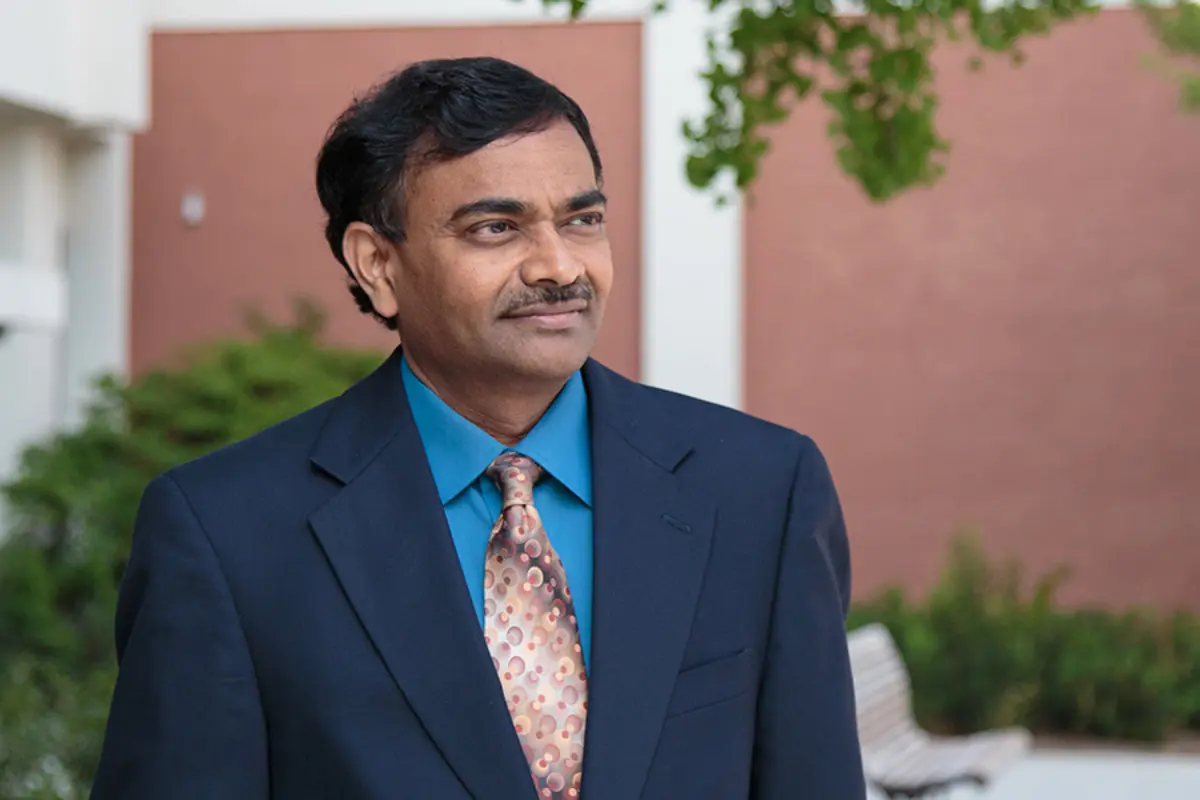
The academic foundation of Srinivas Peeta reflects a lifelong pursuit of excellence across continents and institutions. He earned his B.Tech. in Civil Engineering from the Indian Institute of Technology (IIT) Madras, one of the world’s most competitive engineering institutions. From there, he pursued advanced studies at the California Institute of Technology (Caltech), where he obtained his Master’s degree, followed by a Ph.D. from the University of Texas at Austin.
This rigorous training shaped his ability to synthesize control theory, operations research, and computational modeling—skills that would later become hallmarks of his pioneering research in large-scale transportation systems.
Srinivas Peeta: A Transformative Era at Purdue University
Before joining Georgia Tech in August 2018, Srinivas Peeta spent 24 distinguished years at Purdue University, where he rose to become the Jack and Kay Hockema Professor of Civil Engineering. During this period, he established himself as a leading authority in transportation network modeling and systems analysis.
One of his most consequential leadership roles was as Director of the NEXTRANS Center, which served as the U.S. Department of Transportation’s Region 5 Regional University Transportation Center from 2007 to 2018. Under his guidance, NEXTRANS became a national model for integrated research, education, and outreach—bridging academia, government, and industry to address real-world transportation and logistics challenges.
Peeta also served as Associate Director of the USDOT Center for Connected and Automated Transportation, further cementing his influence on national transportation research priorities.
Leadership at Georgia Tech and Global Influence
At Georgia Tech, Srinivas Peeta continues to shape the future of mobility at both strategic and operational levels. As Director of the ACT Laboratory, he leads interdisciplinary teams exploring how autonomous vehicles, connected infrastructure, and human decision-making interact in complex transportation ecosystems.
In August 2025, his stature in the global research community was further recognized when he was appointed Co-Editor-in-Chief of Transportation Research Part B: Methodological—one of the most prestigious journals in the field. This role places him at the center of shaping future research directions worldwide.
Srinivas Peeta: Pioneering Research That Redefined Transportation Systems
The research portfolio of Srinivas Peeta is remarkable not only for its depth but for its breadth and lasting impact. His work spans multiple methodological domains, addressing transportation as a complex adaptive system rather than a collection of isolated components.
His primary research contributions include:
Autonomous and Connected Transportation
Peeta has been at the forefront of modeling traffic flow, vehicle-human-infrastructure interactions, and human-machine interfaces under emerging automation technologies. His work provides the theoretical backbone for safer and more adaptive autonomous mobility systems.
Large-Scale System Dynamics
He developed advanced network planning and real-time navigation models that incorporate uncertainty, information flow, and user behavior—critical for managing congested, data-rich transportation environments.
Interdependent Infrastructure Systems
Recognizing that transportation does not operate in isolation, Peeta pioneered methodologies to analyze interdependencies between transportation, energy, telecommunications, and environmental systems—especially vital for disaster response and resilience planning.
Human Behavior and Learning
Using advanced driving simulators and behavioral modeling, he examined how travelers learn, adapt, and respond to information—reshaping how traffic management systems account for human decision-making.
Landmark Contributions and Lasting Tools
Among his most influential achievements is his leadership in developing the DYNASMART software suite (DYNASMART-P and DYNASMART-X) for the Federal Highway Administration. These tools remain global benchmarks for dynamic traffic assignment, real-time traffic operations, and intelligent route guidance.
His work in dynamic traffic networks has guided the U.S. Department of Transportation’s deployable architectures for real-time route guidance, influencing how modern transportation systems are designed and operated at scale.
Scholarship, Mentorship, and Global Impact
Srinivas Peeta has authored more than 345 technical publications, including over 280 peer-reviewed journal articles and conference papers. He has delivered over 480 talks worldwide, including more than 120 invited keynote, plenary, and seminar presentations.
Equally significant is his impact as a mentor. Multiple doctoral dissertations supervised by Peeta have received best dissertation awards from leading international organizations, reflecting his commitment to nurturing the next generation of transportation leaders.
Honors, Awards, and Professional Recognition
The excellence of Srinivas Peeta’s work has been recognized globally. His notable honors include:
-
ASCE Walter L. Huber Research Prize
-
NSF CAREER Award
-
Distinguished Alumnus Award, IIT Madras
-
Matthew G. Karlaftis Best Paper Award
-
INFORMS Transportation Science Best Dissertation Award
-
TRB Blue Ribbon Committee Award
-
Visiting Distinguished Scholar Awards in Asia and Australia
-
Honorary Professorship in China
He has also served in leadership roles across premier organizations, including the Transportation Research Board (TRB), the International Federation of Automatic Control (IFAC), and multiple international editorial boards.