
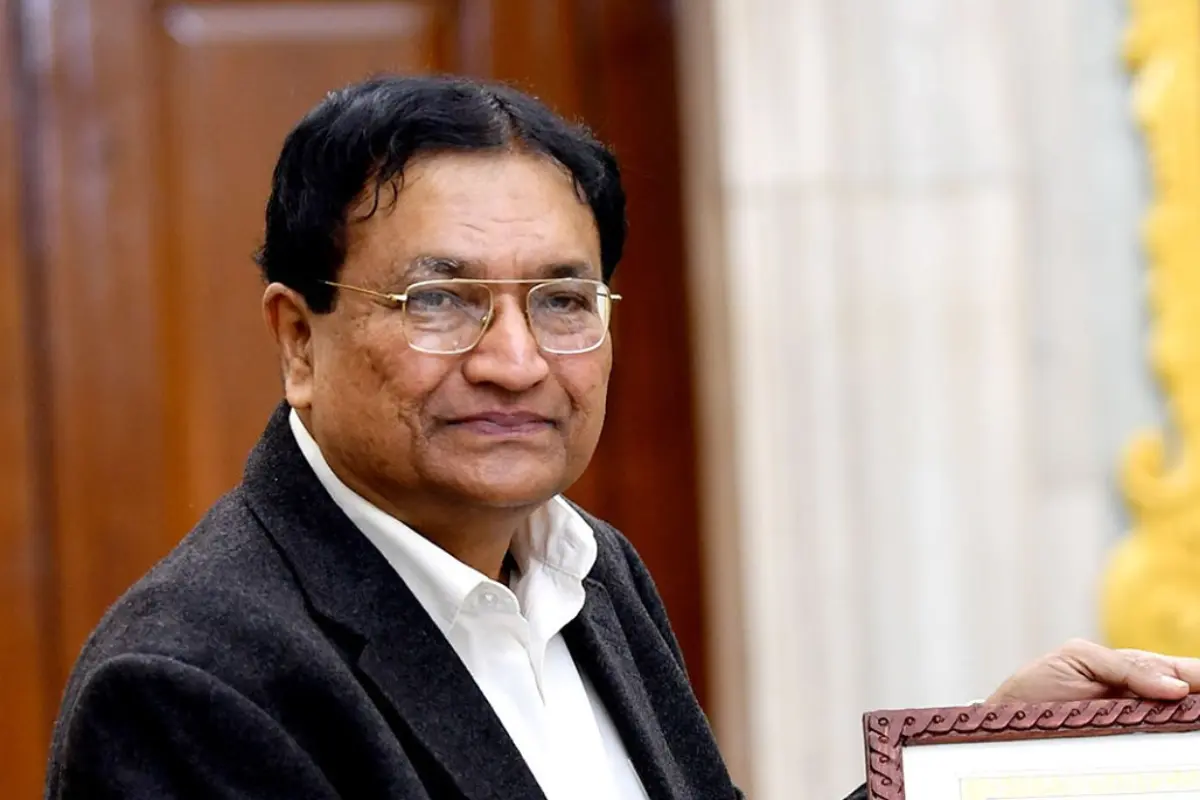
In the expansive universe of Indian science, certain names shine not only for their academic brilliance but for the courage with which they chase the deepest mysteries of nature. Sanjay Puri, born on 23 November 1961 in Rampur, Uttar Pradesh, belongs to that rare constellation of thinkers whose work has transformed the global understanding of statistical physics and nonlinear dynamics.
Early Spark of Sanjay Puri: A Mind Drawn to Complexity
Sanjay Puri’s academic journey began with an exceptional spark. Even as a student, he displayed an unusual fascination for patterns in nature, the hidden order behind chaos, and the mathematical elegance that governs physical systems.
This early passion led him to the Indian Institute of Technology (IIT) Delhi, where he completed his research-based M.S. in Physics in 1982, topping the institute and receiving the Silver Medal of Excellence. His thesis—“Theoretical Investigations of Soliton Dynamics”, under the guidance of K. P. Jain—foreshadowed his lifelong relationship with nonlinear systems.
But curiosity pushes forward, and Puri’s thirst for deeper knowledge took him across continents.
Crossing Oceans for Knowledge
At the University of Illinois at Urbana-Champaign, one of the world’s premier centers for physics research, Sanjay Puri expanded his intellectual horizons. He completed his second master’s degree in 1983 and soon after earned his Ph.D. in 1987, guided by the distinguished physicist Yoshitsugu Oono.
His doctoral work—“Some Problems in the Dynamics of Spatially Extended Systems”—entered the heart of nonequilibrium physics, laying the groundwork for the groundbreaking contributions he would later make in India.
Sanjay Puri: Returning Home – Building a Legacy at JNU
In 1987, while many brilliant Indian scientists stayed abroad, Puri returned to India, motivated by a deep desire to strengthen the country’s scientific foundation. He joined the School of Physical Sciences at Jawaharlal Nehru University (JNU) as an Assistant Professor.
Over the next three decades, his journey at JNU became legendary:
-
Associate Professor in 1993
-
Professor from 2001 onwards
-
Mentor to generations of physicists
-
Contributor to over 170 research papers
-
Editor/Associate Editor of the journal Phase Transitions for over two decades
He also carried Indian science across borders as a Visiting Professor at leading institutions including:
-
Johannes Gutenberg University of Mainz
-
University of Manchester
-
Cambridge University
-
Kyoto University
His international presence strengthened India’s voice in theoretical physics and built powerful global collaborations.
The Science That Changed Our Understanding of Patterns
At the core of Sanjay Puri’s scientific journey is one quest—decoding pattern formation in nonequilibrium systems.
His work reshaped some of the most complex domains of modern physics:
1. Kinetics of Phase Transitions
He developed Cell Dynamical System models to understand how systems evolve after a sudden temperature change. His insights into surface-directed spinodal decomposition—the interplay between wetting and phase separation—are considered foundational.
2. Dynamics of Defects
His analytical solution for vector-defect dynamics revealed how microscopic imperfections control macroscopic ordering—an insight crucial to materials science and condensed matter physics.
3. Granular Materials and Granular Gases
Puri’s pioneering work on freely evolving granular gases expanded understanding in a domain where traditional kinetic theory fails, influencing research in industry, astrophysics, and complex systems.
His contributions are not merely academic—they have opened new pathways for materials engineering, nanotechnology, and nonlinear modeling.
Awards That Celebrate a Lifelong Devotion to Science
Sanjay Puri’s brilliance has been recognized by India’s highest scientific institutions:
-
INSA Young Scientist Medal (1993)
-
N. Satyamurthy Award (1995)
-
B. M. Birla Science Award (2001)
-
Homi Bhabha Fellowship (2003)
-
Shanti Swarup Bhatnagar Prize (2006) – one of India’s highest science honors
-
J. C. Bose National Fellowship (2012)
-
Fellow, Indian Academy of Sciences (2006)
-
Fellow, Indian National Science Academy (2012)