
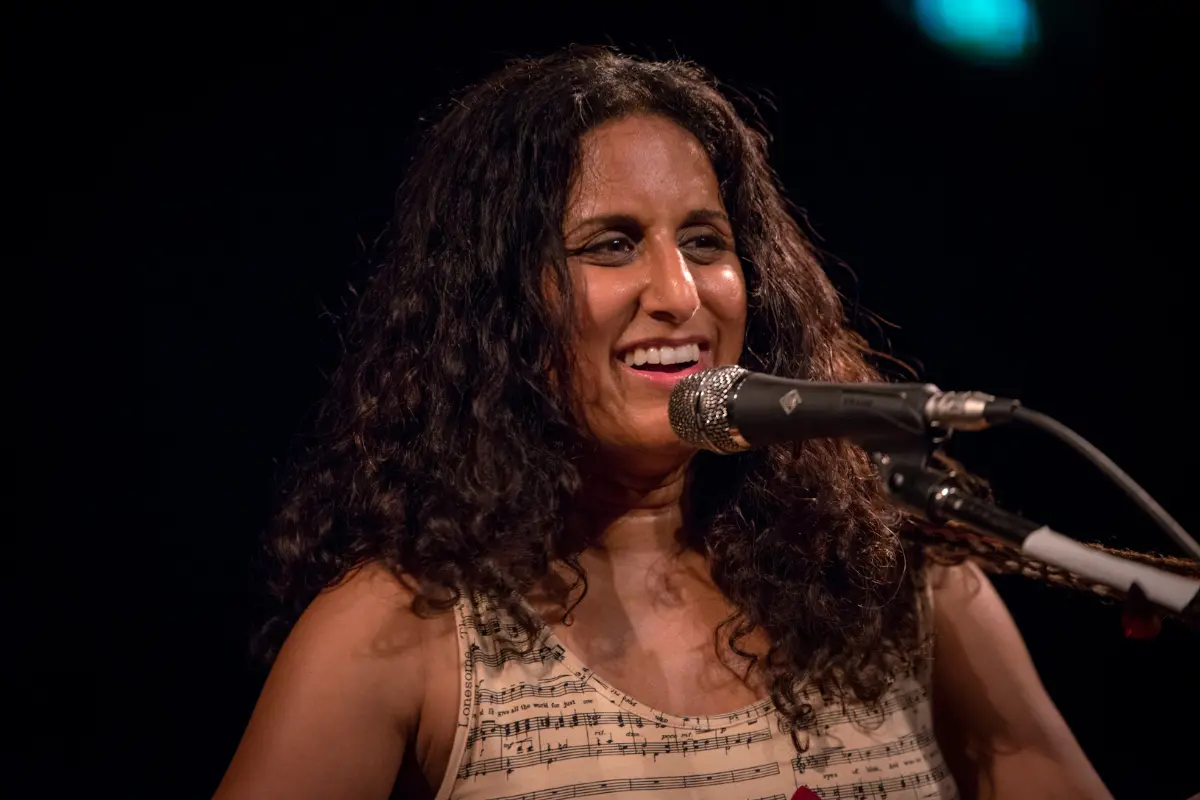
In an age marked by division and disconnection, Rupa Marya stands as a powerful voice echoing across continents, cultures, and consciousness. A physician, activist, musician, and writer, Marya is not simply a product of modern institutions—she is their challenger, their reformer, and at times, their revolutionary. Her life’s work blends the rigor of science with the soul of art, weaving a rich tapestry that redefines what it means to care for people and the planet.
Born in California to Indian immigrant parents, Rupa Marya’s early life was shaped by diversity—geographically, culturally, and spiritually. Raised in the Sikh tradition and exposed to the vibrancy of American, French, and Indian cultures, she cultivated an inclusive worldview from a young age.
Her intellectual appetite led her to earn degrees in theater and molecular biology at UC San Diego, and later, a medical degree from Georgetown University. But it was during her residency at UCSF that her twin passions—healing and music—began to harmonize in extraordinary ways.
Rupa Marya: Healing Beyond the Hospital Walls
For over 18 years, Rupa Marya has practised hospital medicine at the University of California, San Francisco. As an Associate Professor in the Division of Hospital Medicine, she has cared for acutely ill patients with skill and compassion. Yet her understanding of health extends far beyond prescriptions and hospital wards. It reaches deep into the socio-political fabric of our world. She sees disease not just as a biochemical imbalance, but often as the direct result of systemic injustice—colonialism, racism, and environmental degradation.
This radical perspective inspired her to co-found the Do No Harm Coalition, a collective of healthcare workers committed to dismantling structures that perpetuate inequity. Marya’s advocacy has taken her to Standing Rock in 2016, where she responded to the violent suppression of Indigenous land protectors, and to Lakota territory, where she is helping establish the Mni Wiconi Health Clinic and Farm—a decolonized space for healing through traditional medicine and food practices.
Her trust and partnership with Indigenous communities are not symbolic; they are rooted in solidarity, respect, and a shared belief in the transformative power of care.
The Deep Medicine Circle: A New Healing Model
Recognizing that the Western model of medicine often fails to address the root causes of illness, Marya founded the Deep Medicine Circle, a worker-directed nonprofit that reimagines care through food sovereignty, land restoration, and storytelling. This initiative seeks to reverse the harm caused by colonialism by healing not just bodies, but the very ecosystems and communities we belong to.
Through Deep Medicine Circle, Marya is building a culture of care that prioritizes relational health—our connections to one another, the Earth, and the knowledge of our ancestors. She firmly believes that true health equity cannot exist without decolonizing the systems that oppress.
“Inflamed”: Diagnosing Injustice
In 2021, Rupa Marya and Raj Patel co-authored Inflamed: Deep Medicine and the Anatomy of Injustice, a groundbreaking book that explores how historical trauma and systemic violence manifest in inflammatory diseases. The work challenges conventional medicine by diagnosing societal ills with the precision of a physician and the empathy of a healer.
Inflamed is not just a book—it’s a manifesto for planetary and collective healing. Naomi Klein described it as “a work of exhilarating scope and relevance,” and indeed, it has become a cornerstone for movements addressing the intersection of health, environmental justice, and decolonization.
Rupa Marya: Music as Medicine
Before she was known for her pioneering work in medicine, Rupa Marya was—and remains—a powerful voice in global music. As the front-woman of Rupa and the April Fishes, she has toured 29 countries with songs in five languages, creating music that celebrates resistance and unity.
Her compositions, layered with influences from Latin America, South Asia, jazz, reggae, and punk, pulse with the heartbeat of a borderless world. This is not music for escapism—it is what Gil Scott-Heron once described as “Liberation Music.” For Marya, art is activism, and sound is a pathway to healing.
The band’s performances are immersive and emotional experiences that embody the same philosophy guiding her medical practice: that healing is a deeply communal act, not a transactional one.
Also Read : Sadanand Verma: The Founding Father of Mathematical Sciences at UNLV