
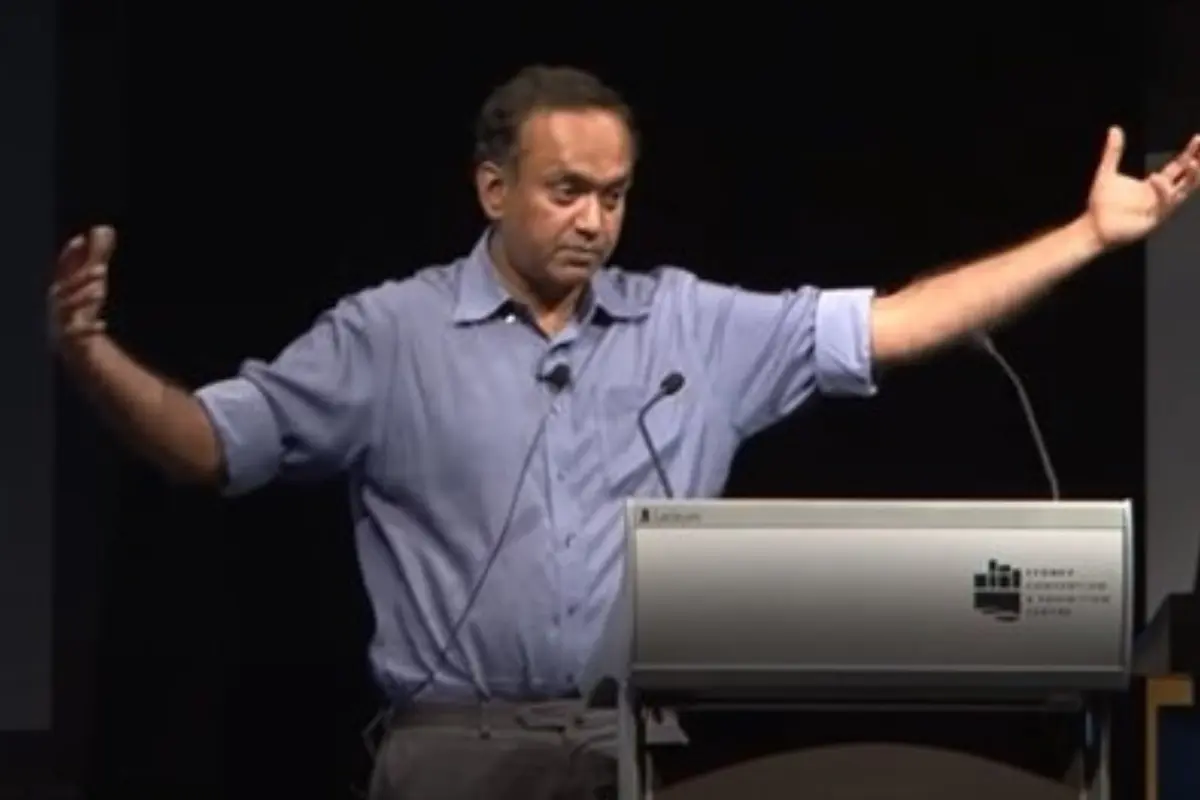
The journey of Ramanathan Guha began in India, where he completed his schooling at Loyola High School, Pune, an institution known for nurturing analytical rigor and curiosity. His early academic promise led him to the Indian Institute of Technology Madras, where he earned a Bachelor of Technology in Mechanical Engineering in 1986.
Yet Guha’s mind refused to be confined to a single discipline. Mechanical engineering taught him systems thinking; curiosity pushed him further. He pursued a Master of Science at the University of California, Berkeley, followed by a Ph.D. in Computer Science at Stanford University, one of the world’s most fertile grounds for technological innovation.
This rare blend—engineering precision, computational theory, and philosophical depth—would later define Ramanathan Guha’s unique approach to the web: not as a collection of pages, but as a living knowledge system.
Ramanathan Guha: The Cyc Project – Teaching Machines to Understand the World
Long before artificial intelligence became a household term, Ramanathan Guha was working on one of the most ambitious AI initiatives ever attempted—the Cyc Project. From 1987 to 1994, at the Microelectronics and Computer Technology Corporation (MCC), Guha served as one of the early co-leaders of this pioneering effort, collaborating closely with AI visionary Douglas Lenat.
At Cyc, Guha played a defining role in:
-
Designing CycL, a powerful knowledge representation language
-
Building the upper ontological layers of the Cyc Knowledge Base
-
Developing early natural language understanding systems
This work laid the intellectual groundwork for modern knowledge graphs and semantic reasoning systems, years before the web itself matured.
From Apple to Netscape: The Birth of Web Metadata
After leaving what later became Cycorp, Ramanathan Guha founded Q Technology, where he created Babelfish, an early database schema-mapping tool—an early signal of his lifelong mission to make disparate data speak the same language.
In 1994, Guha joined Apple Computer, reporting directly to legendary computer scientist Alan Kay. There, he developed the Meta Content Framework (MCF), a groundbreaking idea aimed at describing data relationships rather than just displaying information.
That idea would soon change the web forever.
At Netscape, Guha refined MCF using XML, collaborating with Tim Bray. This work became the direct technical precursor to the World Wide Web Consortium’s Resource Description Framework (RDF)—a cornerstone of the semantic web.
Ramanathan Guha: Inventing RSS and Opening the Web to the World
In 1999, Ramanathan Guha created the first version of RSS while opening the My.Netscape portal to wider participation. This simple yet powerful innovation allowed information to be syndicated, updated, and consumed effortlessly.
Today, RSS feeds power:
-
News aggregation
-
Podcasts
-
Blogs
-
Weather alerts
-
Financial updates
Millions rely on RSS daily—often without knowing the name of the man who invented it.
Entrepreneurship: Epinions and Alpiri
Guha’s vision extended beyond research labs. In 1999, he co-founded Epinions, a pioneering consumer reviews platform that helped democratize opinion and trust online.
In 2000, he founded Alpiri, which developed TAP, a semantic web application and large-scale knowledge base—years ahead of mainstream adoption.
These ventures demonstrated that Ramanathan Guha’s ideas were not only profound, but practical.
IBM and Google: Scaling Knowledge for Billions
In 2002, Guha joined IBM Almaden Research Center, continuing his work on structured data and intelligent systems.
By 2005, he moved to Google, where his influence would reach unprecedented scale. Over nearly two decades, Ramanathan Guha became a Google Fellow, the company’s highest technical honor.
At Google, he:
-
Created Google Custom Search, used by millions worldwide
-
Contributed to enhancements in AdWords
-
Co-founded Schema.org, uniting major search engines around shared structured data standards
-
Helped launch DataCommons.org, enabling public access to structured global data
These initiatives quietly reshaped how search engines understand meaning—not just keywords.
Service to Education and Society
Beyond corporate impact, Ramanathan Guha has consistently given back. He played a key role in supporting India’s NPTEL (National Programme on Technology Enhanced Learning) by helping establish the NPTEL YouTube channel with IIT Madras, expanding access to world-class education for millions of learners.
Microsoft and the Next Chapter: NLWeb
In August 2024, after nearly twenty years at Google, Ramanathan Guha announced his departure—marking the end of one era and the beginning of another.
He soon joined Microsoft as Corporate Vice President and Technical Fellow, where he conceived and developed NLWeb, signaling a renewed focus on natural language, structured data, and intelligent web interfaces for the AI-driven future.
Ramanathan Guha: Awards and Recognition
The impact of Ramanathan Guha’s work has earned global recognition:
-
Distinguished Alumnus, IIT Madras (2013)
-
ACM Fellow (2015) for contributions to structured data representation and web standards