
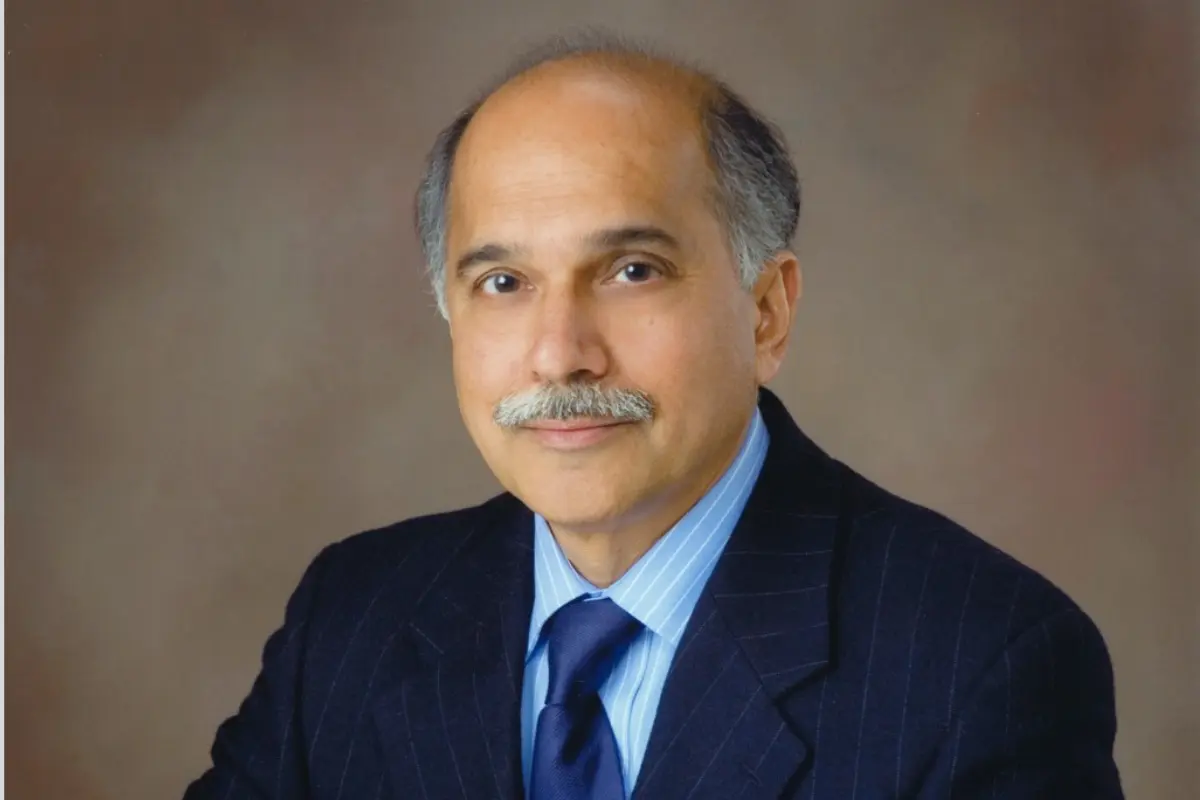
There are some individuals whose lives remind us that intellect, when combined with passion, can move not just mountains—but entire fields of human understanding. Ramamurti Shankar is one of those rare torchbearers. Born on April 28, 1947, in a Tamil family that breathed science and scholarship, he grew into a thinker whose ideas reshaped quantum physics, condensed matter theory, and even the way the world learns physics.
Ramamurti Shankar: A Childhood Rooted in Ideas and Inspiration
Growing up in a home where scientific discussion was part of daily life, Ramamurti Shankar found inspiration early on. His elder brother, Ramamurti Rajaraman, was already emerging as a respected theoretical physicist, and young Shankar absorbed the environment of inquiry that surrounded him.
Instead of simply following footsteps, he carved his own. He pursued a B.Tech. in Electrical Engineering at IIT Madras, one of India’s most prestigious institutions. Yet even as he mastered engineering, theoretical physics beckoned. The universe’s deep symmetry, quantum mysteries, and mathematical elegance drew him into a world where intuition gives way to rigor and imagination works hand-in-hand with logic.
From IIT Madras to Berkeley: Crafting a Physicist of Rare Depth
In pursuit of deeper understanding, Ramamurti Shankar moved to the University of California, Berkeley, where he earned his Ph.D. in theoretical particle physics in 1974. At Berkeley, he specialized in S-matrix theory, tackling the profound structures underlying particle interactions.
His early work revealed not only technical mastery but also a daring intellect—one unafraid to go after the hard problems or challenge long-held assumptions.
These qualities earned him a coveted position as a Junior Fellow at the Harvard Society of Fellows, making him only the second Indian after S. Chandrasekhar to achieve this honor. Harvard gave him the freedom to explore ideas without constraints—freedom he used to push the limits of quantum theory alongside stalwarts like Edward Witten.
Ramamurti Shankar: A Home at Yale: Four Decades of Impact and Innovation
In 1977, Ramamurti Shankar joined Yale University, a place that would become the core of his professional life. Over the next four decades, he held major leadership roles, including Chair of the Physics Department (2001–2007), and ultimately earned the title of Josiah Willard Gibbs Professor of Physics, one of Yale’s highest academic honors.
But titles alone cannot capture his influence. What truly sets him apart is the breadth and depth of his contributions.
A Mind That Wandered Through the Quantum World—and Left Landmarks Everywhere
Throughout his career, Ramamurti Shankar followed his intellectual instincts into multiple domains of physics. Each time, he left behind ideas that shaped the direction of research for years to come.
Early Work: Particle Physics and Exact S-Matrix Theories
His early collaborations with Edward Witten on two-dimensional field theories and exact S-matrices helped sharpen foundational tools used across quantum theory.
The Gross–Neveu Model and the Discovery of Self-Triality
He discovered a remarkably elegant transformation within the Gross–Neveu model—an insight so profound that Witten used it to establish world-sheet supersymmetry in string theory.
Statistical Mechanics and Random Systems
In partnership with G. Murthy, Shankar developed exact solutions to systems plagued by randomness—problems notorious for subtle behavior and conflicting interactions. These solutions became valuable tools in understanding disorder in physical systems.
Renormalization Group and Fermi Liquids
Shankar revolutionized the way physicists understand Fermi systems by reimagining renormalization group techniques in the presence of a Fermi surface. His work provided clarity to Landau’s notoriously complex Fermi liquid theory.
Fractional Quantum Hall Effect and Composite Fermions
In one of his most influential bodies of work, he helped create a Hamiltonian formulation of the Fractional Quantum Hall Effect, enabling calculations of real experimental quantities—gaps, temperatures, polarizations, relaxation rates—and connecting electronic variables to composite fermions with unprecedented clarity.
Topological Insulators and Beyond
As the world of physics moved into the realm of topology, Shankar leaned into the frontier with characteristic enthusiasm, contributing to the theoretical roots of systems that would later revolutionize materials science.
The Teacher Who Made the World Fall in Love with Physics
If research built his reputation, teaching built his legend.
A self-described “compulsive pedagogue,” Ramamurti Shankar believes physics is not a fortress but a playground—and everyone is invited inside. He has delivered public lectures on relativity, quantum mechanics, and classical physics with a clarity that students cherish and professionals admire.
His Open Yale Courses, freely available on YouTube, have been viewed over 40 million times—turning him into one of the most beloved physics teachers in the world.
To many, he is not just a professor—he is the voice that first made the universe make sense.
Author of Some of the Most Influential Physics Texts of Our Time
Shankar’s books are widely celebrated for their clarity and intellectual honesty:
-
Principles of Quantum Mechanics – a modern classic
-
Basic Training in Mathematics – a guide loved by aspiring theorists
-
Fundamentals of Physics I & II – a fresh take on introductory physics
-
Quantum Field Theory and Condensed Matter – bridging two complex worlds
Translated into Polish, Greek, and Chinese, these works have shaped the thinking of countless students around the globe.
Honors, Recognitions, and Leadership
Over the years, Ramamurti Shankar has received several prestigious awards:
-
A.P. Sloan Fellowship
-
Julius Edgar Lilienfeld Prize of the American Physical Society
-
Harwood Burns–Richard Sewell Teaching Prize at Yale
He is a Fellow of the American Physical Society and the American Academy of Arts and Sciences, and has served on influential scientific boards, editorial committees, and visiting professorships around the world.