
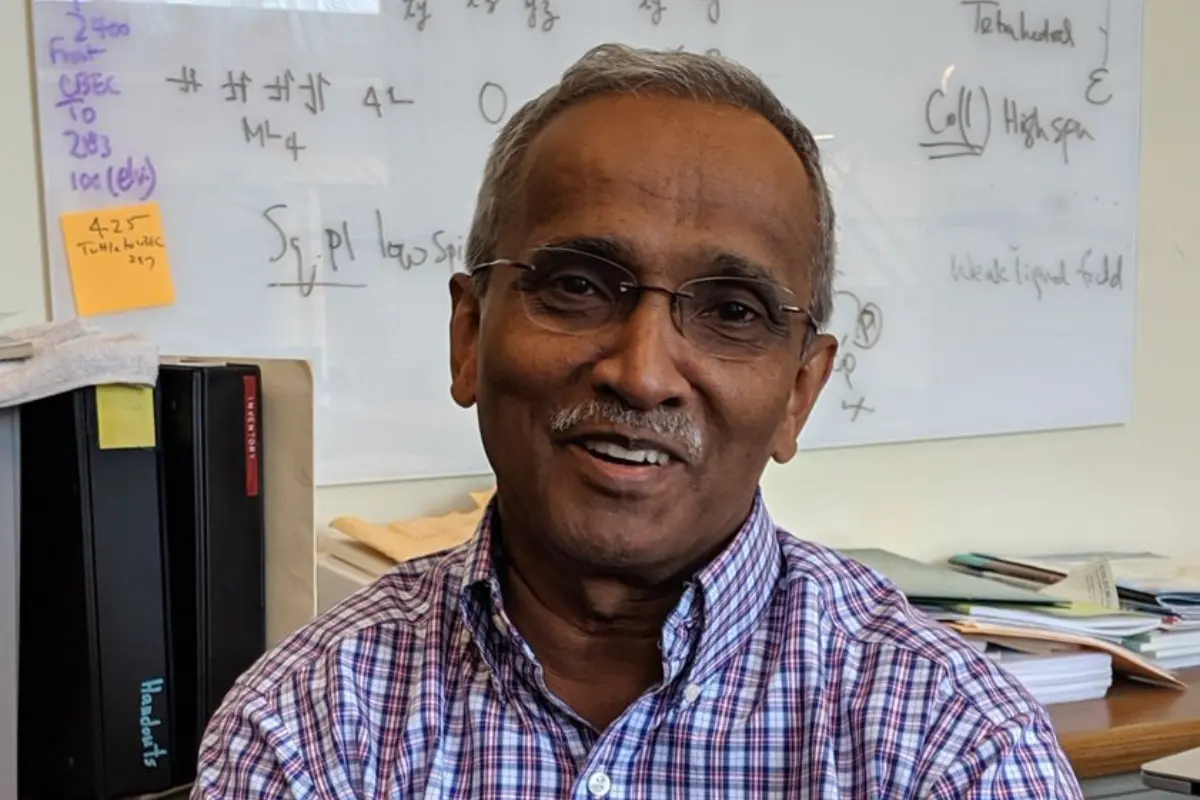
The scientific journey of RajanBabu began in India, where his early education laid the intellectual foundation for a life devoted to chemistry. He earned his Bachelor of Science (Special) degree from Kerala University in 1969, followed by a Master’s degree from the Indian Institute of Technology (IIT), Madras in 1971. These formative years were marked by academic distinction and a growing fascination with molecular structure and reactivity.
Driven by a desire to explore chemistry at its deepest theoretical and practical levels, RajanBabu pursued doctoral studies in the United States. He obtained his Ph.D. from The Ohio State University, working under the guidance of Professor Harold Shechter, where he developed a strong grounding in mechanistic organic chemistry and innovative synthesis.
His academic training reached its pinnacle during his postdoctoral fellowship at Harvard University, where he worked with the legendary Professor R. B. Woodward, one of the most influential chemists of the twentieth century. During this period, RajanBabu contributed to the total synthesis of erythromycin, an achievement that sharpened his mastery of complex molecular architecture and reinforced his commitment to excellence in synthetic design.
RajanBabu: Industrial Excellence at DuPont Central Research
Before entering academia, RajanBabu spent 15 highly productive years at DuPont Central Research, one of the world’s most prestigious industrial research environments. Joining DuPont in 1980, he quickly distinguished himself as a creative and disciplined scientist capable of bridging fundamental chemistry with real-world applications.
His rise to the rank of Research Fellow, the highest technical position at DuPont, reflected both his scientific leadership and his ability to deliver transformative solutions. During this period, RajanBabu gained invaluable experience in applied catalysis, scalable synthesis, and industrial innovation—skills that would later define his academic research philosophy.
Return to Ohio State University and Academic Leadership
In 1995, RajanBabu returned to The Ohio State University as a professor of chemistry, bringing with him a rare blend of industrial insight and academic depth. He later became the Leet Endowed Chair in Chemistry, a recognition of his scholarly excellence and international reputation.
At OSU, he established the RajanBabu Group, a research laboratory dedicated to the development of transition metal-catalyzed reactions for stereoselective synthesis. Under his leadership, the group became a global hub for innovation in asymmetric catalysis, attracting talented researchers from around the world.
RajanBabu: The Nugent-RajanBabu Reagent – A Landmark Contribution
One of the most enduring scientific legacies of RajanBabu is his co-development of the Nugent-RajanBabu reagent, formally known as Bis(cyclopentadienyl)titanium(III) chloride. This reagent revolutionized synthetic organic chemistry by enabling single-electron reduction processes with exceptional control and reliability.
Widely adopted by academic and industrial laboratories, the Nugent-RajanBabu reagent opened new pathways for radical chemistry, epoxide opening reactions, and complex cyclizations. Its continued relevance decades after its introduction is a testament to RajanBabu’s ability to create tools that stand the test of time.
Pioneering Research in Asymmetric Catalysis
The core of RajanBabu’s scientific vision lies in asymmetric catalysis, particularly the formation of carbon–carbon and carbon–hydrogen bonds with precise stereochemical control.
Asymmetric Hydrovinylation
RajanBabu developed transformative methodologies for metal-catalyzed asymmetric hydrovinylation, employing chiral phosphine ligands with hemilabile coordinating groups. These reactions enabled efficient C–C bond formation using substrates such as vinylarenes, dienes, and strained olefins.
This chemistry found powerful applications in the synthesis of biologically important molecules, including (S)-ibuprofen, as well as complex natural products like pseudopterocins and helioporin D. His work demonstrated how elegant catalysis can translate directly into practical and scalable synthesis.
Asymmetric Hydrocyanation
Another major research thrust of the RajanBabu laboratory involved nickel-catalyzed asymmetric hydrocyanation. By carefully tuning phosphine ligand electronics, his group achieved remarkable enantioselectivity in reactions of vinylarenes with hydrogen cyanide.
Innovatively, RajanBabu introduced sugar-derived ligands, such as those based on D-glucose and D-fructose, to fine-tune catalyst behavior—an approach that elegantly combined sustainability, accessibility, and high performance.
Radical Chemistry and Multicomponent Cyclizations
RajanBabu has also made seminal contributions to radical epoxide opening reactions and multicomponent cyclization strategies. His palladium-catalyzed methodologies enabled the construction of complex carbocyclic and heterocyclic frameworks from simple, acyclic precursors.
By exploiting bifunctional reagents and transition-metal reactivity, these methods allowed rapid molecular diversification and efficient access to structurally dense compounds, including highly alkylated indolizidines such as IND-223A.
Innovation Beyond Traditional Boundaries
Beyond his signature research areas, RajanBabu’s intellectual curiosity led him to explore:
-
Asymmetric aziridine openings using lanthanide and yttrium salen complexes
-
Water-soluble rhodium catalysts, enabling reactions in environmentally friendly aqueous media
-
New paradigms for stereoselective synthesis beyond nature’s chiral pool
Each of these efforts reflects his belief that chemistry must evolve continuously—technically, environmentally, and conceptually.
Publications, Patents, and Global Impact
RajanBabu’s scholarly output is both prolific and influential. He has authored over 160 peer-reviewed publications, co-written authoritative reviews, and holds multiple patents. His work has been cited more than 15,000 times, underscoring its foundational role in modern organic chemistry.
With an H-index exceeding 50, his research continues to shape academic curricula, industrial practices, and future scientific inquiry worldwide.
RajanBabu: Awards and Recognition
Among numerous honors, RajanBabu received the prestigious Arthur C. Cope Scholar Award (2020) from the American Chemical Society, recognizing his exceptional contributions to organic chemistry. He has also been named an Arts and Sciences Distinguished Professor, reflecting his profound impact on research, teaching, and institutional leadership.