
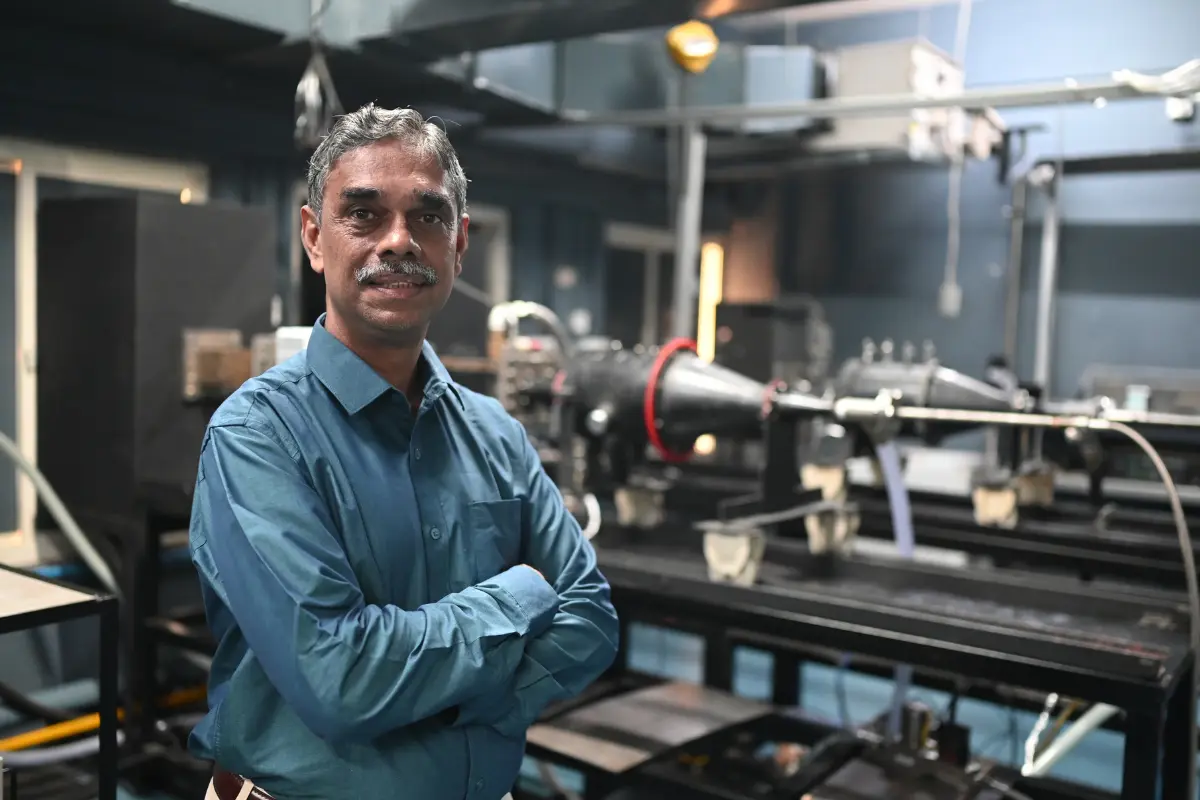
Some individuals spend their lives studying the world. A rare few, however, reshape how the world itself is studied. R. I. Sujith belongs unmistakably to the second category—a mind that rewrote the language of combustion science and transformed our understanding of complex systems with uncommon clarity, courage, and curiosity.
Born on 11 May 1967 in Thiruvananthapuram, Kerala, Sujith grew up with the quiet confidence of someone who intuitively knew that science could not merely explain the world but could elevate it. His early fascination with aerodynamics and propulsion guided him toward the Aerospace Engineering program at IIT Madras, an institution that would later become synonymous with his life’s work.
After graduating with his B.Tech, Sujith set off on a transformative academic journey that took him across the world to the Georgia Institute of Technology, where he earned his M.S. in 1990 and Ph.D. in 1994 under the mentorship of the legendary Ben T. Zinn.
His doctoral work on the behavior of droplets in axial acoustic fields laid the foundation for what would become his scientific signature: the ability to uncover hidden patterns in seemingly chaotic systems.
R I Sujith: A Pioneer in Thermoacoustic Instability
One of the enduring contributions of R. I. Sujith is his pioneering research on thermoacoustic instability, a phenomenon that has challenged the aerospace and energy industries for decades. While earlier studies treated combustion noise as a random disturbance, Sujith was the first to demonstrate that these low-amplitude, aperiodic pressure fluctuations are not random at all—they are deterministic and chaotic.
This insight alone opened a new dimension in combustion research, but Sujith’s scientific curiosity didn’t stop there.
He uncovered that combustion noise exhibits multifractality, a property that dissolves when the system approaches instability. He identified intermittency as the intermediate phase in the transition to instability and even drew a powerful analogy between the onset of oscillatory instabilities and Bose–Einstein condensation, providing universal scaling laws that have influenced a wide spectrum of engineering systems.
These discoveries did not merely solve isolated problems—they forged an entirely new way of studying dynamical transitions, one that has inspired researchers worldwide.
Introducing Complex Networks to Combustion Science
Perhaps one of Sujith’s most revolutionary contributions was his introduction of complex network theory to thermoacoustic systems. By applying network tools to acoustic and combustion data, he revealed how subtle structural changes in network topology could signal the early onset of impending instability.
This breakthrough opened the door to early-warning systems for gas turbines and combustors—an achievement with massive industrial and environmental implications. His exploration extended into chimera states, R-tipping, synchronization theory, amplitude death, partial amplitude death, and phase-flip bifurcation, establishing him as a global leader in complex systems research.
R I Sujith: A Life Dedicated to Knowledge and Leadership
After completing his postdoctoral fellowship at Georgia Tech in 1995, Sujith returned to IIT Madras as a young lecturer. Over the decades, he rose to become:
-
Institute Professor
-
D. Srinivasan Chair Professor
-
Head of the Center of Excellence for Critical Transitions in Complex Systems (CTCS)
His leadership has inspired generations of researchers and students who continue to build on his imagination-driven approach to scientific discovery.
Global Recognition and Exceptional Honours
The world has not been slow to recognise the influence of R. I. Sujith. His remarkable list of accolades includes:
-
International Member, U.S. National Academy of Engineering (2023) – one of the highest honours in engineering, and Sujith is only the second Indian ever elected to its Aerospace Section.
-
Fellow of the Combustion Institute (2022)
-
Distinguished Fellow, International Institute of Acoustics and Vibration (2021)
-
J.C. Bose Fellowship (2019)
-
Swarnajayanti Fellowship (2005)
-
Hans Fischer Senior Fellowship, TUM Institute for Advanced Study
-
Alexander von Humboldt Fellowship (2000)
-
Fellowships in Indian Academy of Sciences, Indian National Academy of Engineering, American Institute of Aeronautics and Astronautics (Associate Fellow), and ISSE
He also served as the founding Editor-in-Chief of the International Journal of Spray and Combustion Dynamics and currently sits on the advisory board of Chaos: An Interdisciplinary Journal of Nonlinear Science.