
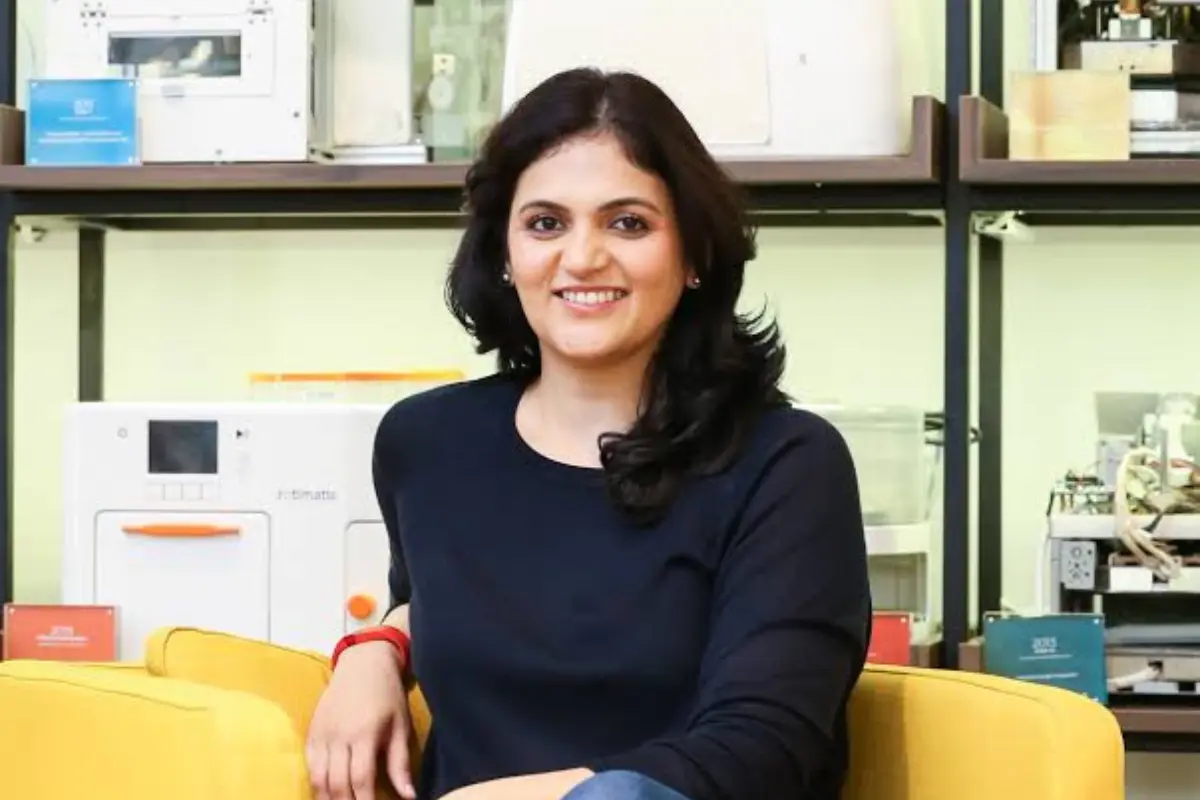
In a world where convenience is king and innovation rules, one woman dared to take on a challenge that generations had silently accepted — the labour-intensive task of making rotis. That woman is Pranoti Nagarkar-Israni, a trailblazing mechanical engineer, industrial product designer, and entrepreneur who created Rotimatic, the world’s first fully automatic roti-making robot. Her journey from a curious child in Pune to the acclaimed inventor of Rotimatic is not only revolutionary but deeply inspiring.
Pranoti Nagarkar: Born to Build, Designed to Innovate
Raised in Pune, Pranoti Nagarkar comes from a family that boasts four generations of engineers. Her childhood was a canvas of logic, creativity, and purposeful play. Her father was a machine design expert turned entrepreneur, while her mother—an interior designer, painter, and later a math teacher—instilled a sense of curiosity and courage in her daughter.
The household thrived on the principle of “High thinking, simple living,” an ideology that shaped Pranoti’s grounded approach to life and work. Growing up, she didn’t just dream of becoming an engineer — she wanted to invent.
Academic Foundations that Sparked Genius
Pranoti’s academic journey took her to Singapore under the Singapore Airlines Youth Scholarship, where she completed her A levels. She went on to earn a Bachelor’s degree in Mechanical Engineering from the National University of Singapore (NUS) and studied further at UC Berkeley as part of an exchange program. During her undergraduate years, she led a team that created an automatic shirt-ironing prototype for Philips — an achievement that won them the best design award. That taste of innovation planted the seeds for something bigger.
Pranoti Nagarkar: The Birth of a Bold Idea
The initial idea for Rotimatic was born not in a lab, but over a casual brainstorming session with her husband, Rishi Israni. The problem was simple yet profound: in most Indian homes, the daily ritual of making rotis tied one family member—usually the mother or wife—to the kitchen while the rest enjoyed meals together.
Despite the prevalence of modern appliances, no fully automated roti maker existed. Pranoti realized that this everyday problem was a universal one in Indian households and took it upon herself to build a solution. In 2008, she quit her job, dug into her savings, and started developing the first prototype of what would become Rotimatic.
Early Struggles and the Power of Belief
Creating something the world has never seen comes with resistance. Critics scoffed at the idea. Skeptics said it couldn’t be done. Some doubted her because she was a woman in a field still riddled with gender bias. Often mistaken for someone in marketing rather than the engineer behind the product, Pranoti faced stereotypes head-on — riding a 200cc motorcycle to meetings to shatter assumptions.
Her unwavering self-belief became her most valuable asset. “You have to 100% believe in your idea and yourself first,” she said in an interview, highlighting how internal conviction precedes external success.
The Power of Partnership
Pranoti co-founded Zimplistic Pte Ltd in 2008 with her husband Rishi, who handled the software side of Rotimatic. The robot, with 300 unique parts, 10 motors, 15 sensors, and complex firmware, required a marriage of hardware precision and software intelligence. Their complementary skills — her mechanical and industrial expertise and his software genius — were the perfect match.
Together, they raised funds through startup competitions like Start-Up Singapore, which Pranoti won in 2009, giving them both credibility and seed money to grow.
Living Simply, Thinking Big
While developing Rotimatic, the couple lived frugally—surviving on $1,000 a month, sharing apartments, and using bikes for transport. Simplicity was not a sacrifice; it was a choice that gave them clarity and grit.
Their lean approach allowed them to focus every dollar, every hour, and every ounce of energy into perfecting Rotimatic — a machine that could mix, knead, flatten, and roast rotis in minutes, producing up to 20 fresh rotis at a time.
Pranoti Nagarkar: Scaling the Innovation
Today, Zimplistic employs a team of over 30 engineers and professionals across disciplines — mechanical, electrical, firmware, marketing, and more. They even have an in-house chef to foster health and wellness within the team. Pranoti’s brother, an automobile engineer, joined forces to lead manufacturing in Malaysia, further cementing the product’s scalability.
Despite being labeled “the world’s most expensive flatbread maker” by Engadget, Pranoti stands by the product’s pricing. As with any revolutionary product — be it the first computer or washing machine — costs are high in the beginning. But the value Rotimatic brings to homes around the globe is immeasurable: more time for families, healthier eating, and stress-free cooking.
What Drives Her
Pranoti’s passion lies in solving real-world problems through industrial design and mechanical engineering. For her, it’s not just about innovation; it’s about impact at scale. While Zimplistic currently focuses solely on Rotimatic, the long-term vision includes automating other types of flatbreads like tortillas and wraps.
Words of Wisdom for Future Innovators
For young women dreaming of becoming creators, Pranoti’s advice is simple yet powerful:
“Believe in yourself, your idea, and persevere. Build a strong support system. Grow constantly, and enjoy the process.”
Also Read : USCIS Marriage Fraud Policy Targets Fake Spouses