
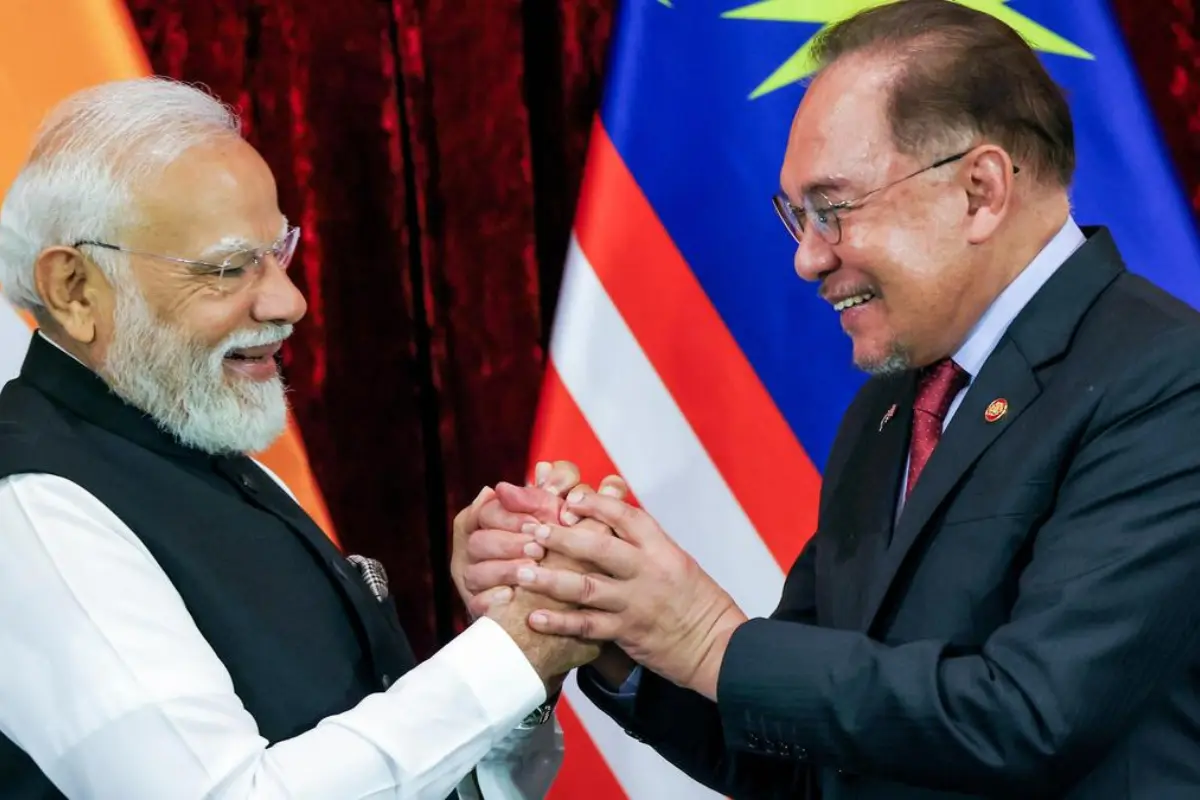
PM Modi Holds Talks with Malaysian PM Anwar Ibrahim
PM Modi, Malaysia Talks Mark New Phase in India–Malaysia Strategic Partnership
PM Modi, Malaysia talks marked a significant step forward in strengthening relations between two influential Asian nations, as Prime Minister Narendra Modi and Malaysian Prime Minister Anwar Ibrahim concluded wide-ranging discussions in Kuala Lumpur. The dialogue spanned political cooperation, defence and security, trade and investment, energy, education, tourism, and regional stability — reflecting the growing depth of a partnership now framed as a Comprehensive Strategic Partnership.
On the final day of Prime Minister Modi’s two-day visit, both countries committed to advancing sixteen agreements and collaborative engagements across multiple sectors. These include disaster management, audiovisual co-production, anti-corruption efforts, and a major focus on semiconductor development — an area increasingly central to global supply chains.
PM Modi: Defence, Security and Counter-Terrorism at the Core
During talks, security cooperation emerged as a key pillar. Prime Minister Modi emphasised that collaboration between India and Malaysia would expand in intelligence sharing, maritime security, defence coordination, and counter-terrorism initiatives. He reiterated India’s uncompromising stance against terrorism, stressing the importance of consistency and collective action in combating global threats.
Given the strategic location of both countries along vital maritime routes, enhanced security cooperation is expected to contribute to greater stability across the Indo-Pacific region.
Trade, Technology and the Digital Economy Drive the Future
Economic collaboration featured prominently throughout the discussions. With Malaysia ranking as India’s third-largest trading partner within ASEAN — and bilateral trade nearing $20 billion — both leaders underscored the need to unlock new growth opportunities.
The Modi Malaysia talks also spotlighted emerging technologies, including artificial intelligence, digital public infrastructure, fintech and cybersecurity. A major outcome was the formalisation of the Malaysia-India Digital Council, designed to accelerate cooperation across the semiconductor ecosystem and digital innovation sectors.
Both sides agreed to pursue cross-border payment linkages, a move expected to simplify business transactions and encourage tourism flows between the two nations.
PM Modi: Semiconductors and Advanced Manufacturing Take Centre Stage
Semiconductor collaboration was described as a cornerstone of future engagement. Officials highlighted a complementary partnership model that combines India’s strength in chip design with Malaysia’s established expertise in manufacturing, assembly, testing and packaging.
Beyond semiconductors, the two countries pledged to expand cooperation in advanced manufacturing, renewable energy, infrastructure development, health technologies and food security — sectors seen as critical to long-term economic resilience.
ASEAN Centrality and Indo-Pacific Stability
Prime Minister Modi reaffirmed India’s commitment to ASEAN centrality, congratulating Malaysia on its leadership role as ASEAN Chair. Both nations agreed to accelerate the review of the ASEAN-India Trade in Goods Agreement, aiming to make regional trade more efficient and mutually beneficial.
The joint statement issued after the talks emphasised the shared objective of maintaining peace, development and stability across the Indo-Pacific. The leaders also welcomed the outcome of the 10th India-Malaysia CEOs’ Forum, which generated fresh ideas for business partnerships and cross-border investments.
Diaspora Engagement and Cultural Connections
Beyond official negotiations, Prime Minister Modi’s visit carried a strong people-to-people dimension. Addressing members of the Indian diaspora at the “Selamat Datang Modi Ji” event in Kuala Lumpur, he announced the opening of a new Indian Consulate and introduced the Thiruvalluvar Scholarship to strengthen educational and cultural exchange.
The Prime Minister also met Persons of Indian Origin and veterans of the Indian National Army, emphasising the deep historical and maritime connections shared by the two nations. He noted that the audiovisual cooperation agreement would encourage collaboration in film, music and creative industries — further strengthening cultural ties.