
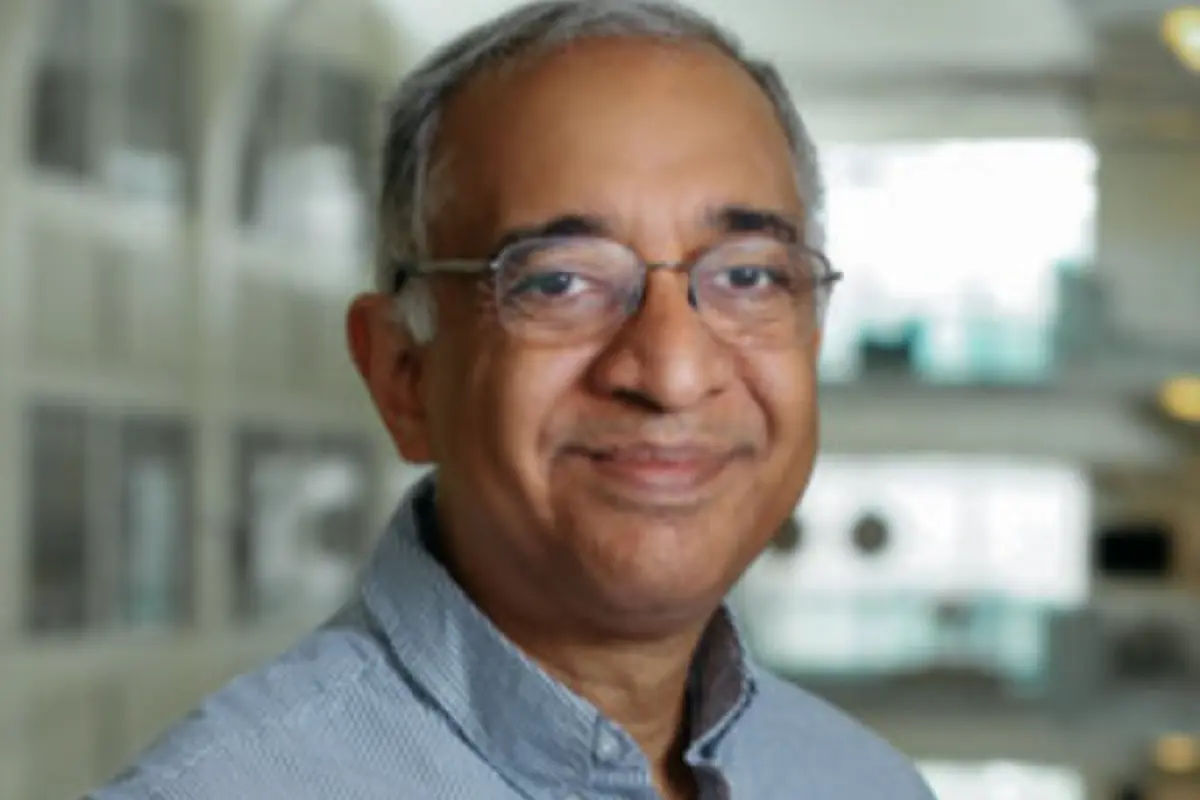
The story of Mohit Randeria is not merely a chronicle of academic accomplishments—it is a testament to curiosity, discipline, and a relentless quest to understand the hidden patterns that govern the universe. Born on March 9, 1958, in New Delhi, he grew up in an India that was dreaming of scientific renaissance. Little did the world know that this young boy, captivated by equations and elegant logic, would one day become one of the most influential voices in theoretical condensed matter physics.
His journey began at IIT Delhi, where he completed his Bachelor’s degree in Electrical Engineering in 1980. While engineering opened the door to problem-solving, physics opened the door to truth. Driven by a deeper calling, he pursued an MS in Physics from Caltech, one of the world’s most demanding scientific environments. That early exposure to cutting-edge research forged a mindset of precision, creativity, and fearless questioning.
By the time he completed his PhD at Cornell University in 1987 under James P. Sethna, he had begun carving out a path that blended bold theoretical frameworks with real-world experimental relevance—an uncommon combination that would define his legacy.
Mohit Randeria: A Scholar Crafting the Future of Condensed Matter Theory
What sets Mohit Randeria apart is not just the volume of his scientific output—over 200 research papers—but the depth and transformative nature of his ideas.
His pioneering contributions to:
-
High-temperature superconductivity
-
Strongly correlated systems
-
BCS-BEC crossover physics
-
Ultracold atomic gases
-
Angle-resolved photoemission spectroscopy (ARPES)
-
Magnetism and nanoscale inhomogeneity in oxides
have become foundational pillars in modern condensed matter and quantum materials research.
He has an extraordinary ability to take complex questions—Why do some materials conduct electricity with zero resistance? How do electrons behave in unconventional superconductors? How do quantum particles transition between paired and unpaired states?—and illuminate them with clarity that pushes the entire field forward.
Today, Google Scholar lists over 223 of his publications, each one a reflection of meticulous thought and groundbreaking insight.
Mohit Randeria: A Career Built on Purpose, Exploration, and Impact
The professional journey of Mohit Randeria mirrors the evolution of modern scientific exploration itself.
After post-doctoral research with Anthony Leggett—who later won the Nobel Prize—Randeria began his academic career at SUNY Stony Brook in 1989. His intellectual hunger soon drew him to the Argonne National Laboratory, where he served as a Staff Scientist in the Materials Science Division.
But India beckoned.
He returned to Mumbai in 1995 to join the Tata Institute of Fundamental Research (TIFR), one of India’s most prestigious scientific institutions. Over nine productive years, he shaped the next generation of physicists, blending rigour with mentorship and helping elevate India’s scientific standing globally.
In 2004, his journey took him back to the United States, where he joined The Ohio State University as a Professor of Physics. It is here that his work flourished even further, earning him global recognition and some of the most respected awards in theoretical physics.
Accolades That Reflect a Life of Excellence
The brilliance of Mohit Randeria is reflected in the long list of prestigious honors bestowed upon him:
-
B.M. Birla Science Prize (1997)
-
Swarnajayanti Fellowship (1998–2003)
-
Shanti Swarup Bhatnagar Prize (2002)
-
ICTP Prize, Trieste (2002)
-
Distinguished Alumni Award, IIT Delhi (2008)
-
Fellow, American Physical Society (2008)
-
John Bardeen Prize (2022)
-
Ohio State University Distinguished Scholar Award (2023)
These are not just awards—they are milestones marking the steady expansion of human understanding through his work.
A Global Voice for Science and Knowledge Sharing
Beyond his research, Mohit Randeria has played a vital role in shaping global scientific discourse. His leadership in organizing major conferences—from the Correlated Quantum Matter workshop to the Many-Body Theories conference—has helped bring together the world’s brightest minds to discuss the future of physics.
His invited talks at Princeton, Oxford, IISc, Max Planck Institutes, and the Kavli Institute for Theoretical Physics stand as a testament to the respect he commands in the global scientific community.