
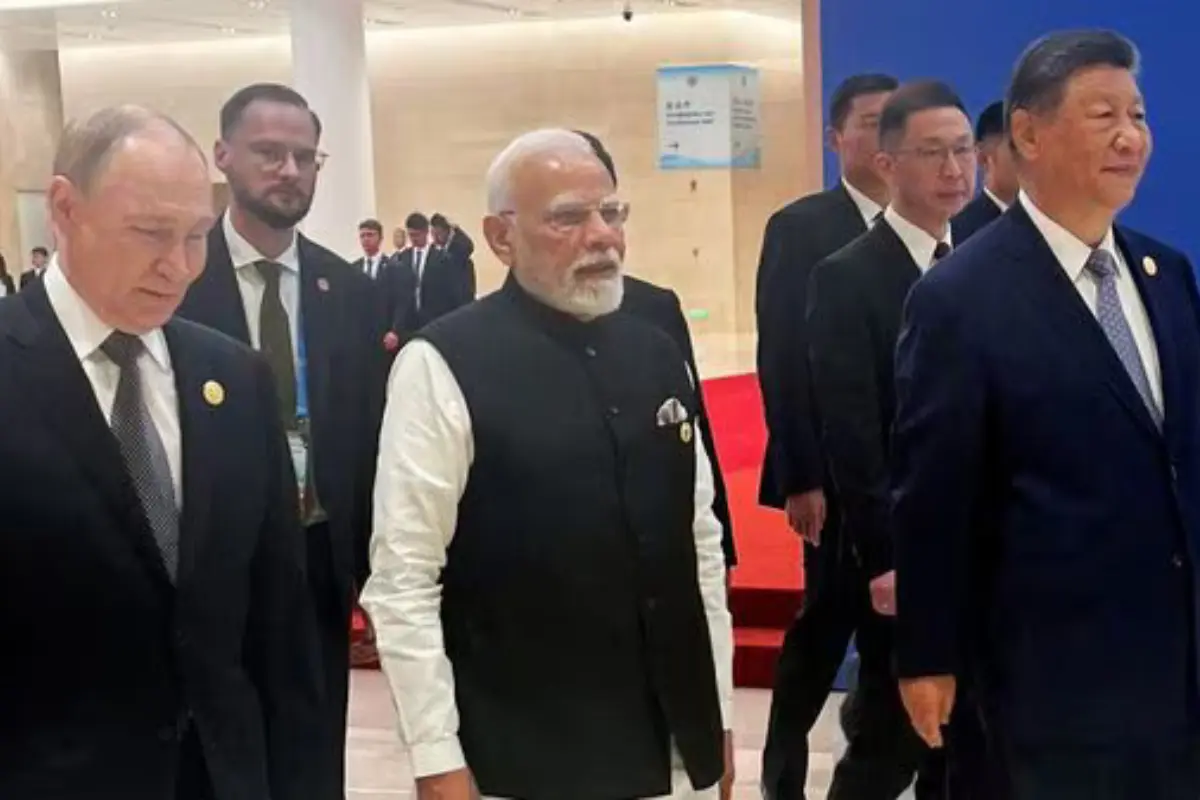
Modi-Xi Summit: Border Talks, Trade Deals & Market Momentum
Modi-Xi Summit 2025: India-China Reset Boosts Stock Market and Trade Hopes
Marking a turning point in Asian geopolitics, Prime Minister Narendra Modi attended the Shanghai Cooperation Organisation (SCO) Summit in Tianjin, his first visit to China in seven years. On the sidelines of the summit, Modi met with Chinese President Xi Jinping, where the two leaders committed to strengthening trade and investment ties, working towards a “fair” resolution of the border issue, and addressing pressing global challenges together.
The Modi-Xi Summit 2025 comes against the backdrop of escalating tariff tensions with the United States, where former President Donald Trump’s steep 50% tariff package on Indian exports has rattled investor confidence. For New Delhi, Beijing, and Moscow, the renewed partnership signals a shift toward regional collaboration at a time of global economic flux.
Adding to the significance, Modi also met Russian President Vladimir Putin, reaffirming India’s enduring partnership with Moscow. Modi emphasized that India and Russia have stood “side by side even in difficult times,” underscoring the trilateral alignment gaining traction in Eurasia.
Stock Market Welcomes Modi-Xi Talks
Indian equity markets opened in September with strong momentum, breaking a three-session losing streak. The Sensex rose 0.7% while the Nifty climbed 0.8%, buoyed by robust Q1 GDP figures, GST rationalisation hopes, and optimism stemming from the India-China thaw.
“Indian markets stayed strong today with Nifty 50 crossing 24,600, supported by robust GDP data that lifted sentiment. Optimism also came from PM Modi’s participation at the SCO Summit in Tianjin, where meetings with Xi Jinping and Putin signalled easing India-China tensions, boosting confidence among investors,” said Pranay Aggarwal, Director and CEO of Stoxkart.
5 Ways the Modi-Xi Summit 2025 Boosts Dalal Street
1. Hedge Against US Tariff Pressures
India’s growing trade friction with Washington has created uncertainty. According to Ajit Mishra, SVP, Research at Religare Broking, closer cooperation with China and Russia provides a vital hedge.
“If China opens its market and reduces trade deficits, while Russia continues energy support, India can absorb the shocks of US tariffs more effectively,” Mishra explained.
2. Reduced Uncertainty in Bilateral Relations
For years, India-China ties were overshadowed by border tensions and Beijing’s support for Pakistan. Analysts say the summit reduces uncertainty and signals stability, offering investors reassurance.
3. Boost for EVs and Renewables
China has assured India of rare earth supplies—critical for EVs and green energy. Shares of Tata Motors surged 3%, while renewable energy firms like Suzlon Energy and Waaree Renewables also posted gains.
4. Multiple Sectors to Gain – From Aviation to Tourism
Closer economic coordination opens new avenues in aviation, tourism, shipping, and logistics. Direct India-China flights, joint ventures in renewable technology, and streamlined Eurasian trade routes are expected to create fresh opportunities across industries.
5. Long-Term Energy Security
India’s heavy reliance on imported crude is being cushioned by discounted Russian oil, now accounting for 35% of total imports. With payments increasingly settled in rupees and yuan, forex pressure is easing, further strengthening India’s macroeconomic stability.
Also Read : Australia: Anti-Immigration Rallies Mostly Targeting Indians