
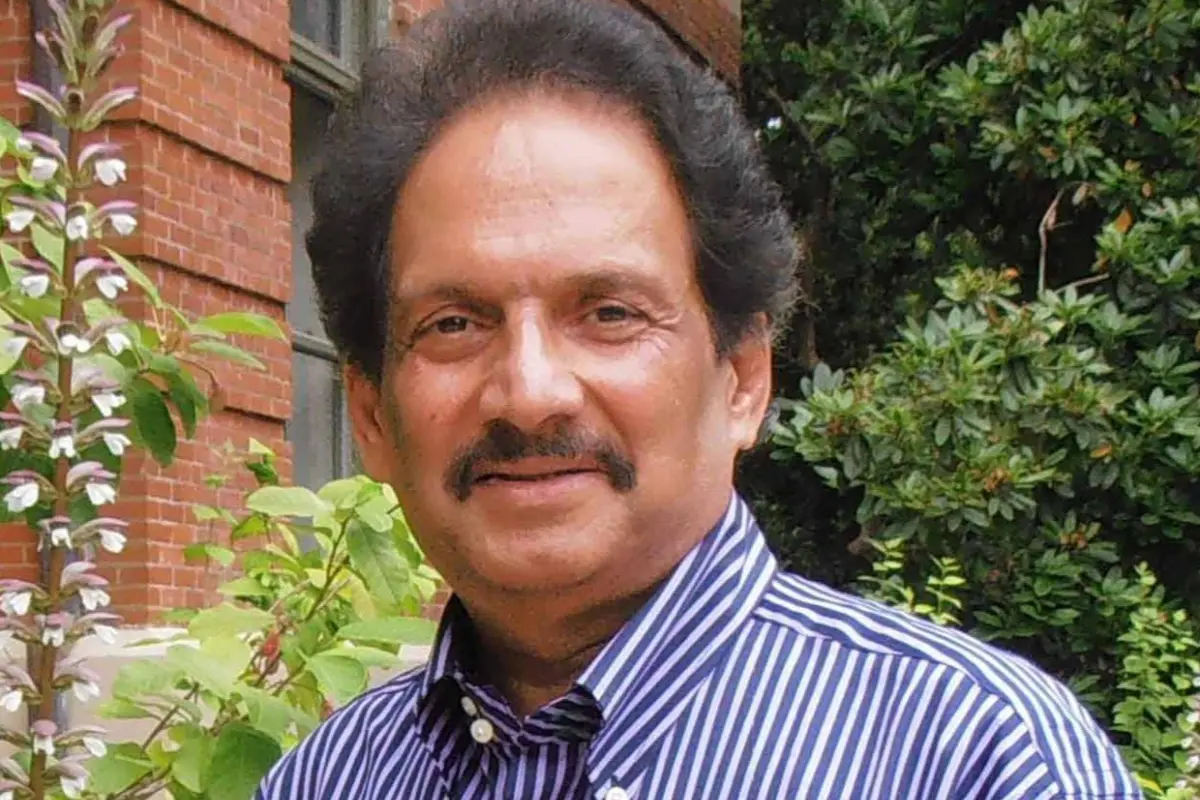
Mas Subramanian was born and raised in Chennai (then Madras), a city known for its deep intellectual traditions and vibrant academic culture. Growing up in post-independence India, he developed an early fascination with how materials behave—how minerals shimmer, alloys transform, and chemical reactions quietly reshape the physical world.
This curiosity led him to the University of Madras, where he earned his Bachelor’s degree in Chemistry in 1975, followed by a Master’s degree in Inorganic Chemistry in 1977. During his postgraduate studies, Mas Subramanian explored minerals and alloys, laying the groundwork for a career that would later bridge chemistry, physics, and engineering.
Mas Subramanian: Doctoral Breakthrough at IIT Madras
In 1982, Mas Subramanian completed his PhD in Solid State Chemistry at the Indian Institute of Technology Madras, working under the mentorship of the legendary scientist G. V. Subba Rao. His doctoral research focused on pyrochlore oxides, a class of materials that exhibit complex structural and electronic behavior.
The introduction to his doctoral thesis—a comprehensive review of pyrochlore chemistry—would go on to become his most cited scientific work, an extraordinary achievement that underscores the depth and clarity of his early thinking. Even decades later, researchers around the world continue to reference this foundational contribution.
Global Exposure and the American Scientific Ecosystem
Following his doctorate, Mas Subramanian joined Texas A&M University as a National Science Foundation Post-Doctoral Fellow from 1982 to 1984, working with Abraham Clearfield, a pioneer in solid-state chemistry. This period exposed him to the collaborative, interdisciplinary research culture of the United States and sharpened his ability to translate theory into application.
Mas Subramanian: DuPont Years – Science Meets Industry
In 1984, Mas Subramanian joined the Central Research and Development Department at the DuPont Experimental Station in Wilmington, Delaware. What followed was a remarkable 22-year industrial research career, culminating in his appointment as a DuPont Research Fellow in 2002—one of the company’s highest scientific honors.
At DuPont, Mas Subramanian worked across an astonishing range of disciplines:
-
Advanced ceramics
-
High-temperature superconductors
-
Colossal dielectric materials
-
Catalysts for Fischer–Tropsch synthesis
-
Thermoelectric materials
-
Magnetoresistive oxides
-
Ionic conductors
-
Fluoroaromatic compounds
His discoveries during this period reshaped industrial materials science, proving that deep fundamental chemistry could coexist with real-world scalability. Few scientists have successfully navigated both academic rigor and industrial relevance with such mastery.
Oregon State University: A New Chapter of Discovery
In 2006, Mas Subramanian joined Oregon State University as the Milton Harris Chair Professor of Materials Science, marking a return to academia with renewed creative freedom. He also became a Signature Faculty Fellow of the Oregon Nanoscience and Microtechnologies Institute (ONAMI) and later served as Director of the OSU Materials Institute from 2006 to 2013.
At OSU, his research expanded into emerging areas critical to the future:
-
Energy-efficient thermoelectrics
-
Environmentally friendly pigments
-
High-K dielectrics
-
Solid fast ion conductors
-
Magnetoresistive and multiferroic materials
-
Topological insulators
The Discovery That Changed Color: YInMn Blue
In 2009, Mas Subramanian and his research team made a discovery that captured global imagination—the creation of YInMn Blue, a brilliant, durable, non-toxic blue pigment composed of yttrium, indium, and manganese oxides.
It was the first new blue pigment discovered in over 200 years, since cobalt blue in 1802.
Unlike traditional blue pigments, YInMn Blue reflects infrared radiation, making it cooler, more durable, and environmentally safe. The discovery bridged chemistry, art, architecture, and sustainability—proving that fundamental materials science could transform everyday life.
The pigment gained worldwide attention, featuring in major media outlets and drawing interest from Nike, Crayola, museums, architects, and designers. Mas Subramanian’s public lectures—including TEDxSalem and TEDxUNC—introduced millions to the idea that science could be both beautiful and practical.
A Global Scientific Voice
Beyond his laboratory achievements, Mas Subramanian is a globally respected scientific leader. He has delivered over 200 invited lectures worldwide and has served on the editorial boards of leading journals such as:
-
Journal of Materials Chemistry
-
Chemistry of Materials
-
Materials Research Bulletin
-
Journal of Solid State Chemistry
He continues to serve as Editor of Solid State Sciences and Progress in Solid State Chemistry, shaping the future direction of materials research across continents.
Mas Subramanian: Honors That Reflect a Lifetime of Impact
Mas Subramanian’s career has been recognized with numerous prestigious honors, including:
-
American Chemical Society National Award in Inorganic Chemistry (2025)
-
Fellow, Neutron Scattering Society of America (2024)
-
Fellow, American Association for the Advancement of Science (2018)
-
Perkin Medal (2019)
-
University Distinguished Professor, Oregon State University (2019)
-
NSF Creativity Award (2012)
-
DuPont Charles Pedersen Medal (2004)