
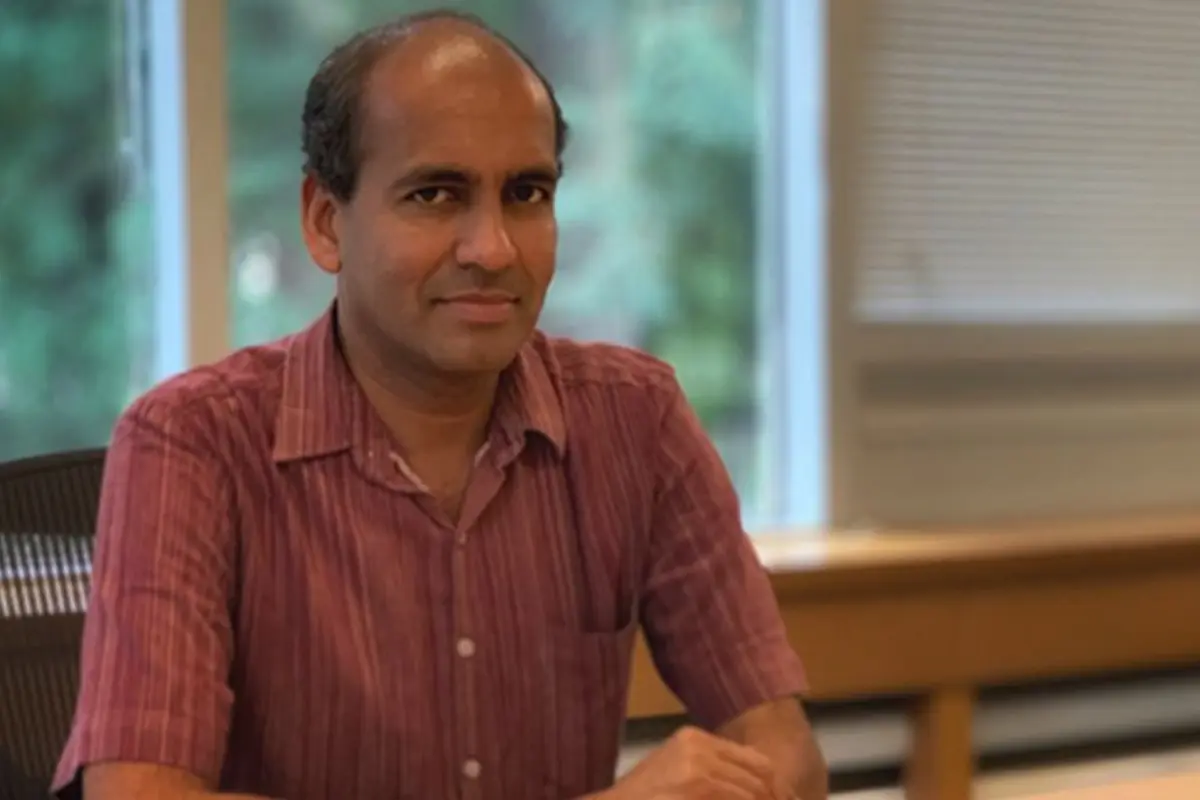
In an era marked by escalating geopolitical tensions, accelerating climate crises, and widening social inequalities, few voices resonate with the clarity, courage, and intellectual depth of M V Ramana. A physicist by training, a scholar by practice, and a global advocate by conviction, Ramana has built a career that stands as a testament to the power of knowledge applied with conscience.
As the Simons Chair in Disarmament, Global and Human Security and a Professor at the University of British Columbia, Ramana brings a rare blend of scientific expertise and policy insight to some of humanity’s most daunting challenges. He also serves as the Director of the Masters of Public Policy and Global Affairs program, shaping future leaders who will steward the world toward peace and sustainability.
M V Ramana: A Journey Rooted in Science, Elevated by Purpose
Ramana’s story began with an unshakeable fascination for physics. He completed his PhD from Boston University in 1994, a foundation that propelled him into post-doctoral research at both the University of Toronto and the Center for International Studies at MIT. These formative years cemented his reputation as a scientist capable of bridging technical precision with global issues.
Over the decades, his work has taken him through some of the most respected scientific and policy institutions in the world:
-
Princeton University’s Nuclear Futures Laboratory
-
Program on Science and Global Security (SGS), Princeton
-
Centre for Interdisciplinary Studies in Environment and Development, Bangalore
-
International Panel on Fissile Materials
-
Canadian Pugwash Group
-
International Nuclear Risk Assessment Group
-
World Nuclear Industry Status Report team
These affiliations reflect not only his expertise, but also his commitment to elevating public discourse on nuclear policy, environmental sustainability, and human security.
In Spring 2024, Ramana returned to Princeton SGS as a visiting researcher—a homecoming to one of the intellectual communities that helped shape his early worldview.
Scholarship That Challenges Powerful Narratives
One of the defining strengths of M V Ramana is his ability to demystify complex technical issues and translate them into insights that influence public policy.
His books, including
“The Power of Promise: Examining Nuclear Energy in India” (2012)
and the forthcoming
“Nuclear is Not the Solution: The Folly of Atomic Power in the Age of Climate Change” (2024),
have become essential reading for those seeking clarity on nuclear energy, safety, economics, and geopolitics.
He also co-edited “Prisoners of the Nuclear Dream” (2003), a book that continues to inform debates on nuclear technologies and their human implications.
Through his work, Ramana consistently questions assumptions—particularly those that legitimize large-scale military spending and nuclear infrastructure in democratic societies. His research probes critical questions:
-
Why do nuclear weapons programs continue to enjoy political legitimacy?
-
How are vast budgets justified when nations face urgent social, economic, and environmental challenges?
-
How does a growth-centric global economy constrain humanity’s ability to address climate and ecological crises fairly?
These inquiries are not abstract—they challenge deeply entrenched systems that shape the lives of billions.
M V Ramana: Explaining Nuclear Risks with Extraordinary Clarity
Ramana is widely admired for his accessible explanations of nuclear risk, exemplified by his analyses of the Fukushima Daiichi disaster. He breaks down complex science into understandable narratives: meltdowns, hydrogen explosions, radionuclide release, and long-term contamination—while comparing it with incidents like Chernobyl and Three Mile Island.
His insights go far beyond disaster analysis. He offers clear-eyed assessments of:
-
the shrinking share of nuclear energy in global electricity
-
rising costs of construction and maintenance
-
competition from cheaper renewable technologies
-
public perceptions shaped by real-world failures
-
the impossibility of building fully risk-free reactors
This ability to merge science with public communication has made him a sought-after global expert.
Awards That Celebrate Excellence and Courage
The world has taken notice of Ramana’s contributions. His accolades include:
-
Guggenheim Fellowship (2003) – honoring innovative scholarship
-
Leo Szilard Award by the American Physical Society (2014) – for outstanding contributions to nuclear policy and peace
-
Distinguished Lecturer, Sigma Xi Society (2017–18) – highlighting his influence as a communicator of science