
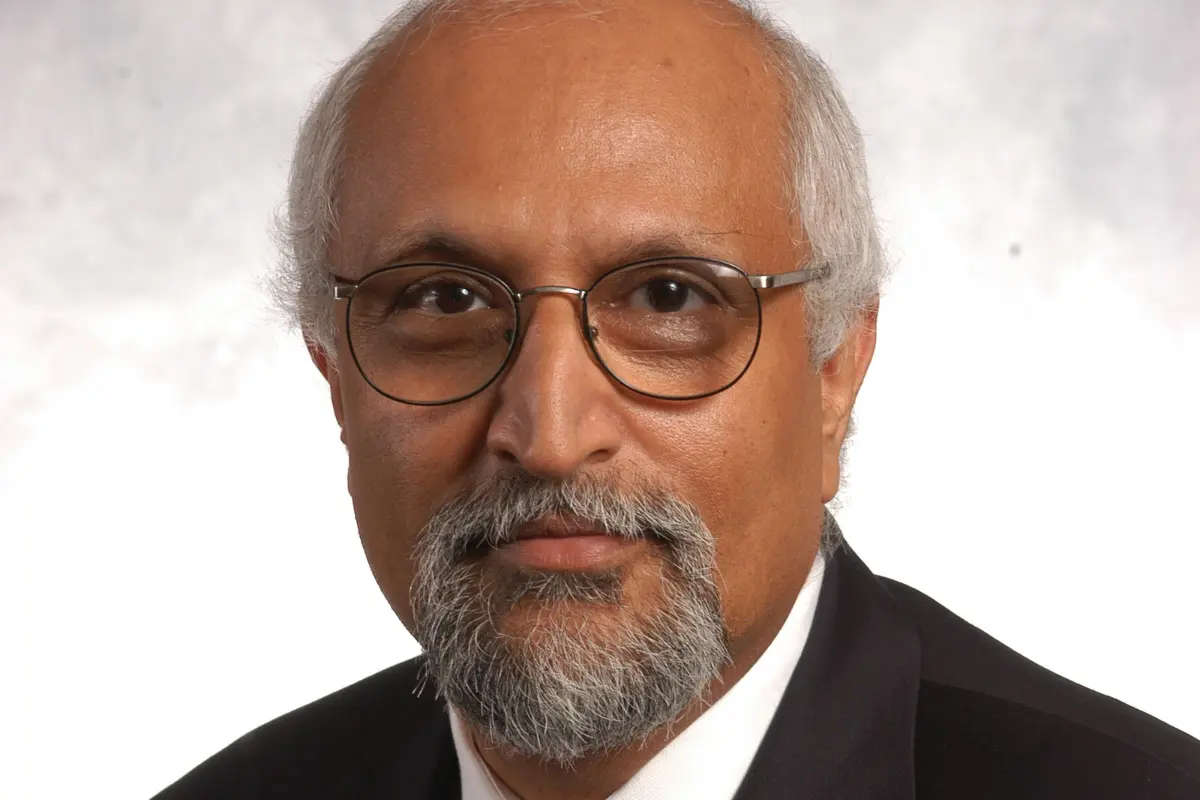
Born in Delhi, India, on November 24, 1950, Kumbakonam Ramamani Rajagopal grew up in a family deeply rooted in scholarship and public service. His maternal grandfather, V. S. Sundaram, authored The Law of Income Tax in India, one of the earliest comprehensive texts on Indian taxation laws. His father, K. R. Ramamani, was a distinguished tax lawyer in Chennai.
Surrounded by rigorous thinking and disciplined reasoning, Rajagopal developed a natural affinity for analytical thought. Yet his intellectual journey would take him far beyond law and governance—into the fascinating realm of mechanics and mathematical modeling.
He earned his B.Tech. in Mechanical Engineering from the prestigious Indian Institute of Technology, Madras, in 1973. Determined to deepen his expertise, he moved to the United States, completing his M.S. in Aerospace and Mechanical Engineering from the Illinois Institute of Technology in 1974. His academic ascent culminated in a Ph.D. in mechanics from the University of Minnesota in 1978—a milestone that marked the beginning of an extraordinary scholarly career.
Kumbakonam Ramamani Rajagopal: Academic Journey – From Young Scholar to Global Authority
After completing his doctorate, Kumbakonam Ramamani Rajagopal began his academic career as a postdoctoral lecturer and fellow at the University of Michigan (1978–1980). His brilliance and clarity of thought quickly distinguished him.
In 1980, he joined the Catholic University of America as an assistant professor. By 1982, he moved to the University of Pittsburgh, where he would serve in multiple departments—including Mechanical Engineering, Mathematics, and Surgery—until 1995. This interdisciplinary engagement reflected a hallmark of his career: intellectual boundaries were meant to be crossed, not guarded.
At Pittsburgh, he held the James T. MacLeod Professorship and received the President’s Distinguished Research Award in 1991—early recognition of his growing global influence.
In 1996, Rajagopal joined Texas A&M University as the Forsyth Chair and Professor in Mechanical Engineering. His tenure there was transformative. Over the years, he held appointments in Biomedical Engineering, Chemical Engineering, Civil Engineering, Mathematics, and Ocean Engineering—an extraordinary testament to his versatility.
By 2003, he was named University Distinguished Professor. In 2008, he became a Regents Professor, one of the highest academic honors at the institution. His intellectual stature was further cemented through his collaboration with Clifford Truesdell on the textbook An Introduction to the Mechanics of Fluids (2000), a work that continues to guide students and researchers.
Beyond the United States, Kumbakonam Ramamani Rajagopal held honorary and adjunct positions at Charles University (Czech Republic), the University of Pretoria (South Africa), the University of Witwatersrand (South Africa), and IIT Madras (India). His scholarship was global, his influence universal.
Research Excellence: Expanding the Frontiers of Continuum Mechanics
The research contributions of Kumbakonam Ramamani Rajagopal reshaped modern continuum mechanics. His work was not incremental—it was foundational.
1. Non-Newtonian Fluid Mechanics
Rajagopal made pioneering contributions to understanding non-Newtonian fluids—materials whose viscosity changes under applied stress. Unlike water or air, these fluids behave in complex, often counterintuitive ways.
He developed constitutive models capable of describing shear-thinning and viscoelastic materials with mathematical precision. His studies on the flow of non-Newtonian fluids between rotating disks provided deep insights into rheological behavior, influencing both industrial processing and biomedical modeling.
2. Thermodynamic Frameworks for Complex Fluids
Recognizing the limitations of classical models, he constructed thermodynamic frameworks for rate-type fluid models, especially for viscoelastic fluids lacking instantaneous elasticity. His formulations captured critical phenomena such as creep and stress relaxation—key behaviors in polymers and biological tissues.
3. Electrorheological Materials
Rajagopal advanced the mathematical modeling of electrorheological materials—substances whose mechanical properties change under electric fields. His theoretical frameworks provided clarity to a field rich with technological promise, from smart dampers to adaptive systems.
4. Biomechanics and Blood Flow Modeling
In biomechanics, Kumbakonam Ramamani Rajagopal applied his mastery of fluid mechanics to model blood flow and soft tissue behavior. His work helped deepen scientific understanding of how biological materials respond to stress, strain, and dynamic forces—contributions that resonate in medical research today.
5. Implicit Constitutive Theories
Among his most innovative contributions was the introduction of implicit constitutive theories. By generalizing classical fluid models like Euler and Korteweg fluids, he offered new ways to describe capillarity and complex fluid interactions. This bold rethinking opened fresh pathways in theoretical mechanics.
6. Pressure-Dependent Viscosity and Mathematical Rigor
Rajagopal also tackled fluids whose viscosity depends on pressure—a mathematically challenging domain. His work on the global existence of solutions addressed fundamental theoretical questions while maintaining practical relevance.
7. Rheologically Nonstationary Fluids
He developed differential models for rheologically nonstationary fluids—materials whose properties evolve over time or conditions. This line of inquiry reflected his lifelong commitment to capturing the true complexity of physical systems.
Kumbakonam Ramamani Rajagopal: Honors and Recognition
The global scientific community recognized the extraordinary contributions of Kumbakonam Ramamani Rajagopal.
He received:
-
The Eringen Medal from the Society of Engineering Science (2004)
-
The Werner Medal from the American Society of Mechanical Engineers (2022)
-
The Genesis Award from Texas A&M University (2024)
He was elected Fellow of the American Society of Mechanical Engineers and the Indian National Academy of Engineering. Numerous universities—including the University of Pretoria, Charles University, the University of Perugia, and Gheorghe Asachi Technical University in Iași—conferred honorary degrees upon him.
Frequently listed among the world’s most cited researchers, he also served on editorial boards of more than 30 scientific journals, shaping the direction of mechanical sciences for generations.