
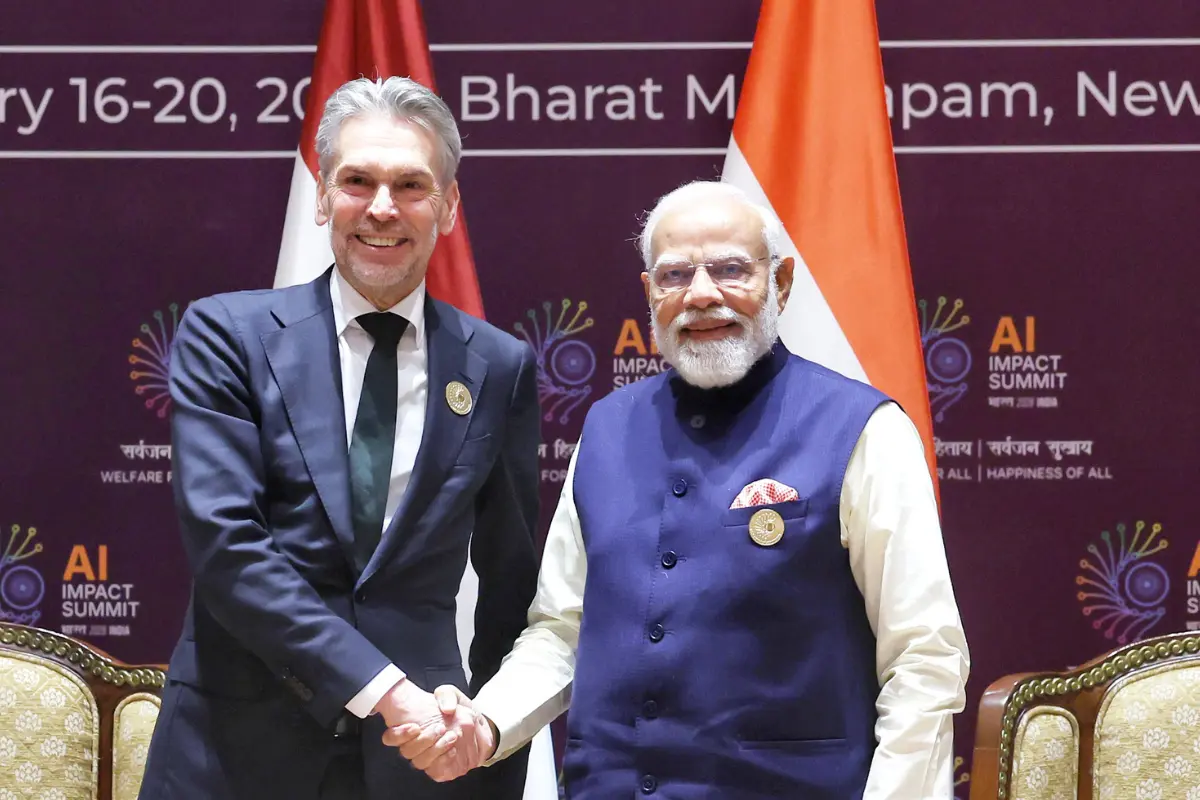
The India-Netherlands AI Partnership moved into sharper global focus as Narendra Modi held a high-level bilateral meeting with Dick Schoof on the sidelines of the AI Impact Summit in New Delhi.
Prime Minister Schoof is leading the Netherlands delegation to the global gathering, marking the first time the AI summit is being hosted in the Global South. The summit has drawn major global leaders including Emmanuel Macron, Pedro Sánchez, and António Guterres, reflecting the growing urgency of shaping international governance for artificial intelligence.
India-Netherlands: A Shared Vision for Responsible AI
During their discussions, Prime Minister Modi thanked his Dutch counterpart for actively participating in the summit and for the Netherlands’ role as Co-Chair of the Working Group on AI for Economic Growth and Social Good. Both leaders agreed that artificial intelligence represents a pivotal moment in technological evolution—one capable of reshaping economies, governance systems, and societies at large.
Schoof underscored his confidence that the Summit Declaration would help steer global policy discussions on AI in the coming years. He also emphasized that countries beyond the US and China must collaborate to create norms for responsible AI development, particularly in a geopolitical landscape defined by technological rivalry.
“The fact that the US and China are not at this conference at the leadership level shows that other countries see the advantage of working together,” Schoof noted at a joint interaction with the media. He added that it is essential for nations to reduce over-dependence and chart their own strategic path in emerging technologies.
The India-Netherlands AI Partnership, leaders said, could serve as a model for value-driven AI—balancing innovation with privacy safeguards, ethical standards, and inclusive growth.
Expanding Cooperation in Emerging Technologies
Beyond AI governance, the two Prime Ministers discussed expanding cooperation in emerging sectors including quantum technologies and semiconductors. Both sides acknowledged that technological self-reliance and collaborative innovation are critical in the current global environment.
Schoof pointed out that Europe seeks greater strategic autonomy while maintaining strong relationships with traditional partners. He stressed the importance of building independent AI capabilities, saying that the AI revolution may mirror the transformative impact of the digital revolution—disrupting workforces but also generating new industries and employment avenues.
“AI will change the workforce, especially in public services,” he observed, while highlighting its immense potential to create new opportunities and economic resilience.
India-Netherlands: India-EU Trade Boost Creates Historic Opportunity
Reviewing the broader bilateral relationship, both leaders welcomed steady progress across sectors and reaffirmed their commitment to deepening ties in Water, Agriculture and Health (WAH), clean energy, green hydrogen, defence and security, education, and people-to-people exchanges.
They agreed that the conclusion of milestone India–European Union Free Trade Agreement negotiations opens a historic window to unlock the full potential of trade and economic engagement between India and the Netherlands.
The India-Netherlands AI Partnership is now seen as a strategic extension of an already strong foundation built on trade, investment, maritime cooperation, renewable energy, and innovation.
Global Security and Multilateral Cooperation
The leaders also exchanged views on pressing regional and international developments. Prime Minister Modi reiterated India’s consistent position on the conflict in Ukraine, emphasizing the need for its earliest possible cessation and a diplomatic resolution.
Both nations reaffirmed their commitment to strengthening the global fight against terrorism and to working together across multilateral platforms to address shared global challenges.
A Call for a New AI Bloc
In a notable remark, Schoof suggested that countries around the world—particularly those outside the US-China AI competition—should come together to form a bloc to develop norms for responsible AI.
He referenced remarks made by Mike Carney at the World Economic Forum in Davos, where Carney called for “middle powers” to unite in shaping a stable global order. While noting that India’s scale and global stature place it beyond the label of a middle power, Schoof said cooperation among like-minded nations is essential.
“We want to use all the opportunities AI offers, but at the same time, we care about values and privacy,” he said, emphasizing the importance of safeguards and ethical frameworks.