
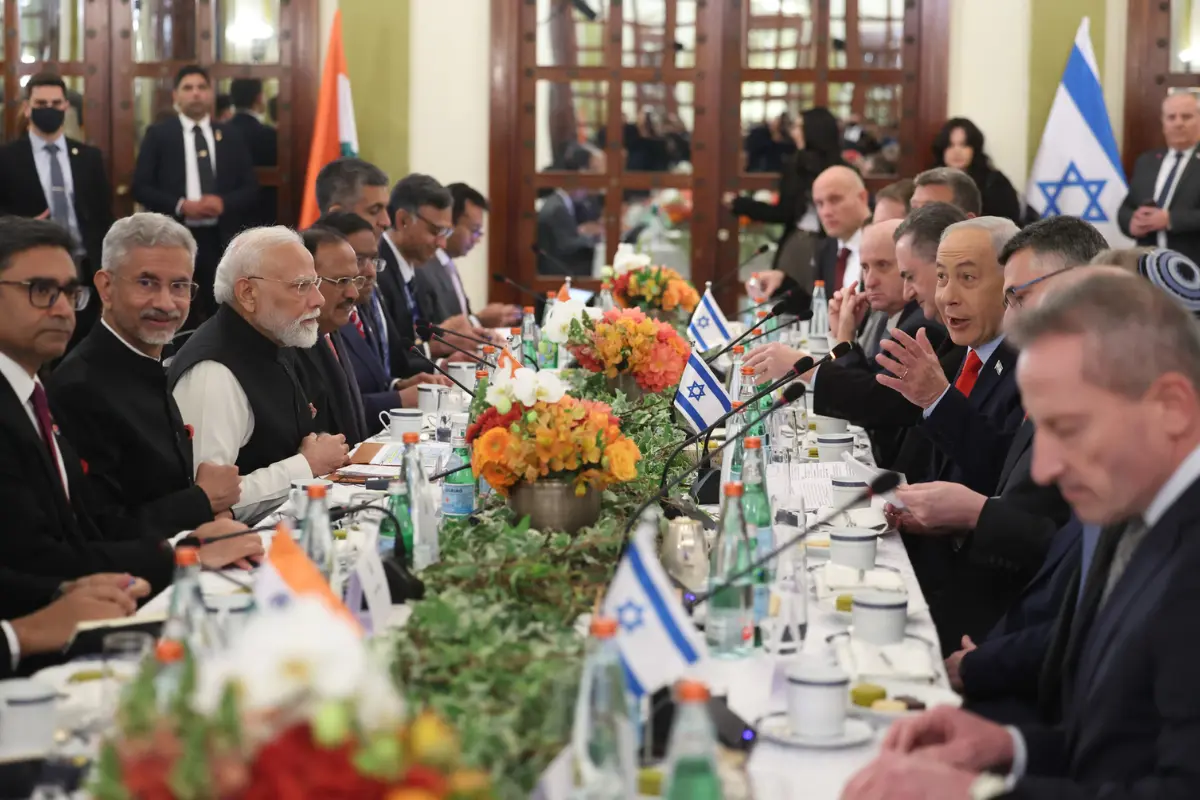
India-Israel Special Strategic Partnership: List of Outcomes
India–Israel Special Strategic Partnership Gains Momentum in Defence, Digital Payments and Labour Mobility
Prime Minister Narendra Modi on Thursday concluded his two-day visit to Israel with a bold declaration that the India-Israel Special Strategic Partnership would enter a new and more ambitious phase, marked by expanded defence collaboration, deeper artificial intelligence cooperation, and a renewed push toward a free trade agreement.
Standing beside his Israeli counterpart Benjamin Netanyahu, Modi described the moment as “historic,” announcing that the two nations had agreed to elevate their longstanding ties to a “Special Strategic Partnership.” In a message shared on X, he said the decision reflects mutual trust, shared democratic values, and converging technological ambitions.
India-Israel: Stronger Defence and AI Collaboration
Artificial intelligence emerged as a defining theme of the visit. A dedicated Memorandum of Understanding on AI will facilitate collaboration in ethical AI development, civilian applications, academic research, and public–private innovation ecosystems. A separate Declaration of Intent on Horizon Scanning aims to leverage AI-driven tools to improve strategic foresight, risk assessment, and emerging technology planning.
The two sides also committed to advancing AI-powered education models, ensuring that digital learning remains human-centered, inclusive, and future-ready.
Pursuit of a Free Trade Agreement
In a significant economic signal, Modi and Netanyahu confirmed their intent to accelerate negotiations toward a comprehensive free trade agreement.
The fourth India–Israel CEO Forum report, presented during the visit, recommended stronger policy alignment, industry-driven innovation, and deeper public–private collaboration to unlock the full economic potential of the partnership.
India-Israel: Tribute at Yad Vashem and Address to the Knesset
During his visit, Modi toured Yad Vashem, Israel’s Holocaust memorial, paying tribute to victims and underscoring the importance of remembrance and resilience.
He later addressed the Knesset, where he unequivocally condemned the October 2023 Hamas-led attack on Israel.
“We feel your pain. We share your grief. India stands with Israel, firmly, with full conviction, in this moment, and beyond,” Modi said, reaffirming India’s solidarity while reiterating its long-standing support for a two-state solution and concern over civilian casualties in Gaza.
At a joint news conference, both leaders “unequivocally condemned terrorism” and cross-border violence, while acknowledging diplomatic initiatives aimed at restoring peace in Gaza. Modi emphasized that humanitarian considerations must remain central to any conflict resolution effort.
Labour Mobility and Workforce Expansion
One of the most immediate outcomes of the visit is Israel’s pledge to allow an additional 50,000 Indian workers into its labour market over the next five years. Implementation protocols were signed covering commerce and services, manufacturing, and the restaurant sector.
These agreements will open regulated employment pathways in retail, logistics, hospitality, food processing, textiles, electronics, chemicals, and other industries. For thousands of skilled and semi-skilled Indian workers, the arrangement promises new economic opportunities while addressing workforce gaps in Israel.
Digital Payments and Financial Integration
In a landmark digital finance development, India’s Unified Payments Interface (UPI) will be extended to Israel through cooperation between NPCI International and MASAV. The move is expected to enable seamless cross-border remittances and strengthen fintech ties under the broader India–Israel Special Strategic Partnership.
Financial regulators — India’s International Financial Services Centres Authority and the Israel Securities Authority — also agreed to collaborate on information exchange, fintech innovation, and regulatory best practices.
Agriculture, Fisheries and Innovation
Agricultural innovation featured prominently in the agreements. A new India–Israel Innovation Centre for Agriculture will be established to develop precision farming tools, satellite-based irrigation systems, advanced machinery, and integrated pest management technologies.
Cooperation will also extend to fisheries and aquaculture, focusing on sustainable and technology-driven solutions including mariculture, disease management systems, and seaweed cultivation.
India-Israel: Expanding Cooperation Across Sectors
The visit produced more than a dozen additional agreements spanning:
-
Geophysical exploration using AI-enabled mineral mapping
-
Maritime heritage collaboration at India’s National Maritime Heritage Complex in Lothal
-
Cultural exchanges from 2026 to 2029
-
Cybersecurity cooperation and the establishment of an Indo-Israel Cyber Centre of Excellence
-
Arbitration and mediation partnerships
-
Academic exchanges between Nalanda University and the Hebrew University of Jerusalem