
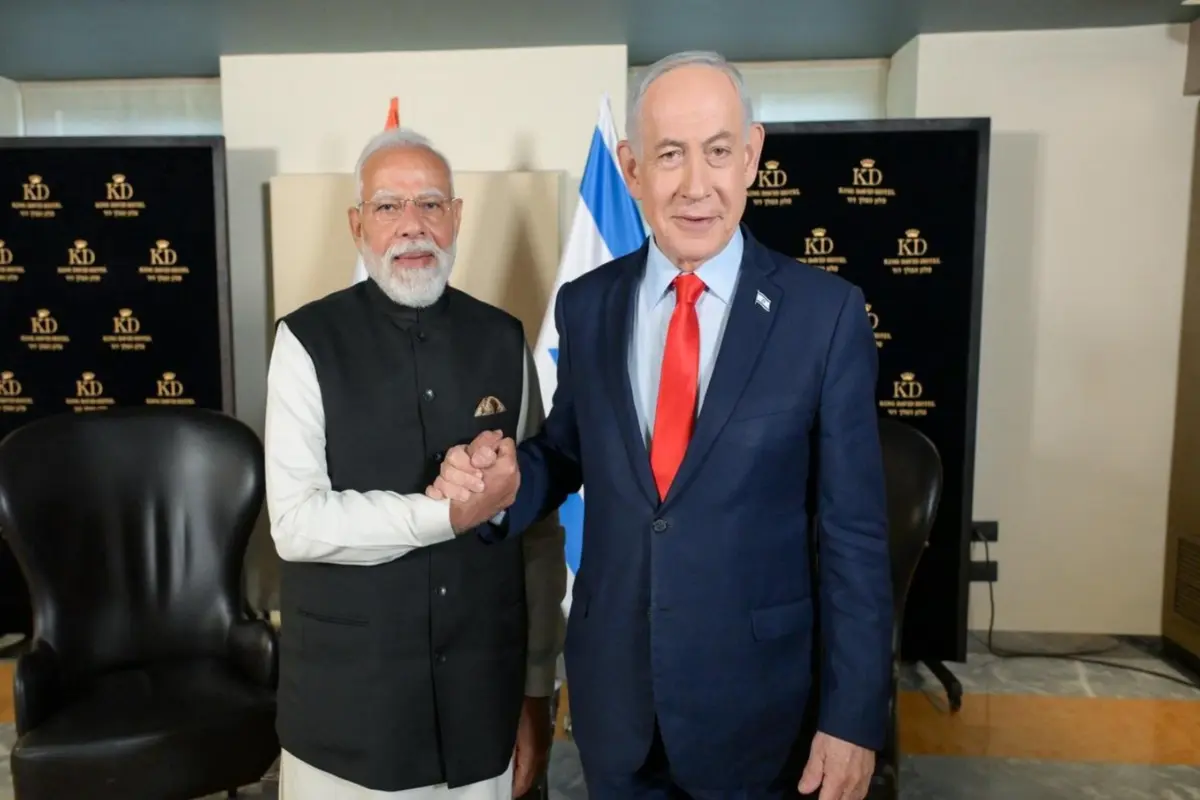
India-Israel: Historic Talks Between Modi and Netanyahu
India-Israel Agreements 2026: Modi and Netanyahu Usher in a New Strategic Era
The delegation-level talks marked a significant moment in India-Israel relations, underscoring the growing strategic alignment between New Delhi and Jerusalem. Prime Minister Modi’s two-day state visit reflects the maturity of ties that have evolved from defense-centric cooperation into a multi-dimensional partnership spanning innovation, agriculture, water management, cybersecurity, and education.
During the visit, Prime Minister Modi also met with Israeli President Isaac Herzog, further reinforcing the diplomatic warmth between the two nations. The meeting highlighted shared values, mutual respect and a common vision for global stability and development.
Speaking about the potential of the partnership, Modi noted that bilateral cooperation “in many areas can be very strong and useful for the global good.” He praised Israel’s expertise in science, innovation and academic excellence, particularly in water conservation and agriculture — areas where India has increasingly adopted Israeli best practices with measurable success.
Innovation, Agriculture and Water at the Core
A major pillar of the India-Israel Agreements 2026 revolves around technological synergy. Israel’s advanced irrigation systems and desert farming techniques have already been integrated into several Indian agricultural initiatives. The Prime Minister acknowledged that these models have delivered encouraging outcomes and confirmed India’s intent to scale them further.
The two sides reviewed progress in joint innovation funds, academic exchange programmes and collaborative research projects. Water conservation technologies, drip irrigation systems and smart farming solutions were among the areas discussed, reflecting Israel’s specialized expertise and India’s vast implementation capacity.
Officials indicate that the upcoming agreements could deepen collaboration in climate resilience, digital transformation and startup ecosystems — sectors seen as vital for both economies in an era of rapid global change.
India-Israel: A Strong Stand Against Terrorism
In a historic address to the Israeli Knesset, Prime Minister Modi delivered a firm message on global security and counterterrorism. Condemning the October 7, 2023 attacks, he described the acts carried out by Hamas as “barbaric” and expressed unwavering solidarity with Israel.
“We feel your pain, share your grief. No cause can justify the murder of civilians. Nothing can justify terrorism,” Modi said, drawing strong applause.
Drawing parallels with the 26/11 Mumbai terror attacks — which claimed Israeli lives among others — the Prime Minister reiterated India’s zero-tolerance policy toward terrorism. He emphasized that terrorism seeks to destabilize societies, obstruct development and erode trust, calling for coordinated global action.
“Countering terrorism requires sustained and coordinated global action, because terror anywhere threatens peace everywhere,” he stated, reinforcing a shared security doctrine between the two nations.
Gaza, Peace Efforts and the Abraham Accords
While expressing solidarity with Israel, Modi also addressed the broader regional situation, noting that the path to peace is complex but essential. He endorsed the United Nations Security Council-backed Gaza peace initiative, describing it as a pathway toward a just and durable solution that addresses the Palestinian issue.
The Prime Minister also referred to the Abraham Accords, which normalized relations between Israel and several Arab nations. He recalled that India had welcomed the accords as a moment of courage and vision for a historically troubled region.
“Since then, the situation has changed significantly. The path is even more challenging. Yet it is important to sustain that hope,” Modi remarked, signaling India’s support for dialogue, diplomacy and regional stability.