
India–Israel Economic Partnership: FTA Talks Get Fresh Push
Piyush Goyal, Netanyahu Revive India–Israel Economic Partnership With Renewed FTA Momentum
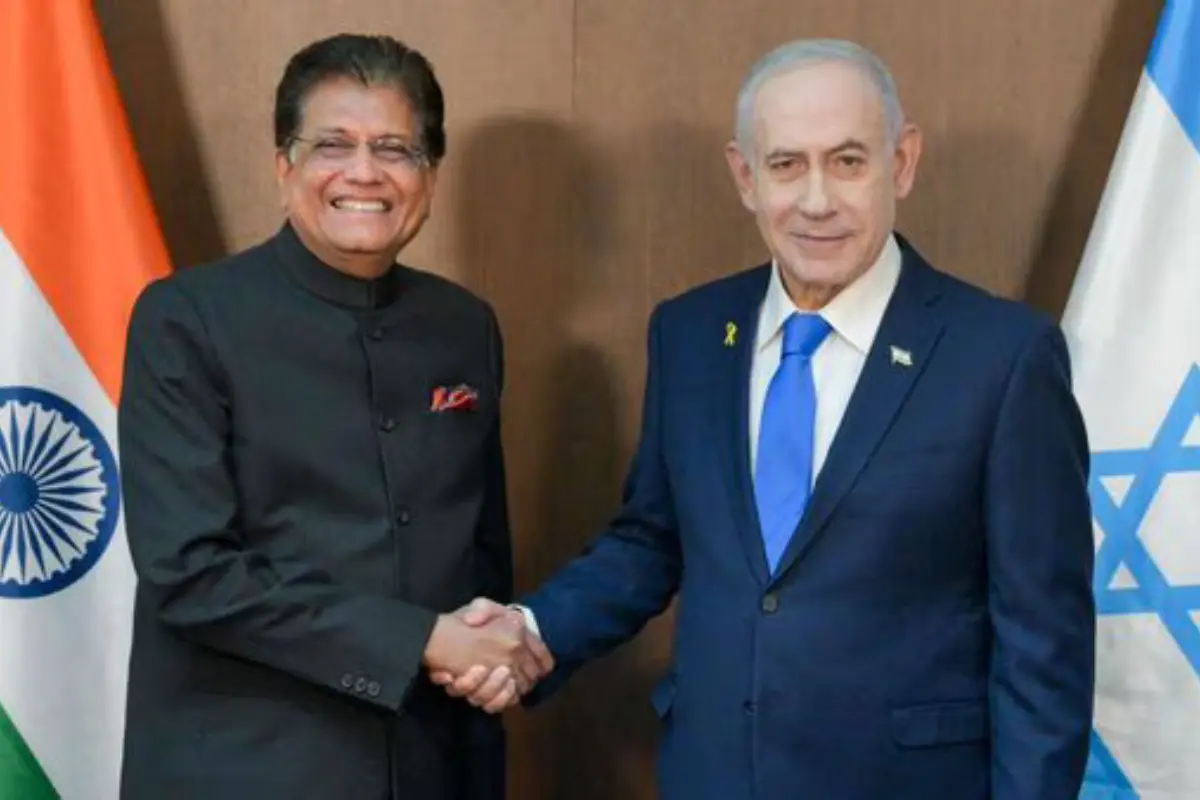
India–Israel Economic Partnership: In a decisive political and economic shift, India and Israel signalled a fresh boost to the India–Israel Economic Partnership on Sunday, following a series of high-level meetings in Jerusalem. Commerce and Industry Minister Piyush Goyal met Israeli Prime Minister Benjamin Netanyahu and President Isaac Herzog, marking the strongest revival of bilateral engagement after more than a decade of drift.
Their discussions focused sharply on trade, technology, and investment, sending an unmistakable signal that both countries are ready to move forward with long-pending free trade agreement (FTA) negotiations—first proposed in 2010 but stalled since 2013.
India–Israel Economic Partnership: Netanyahu Highlights Strategic Shift
Prime Minister Benjamin Netanyahu emphasised a new phase of economic collaboration, calling the moment a turning point for both nations.
“Israel and India are strengthening our strategic partnership—more investments, more innovation, and a strong economic corridor from India through Israel to Europe. Together we are building economic power,” he posted on X.
This vision aligns with recent geopolitical and trade priorities on both sides, especially as India seeks to diversify exports and Israel looks to deepen economic ties with Asia.
Goyal–Herzog Meeting Underscores Full-Spectrum Cooperation
Later in the day, Minister Goyal also met President Isaac Herzog, describing their conversation as wide-ranging and forward-looking.
He noted that the discussions covered the full spectrum of the India–Israel Economic Partnership, including trade, investment, innovation, science and technology, and emerging opportunities for deeper engagement.
According to Goyal, both sides also reviewed the outcomes of the business forum and CEOs’ forum, which served as critical platforms for connecting Indian industries with Israeli innovators.
India–Israel Economic Partnership: Formal Path to FTA Opens After a Decade
A crucial milestone was reached on 20 November, when the two governments signed the Terms of Reference (ToR) for the FTA.
Goyal and Israel’s Minister of Economy and Industry Nir Barkat expressed confidence that negotiations would move constructively toward a “balanced and mutually beneficial pact.”
Goyal—who led a 60-member delegation facilitated by industry bodies—said the new approach focuses on pragmatism:
-
Phase 1 will target low-hanging fruit to deliver early gains for businesses.
-
Sensitive issues will be handled in later stages.
-
Key areas of emphasis include innovation, joint R&D, investments, and scalable market opportunities.
The minister noted that the FTA could help both countries leverage complementary strengths—Israel’s cutting-edge innovation with India’s vast market and manufacturing depth.
Strategic Timing: Trade Drop Spurs Urgency
The revived push comes as bilateral trade faces a steep decline.
India’s exports to Israel halved from $4.52 billion in FY24 to $2.14 billion in FY25, while imports fell from $2 billion to $1.48 billion during the same period.
With India aiming to reduce its dependence on the US market and Israel seeking diversified economic alliances, the India–Israel Economic Partnership has become strategically vital.
Experts believe the FTA could unlock high-value potential in:
-
Cybersecurity
-
Agri-technology
-
Food processing and water solutions
-
Digital services
-
Clean energy and climate technologies
Agriculture: Natural Synergy for Both Nations
For decades, agriculture has been a pillar of India–Israel cooperation.
Binod Anand, Secretary General of the Confederation of NGOs of Rural India, observed that Israel’s expertise in precision farming, drip irrigation, and water-use efficiency fits closely with India’s needs in an era of climate stress.
He noted that a structured FTA could:
-
Accelerate technology transfer
-
Reduce costs of critical agricultural equipment
-
Facilitate joint innovation in protected cultivation, horticulture, and post-harvest management
Past Bottlenecks, New Momentum
India and Israel last held formal FTA talks in 2013, but negotiations stalled over issues including:
-
Pharmaceutical market access
-
Tariff reduction for plastics and chemicals
-
Rules of origin
-
Movement of services professionals
The renewed push from top political leadership indicates that both nations now want to break the deadlock and realign the partnership with current economic priorities.
India–Israel Economic Partnership: Two-Phase FTA: A Practical Roadmap
According to PTI, Goyal confirmed that India and Israel intend to implement the FTA in two phases, enabling early benefits while allowing time to address sensitive domains.
The recently signed ToR includes commitments to:
-
Remove tariffs and non-tariff barriers
-
Facilitate investments
-
Streamline customs procedures
-
Strengthen collaboration in innovation and technology transfer
-
Promote trade in services
Goyal added that both sides are exploring co-created R&D projects and joint ventures, leveraging Israel’s innovation ecosystem and India’s scale.