
India-France Special Global Strategic Partnership
India-France Special Global Strategic Partnership: Modi and Macron Chart a Bold New Global Vision
In a landmark diplomatic moment that could reshape geopolitical alignments for decades, India and France have unveiled the India-France Special Global Strategic Partnership, a sweeping upgrade of their bilateral ties that stretches far beyond traditional diplomacy.
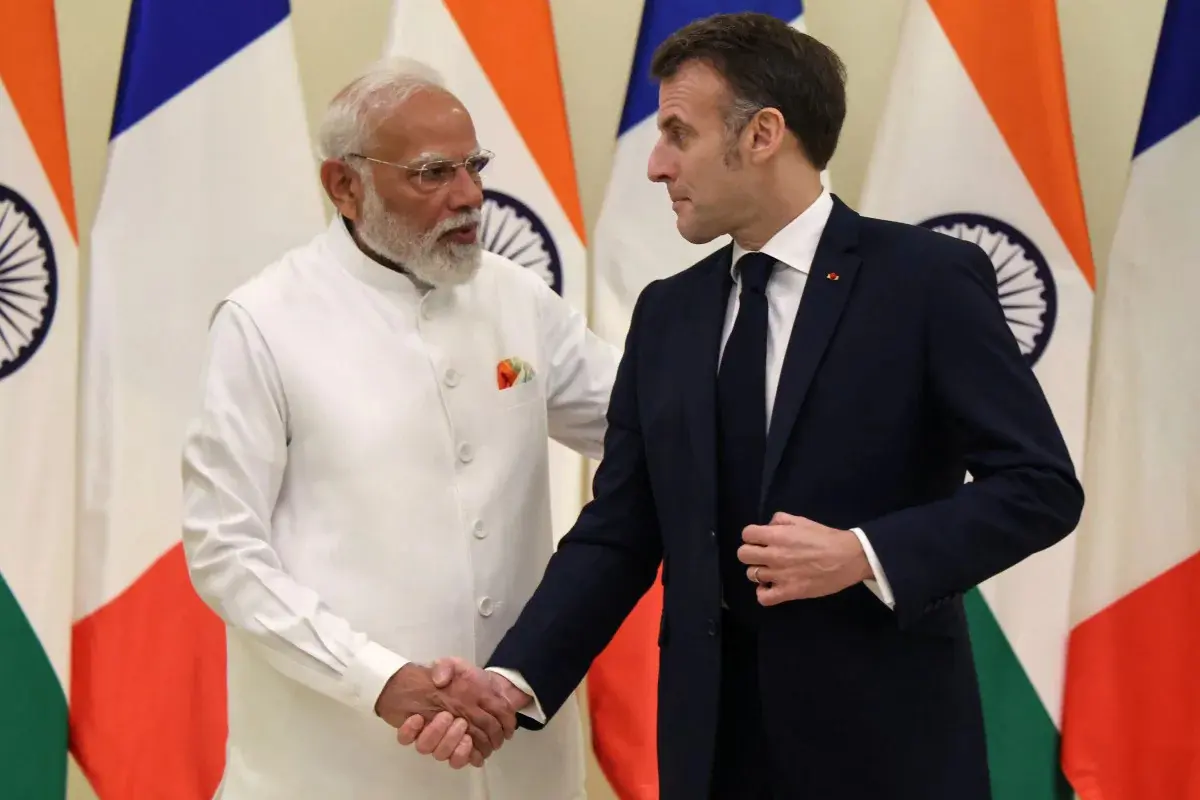
The announcement followed high-level talks between Prime Minister Narendra Modi and French President Emmanuel Macron in Mumbai, marking Macron’s fourth visit to India. The joint statement signals not just closer cooperation, but a shared intent to influence the direction of global economic, security, technological, and climate governance in an era defined by fragmentation and uncertainty.
India-France: From 1998 to a Global Vision
India and France first formalised their strategic partnership in 1998. Nearly three decades later, that framework has evolved into something far more ambitious: a special global strategic partnership designed to guide cooperation up to 2047 — the centenary of India’s independence and 50 years of India-France strategic ties.
Central to this evolution is the ‘Horizon 2047 Roadmap,’ a long-term blueprint aligning defence, economic security, energy transition, digital governance, and people-to-people collaboration.
To give the new partnership institutional weight, both sides announced an annual Foreign Ministers Comprehensive Dialogue, ensuring that strategic coordination becomes structured, sustained, and future-oriented.
Defence Cooperation: From Buyer-Seller to Co-Creators
Defence emerged as the most concrete pillar of the India-France Special Global Strategic Partnership. The two countries agreed to intensify co-design, co-development and co-production of advanced defence platforms across air, naval and land domains, including emerging and dual-use technologies.
A major highlight was the endorsement of the contract for 26 Rafale Marine fighter jets for the Indian Navy, strengthening France’s standing as one of India’s most trusted defence partners.
French aerospace leader Safran is set to expand its footprint in India, supporting combat engine manufacturing under the Make in India initiative.
Among key defence milestones announced:
-
New Maintenance, Repair and Overhaul (MRO) facilities for LEAP and M-88 engines.
-
A joint venture with Bharat Electronics Limited to manufacture HAMMER missiles in India.
-
The launch of the H125 helicopter Final Assembly Line — India’s first private-sector helicopter manufacturing facility — backed by Tata Advanced Systems and Airbus.
France also signalled interest in India’s Pinaka multi-barrel rocket launcher, raising prospects of future exports and joint development.
The message was unmistakable: this is no longer a transactional defence relationship — it is becoming a co-production alliance.
India-France: Submarines, Space and Strategic Domains
The leaders hailed the success of the Scorpene submarine programme, with the recent delivery of the sixth Kalvari-class submarine to the Indian Navy. Submarine cooperation will continue, reinforcing maritime security collaboration in the Indo-Pacific.
In space cooperation, ties between the Indian Space Research Organisation and CNES will deepen in sovereign access to space, space situational awareness and defence space capabilities.
India also confirmed participation in France’s International Space Summit in July 2026, highlighting a growing alignment on multilateral space governance.
Artificial Intelligence: Building Trusted and Democratic AI
Artificial intelligence stood at the centre of Macron’s visit, particularly with his participation in the AI Impact Summit 2026 in Mumbai.
Building on the India-France AI Declaration adopted in Paris last year, both nations reaffirmed their commitment to developing “secure, trustworthy and people-centric AI.” The focus extends beyond innovation — it includes reducing the global AI divide, ensuring open access to digital resources, and mitigating technological risks.
France’s role as co-chair of a working group on resilience and innovation reflects the seriousness of this digital alignment. In a world increasingly shaped by AI competition, the India-France Special Global Strategic Partnership positions both nations as advocates of responsible technological governance.
Nuclear Energy and Climate: Powering the Future
Energy transition featured prominently in the discussions. President Macron praised India’s ambition to achieve 100 GW of nuclear power capacity by 2047 and welcomed recent reforms allowing private investment in the nuclear sector.
Cooperation will span the full nuclear value chain, including large reactors, Small Modular Reactors (SMRs), and Advanced Modular Reactors (AMRs). Discussions on the long-pending Jaitapur Nuclear Power Plant project were revisited, alongside plans for closer regulatory and research collaboration.
Climate cooperation was equally robust. Both countries reaffirmed their commitment to the Paris Agreement and initiatives such as the International Solar Alliance and the Coalition for Disaster Resilient Infrastructure. They also backed stronger ocean governance and the expansion of marine protected areas following the High Seas Biodiversity Treaty’s entry into force.
A Strong Multilateral Message: G7 and UNSC Reform
In a significant diplomatic gesture, President Macron invited Prime Minister Modi to attend the G7 Summit in France in 2026 — a move underscoring India’s growing centrality in global economic and climate debates.
France reiterated its strong support for India’s permanent membership in the United Nations Security Council and pledged close coordination on UNSC reform, including discussions on limiting veto use in cases of mass atrocities.
Both nations also reaffirmed their commitment to a rules-based Indo-Pacific and initiatives such as the India-Middle East-Europe Economic Corridor (IMEC).
India-France: People, Mobility and Culture: The Human Dimension
Beyond geopolitics and defence, the India-France Special Global Strategic Partnership places strong emphasis on mobility and cultural exchange.
France announced plans for visa-free airport transit for Indian nationals as a six-month pilot. The two sides also reaffirmed their goal of welcoming 30,000 Indian students to France by 2030 — nearly tripling current numbers.
Cultural ties will be strengthened through the India-France Year of Innovation 2026, expanded artist residencies, museum collaborations, and future editions of “Namaste France.” In health and research, a new AI-focused research centre involving leading institutions from both countries is expected to launch soon.