
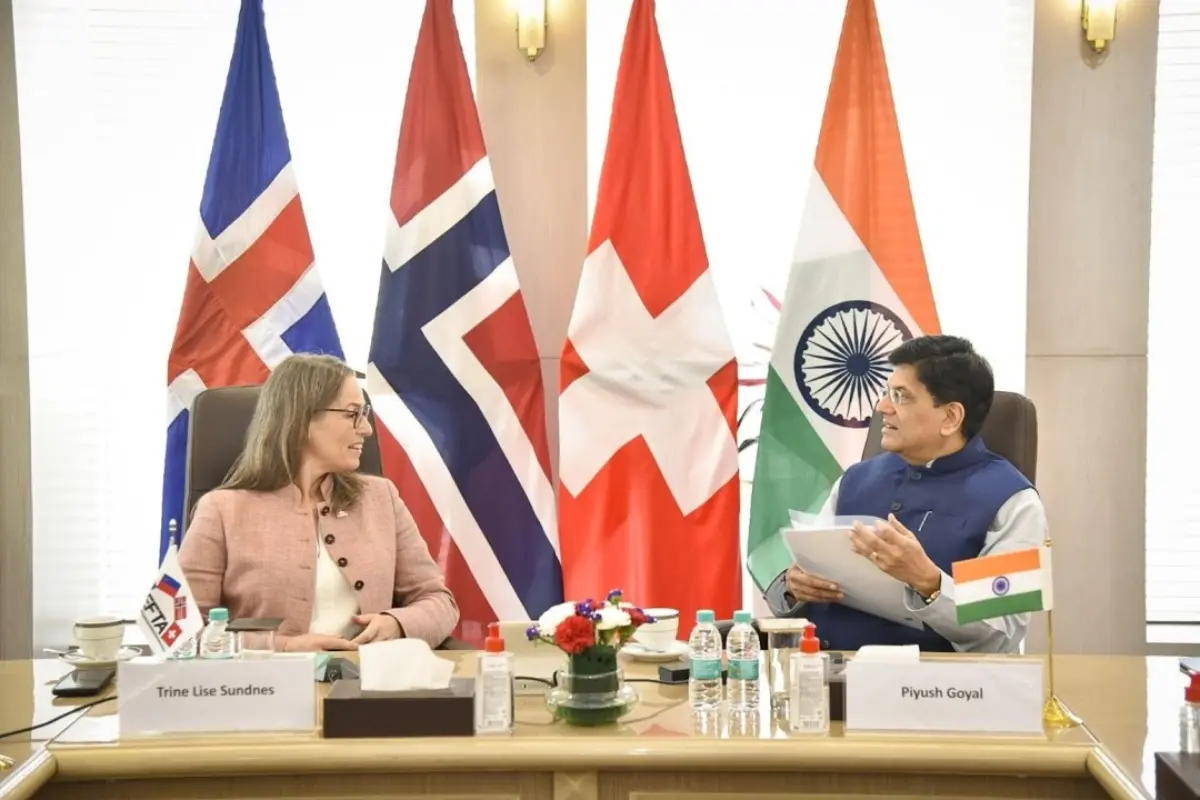
India-EFTA Trade Agreement: 1st Ever Trade Pact From Oct 1
Historic India-EFTA Trade Agreement to Unlock $100 Billion Investment and Jobs
India is preparing to take a historic step in its trade policy as the India-EFTA Trade Agreement comes into force on October 1, 2025. The landmark pact will mark the country’s first-ever trade agreement with a European bloc, formally linking New Delhi with the four-nation European Free Trade Association (EFTA) comprising Switzerland, Norway, Iceland, and Liechtenstein.
The government will host a high-profile launch ceremony at Bharat Mandapam in New Delhi, where Commerce and Industry Minister Piyush Goyal, senior EFTA ministers, officials, and industry representatives will gather to usher in the new economic chapter. “From the first of next month, a group of four countries—Switzerland, Liechtenstein, Norway, and Iceland—will also come into effect,” Goyal said during the UP International Trade Show’s closing session.
What Makes the India-EFTA Trade Agreement Unique
Unlike India’s previous free trade agreements, the India-EFTA Trade Agreement goes beyond tariff reductions and integrates investment commitments at its core.
-
Tariff Commitments: India will slash tariffs to zero on nearly 80–85% of goods imported from EFTA nations, while Indian exporters will benefit from duty-free access on 99% of goods in EFTA markets. Sensitive segments like agriculture and dairy remain protected.
-
Investment Promises: In return, the EFTA bloc has pledged to invest $50 billion in India within the first decade of the agreement, followed by another $50 billion in the subsequent five years. The Indian government estimates these inflows could generate one million direct jobs over a 15-year period.
Government officials emphasize that the October 1 launch is not just ceremonial. “The idea is to ensure that industry stakeholders are aware of the deal and well-positioned to take full advantage of it,” a senior official told Business Standard.
Trade Dynamics Between India and EFTA
While tariff gains for India may be limited due to EFTA’s already low import duties, the pact’s real strength lies in securing long-term capital inflows and industrial growth.
-
Exports and Imports: In FY25, India exported goods worth $1.97 billion to the bloc, with Switzerland alone accounting for nearly three-fourths of the total. Imports, however, were much higher at $22.44 billion, driven primarily by gold and other commodities from Switzerland.
-
Trade Deficit: The imbalance resulted in a $20.47 billion trade deficit, underscoring the importance of diversifying India’s exports and leveraging the new investment-linked framework.
Switzerland remains the heavyweight in the bloc, contributing nearly 97% of all EFTA exports to India, making it the pivot of India’s trade engagement with Europe.
Why the India-EFTA Trade Agreement Matters
This pact is more than a trade opening—it represents a strategic shift in India’s global trade negotiations. By tying tariff concessions to assured foreign direct investment, New Delhi has crafted a deal that safeguards its domestic priorities while unlocking long-term growth opportunities.
For India, the India-EFTA Trade Agreement signals three big wins:
-
Breaking Ground in Europe: A first-ever pact with a European grouping, creating new trust and partnerships.
-
Job Creation Potential: A projected one million direct jobs in sectors boosted by $100 billion in investments.
-
Balanced Trade Diplomacy: Moving away from tariff-only negotiations to a growth-oriented, investment-driven model.
As the October 1 implementation date approaches, anticipation is running high among industry leaders, policymakers, and global investors. With the India-EFTA Trade Agreement, New Delhi is positioning itself as not just a trading partner but also a key investment hub for European economies seeking growth opportunities in Asia.
Also Read : Foreign Films: Trump 100% Tariff Sparks Global Backlash