
EFTA TEPA Agreement: $100B Investment & 1 Million Jobs
EFTA TEPA Agreement: Transforming India’s Trade Landscape with Ambitious Investment Commitments
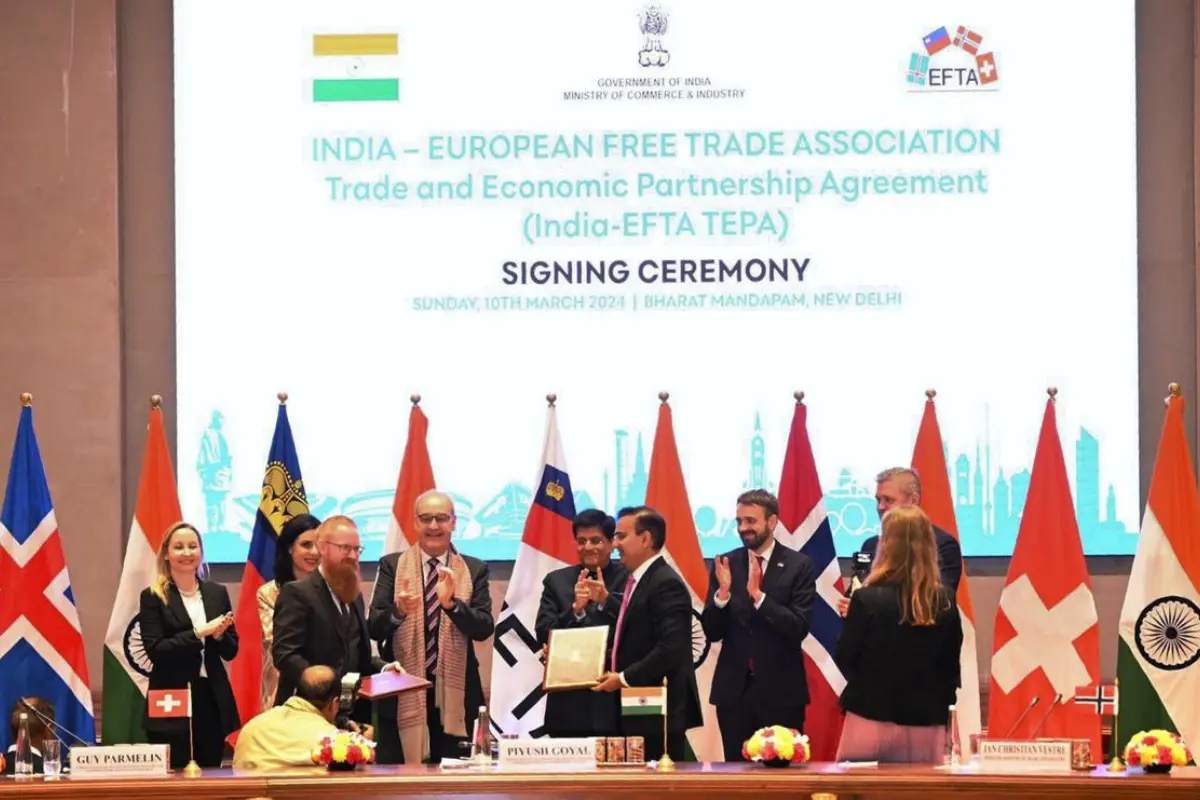
EFTA: In a historic breakthrough for India’s global trade ambitions, the India–EFTA TEPA Agreement officially came into force today. The landmark free trade pact, signed on March 10, 2024, cements India’s first-ever free trade agreement with the European Free Trade Association (EFTA) nations — Switzerland, Norway, Iceland, and Liechtenstein.
Hailed as one of the most ambitious trade deals in India’s history, the agreement is more than just tariff concessions. It reflects a transformative partnership that aims to combine India’s growth vision with Europe’s innovation and investment strengths.
EFTA: $100 Billion Investment and Job Creation
Unlike any previous Indian trade deal, the India–EFTA TEPA Agreement contains a binding commitment from EFTA countries to bring $100 billion in foreign direct investment (FDI) into India over 15 years. This inflow is tied to the creation of one million direct jobs, offering a tangible promise of economic growth and skill development.
The pact has set a milestone target: $50 billion in the first decade, followed by another $50 billion in the next five years. To ensure smooth execution, a dedicated India–EFTA Desk has been active since February 2025, driving collaborations in renewable energy, engineering, life sciences, and digital transformation.
Market Access and Tariff Concessions
For Indian exporters, the pact is a golden gateway into high-income European markets. EFTA has extended tariff concessions on 92.2% of tariff lines, covering a massive 99.6% of India’s exports. This includes machinery, organic chemicals, textiles, processed foods, and marine products.
-
Agriculture Exports: India’s guar gum, basmati rice, pulses, and fresh fruits are set to benefit. Switzerland has scrapped tariffs of up to 272 CHF/100 kg on grapes and 127.5 CHF/100 kg on food preparations. Norway has offered duty-free access for rice, processed fruits, and vegetables.
-
Marine Products: Tariff reductions up to 13.16% in Norway and 10% in Iceland will strengthen India’s seafood exports.
-
Tea and Coffee: Premium products gain zero-duty entry into Switzerland and Norway, markets where Indian tea already commands rising prices.
In return, India has offered concessions on 82.7% of tariff lines, but sensitive sectors like dairy, soya, coal, pharmaceuticals, and gold remain safeguarded.
EFTA: Boost for Services and Professional Mobility
With services driving over 55% of India’s economy, the India–EFTA TEPA Agreement opens fresh avenues for IT, education, business services, and skilled professionals. India has committed to 105 service sub-sectors, while EFTA offers broad access — 128 in Switzerland, 114 in Norway, 110 in Iceland, and 107 in Liechtenstein.
Mutual Recognition Agreements (MRAs) in nursing, accountancy, and architecture are set to ease professional mobility, encouraging Indian talent to contribute in European economies while strengthening services exports via digital platforms.
Strengthening Manufacturing and Innovation
The deal is designed to supercharge India’s industrial and manufacturing capacity. Exports of engineering goods to EFTA have already surged 18% to $315 million in FY 2024–25. MSMEs and OEMs in electronics, EV components, and medical devices will gain a stronger global foothold through simplified standards and IPR protections.
Chemical exports, currently valued at $49 million, are projected to grow to $70 million, supported by tariff reductions across 95% of product lines. Sectors like textiles, gems, and jewellery will also benefit from stability in duty structures.
Also Read : Preeti Aghalayam: First Woman Director of an IIT Campus