
India-Brazil Strategic Partnership Set $20B Trade Target
India-Brazil Strategic Partnership 2026 Gains Momentum with Critical Minerals and Digital Cooperation Deals
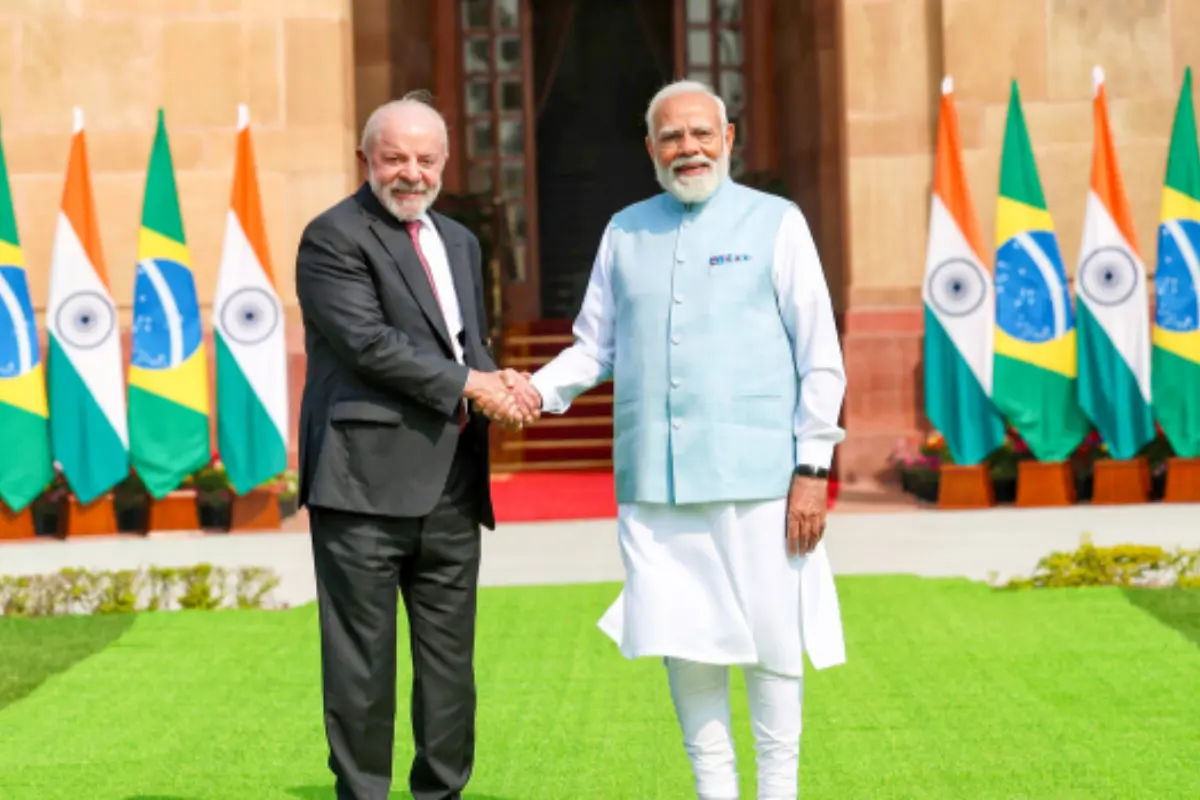
New Delhi witnessed a decisive diplomatic moment as Prime Minister Narendra Modi held extensive talks with Brazil’s President Luiz Inácio Lula da Silva at Hyderabad House, reinforcing the growing momentum of the India-Brazil Strategic Partnership 2026. The high-level engagement underscored the two democracies’ shared ambition to shape a more inclusive, multipolar global order while unlocking fresh avenues of economic and technological collaboration.
India-Brazil: Ceremonial Welcome and Symbolic Diplomacy
Earlier in the day, President Lula was accorded a ceremonial reception at the forecourt of Rashtrapati Bhavan, hosted by President Droupadi Murmu and Prime Minister Modi. The Brazilian leader also paid homage at Rajghat, honoring Mahatma Gandhi. The gesture was a powerful reminder that shared democratic values and moral leadership continue to anchor India-Brazil relations.
India and Brazil have been strategic partners since 2006, and over the years, the relationship has evolved into one of the most dynamic partnerships connecting Asia and Latin America.
Expanding Trade, Strengthening Economic Trust
Brazil remains India’s largest trading partner in the Latin American region. During the joint statement, Prime Minister Modi described bilateral trade as “not just a figure, but a reflection of trust.” The two leaders agreed to push total trade beyond $20 billion over the next five years under the India-Brazil Strategic Partnership 2026 framework.
Ten agreements were exchanged during the visit, spanning critical minerals, digital cooperation, traditional knowledge sharing, healthcare, MSMEs, entrepreneurship, and mass communication. These agreements are expected to diversify trade baskets and enhance supply chain resilience.
Particularly significant is the agreement on critical minerals and rare earth elements, seen as essential for next-generation technologies, renewable energy systems, and defence manufacturing. Both sides emphasized building resilient and transparent supply chains to reduce global vulnerabilities.
India-Brazil: Technology, AI and Digital Public Infrastructure
Technology emerged as a defining pillar of the India-Brazil Strategic Partnership 2026. Prime Minister Modi expressed satisfaction over collaborative efforts to establish a Centre of Excellence for Digital Public Infrastructure in Brazil. This initiative is expected to leverage India’s expertise in digital governance and scalable public tech systems.
Cooperation in artificial intelligence, semiconductors, and innovation ecosystems was highlighted as a shared priority. Leaders stressed that such collaboration would not only benefit their domestic economies but also empower the wider Global South with accessible and inclusive technological solutions.
Defence Cooperation and Strategic Synergy
Defence engagement between India and Brazil continues to expand steadily. Prime Minister Modi termed defence cooperation a “clear example of trust and strategic synergy.” Both sides agreed to explore deeper collaboration in defence manufacturing, training exchanges, and technology partnerships.
As emerging powers, India and Brazil recognize the need for diversified defence partnerships to ensure strategic autonomy and regional stability.
Climate Action and Energy Collaboration
The India-Brazil Strategic Partnership 2026 also places climate action and renewable energy at its core. With both countries playing influential roles in the Global South, they pledged to strengthen collaboration in renewable energy, biofuels, and sustainable agriculture.
Brazil’s leadership in bioenergy and India’s renewable energy expansion create natural synergies. Cooperation in these sectors is expected to drive sustainable growth and contribute to global climate commitments.
Call for UN Reform and Counter-Terrorism Commitment
A significant portion of discussions focused on global governance reform. Both leaders reiterated the urgent need for reforms within the United Nations, particularly the UN Security Council, to better reflect contemporary geopolitical realities.
On security matters, the two nations delivered a strong and unified message against terrorism. Prime Minister Modi asserted that terrorism and its supporters are enemies of humanity, a view echoed by President Lula. The shared stance reinforces their determination to collaborate closely on global counter-terrorism frameworks.