
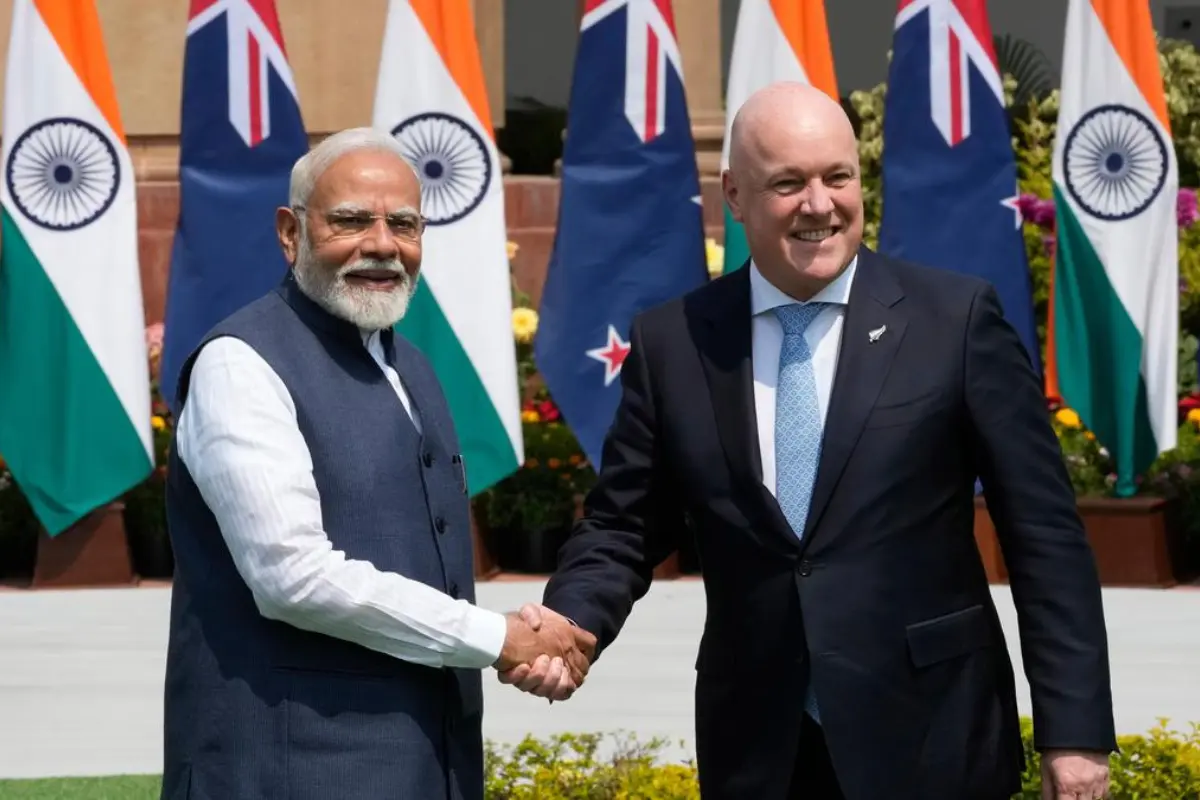
India and New Zealand Conclude Landmark Free Trade Deal
India-New Zealand Free Trade Agreement Concluded, Duty-Free Trade and $20 Billion Investments Unlocked
India on Monday announced the conclusion of a landmark India-New Zealand Free Trade Agreement, marking a significant step in New Delhi’s expanding global trade strategy. The pact is expected to allow duty-free entry of Indian goods into New Zealand and facilitate investments worth nearly $20 billion over the next 15 years, while setting an ambitious target of doubling bilateral trade within five years.
Prime Minister Narendra Modi and New Zealand Prime Minister Christopher Luxon confirmed the breakthrough simultaneously through their respective social media platforms, underscoring the strategic importance both nations attach to the agreement.
The deal becomes India’s third free trade agreement within a year, following the Comprehensive Economic and Trade Agreement with the United Kingdom in July and the Comprehensive Economic Partnership Agreement with Oman earlier this month.
India and New Zealand: Political Dissent Emerges in New Zealand
Despite the official announcement, the agreement has triggered political pushback within New Zealand. Foreign Affairs Minister Winston Peters, leader of the New Zealand First party, publicly opposed the pact, calling it “neither free nor fair.”
Posting on X, Peters said the agreement “gives too much away, particularly on immigration, and fails to secure adequate returns for New Zealanders,” especially in sensitive sectors such as dairy. His remarks highlight internal political divisions even as Wellington moves forward with formal ratification.
India, however, has maintained a firm stance on protecting its farmers. Officials reiterated that agriculture and dairy remain red-line sectors in all Indian trade negotiations, and the current agreement does not open India’s market to dairy imports.
Key Features of the India-New Zealand FTA
Under the terms of the India-New Zealand Free Trade Agreement, all Indian exports to New Zealand will eventually enjoy zero-duty access once the pact comes into force. In return, India has agreed to reduce or eliminate tariffs on around 95% of New Zealand’s exports, including wool, coal, timber, wine, avocados, and blueberries.
Sensitive Indian sectors such as dairy, sugar, onions, edible oils, spices, and rubber remain protected to safeguard domestic producers and rural livelihoods.
The agreement also includes provisions for:
-
Additional temporary employment visas for Indian professionals
-
Improved market access for Indian pharmaceuticals and medical devices
-
Enhanced cooperation in services, innovation, and investment facilitation
The FTA is expected to be formally signed within three months and could come into effect as early as next year.
India and New Zealand: Strategic Timing Amid Global Trade Uncertainty
Commerce and Industry Minister Piyush Goyal described the agreement as India’s seventh free trade pact under the Modi government, emphasizing its relevance at a time when global trade faces renewed protectionist pressures.
“In an increasingly protectionist world, India is trading more and concluding FTAs,” Goyal said, adding that such agreements are driving exports and creating prosperity for farmers, exporters, traders, and MSMEs.
The deal also gains importance as India seeks to diversify export destinations amid trade barriers erected by the Donald Trump administration, particularly in developed markets.
Why Free Trade Agreements Matter
A free trade agreement is an economic arrangement aimed at eliminating or substantially reducing customs duties on traded goods, while also addressing non-tariff barriers. FTAs encourage services exports, promote cross-border investments, and provide exporters with predictable, rules-based market access.
For India, FTAs help strengthen manufacturing, attract foreign capital, and improve access to raw materials and intermediate goods essential for higher-value production. For partner countries, they offer entry into one of the world’s fastest-growing major economies.
According to trade experts, the India-New Zealand pact aligns with New Delhi’s broader Indo-Pacific economic strategy, while giving Wellington secure access to India amid rising global trade uncertainty.
India’s Seven Major Trade Agreements in the Last Five Years
With the conclusion of the India-New Zealand Free Trade Agreement (2025), India has now sealed seven major trade pacts in five years:
-
India-New Zealand FTA (2025)
-
India-Oman CEPA (2025)
-
India-UK CETA (2025)
-
India-EFTA TEPA (2024)
-
India-Australia ECTA (2022)
-
India-UAE CEPA (2022)
-
India-Mauritius CECPA (2021)