
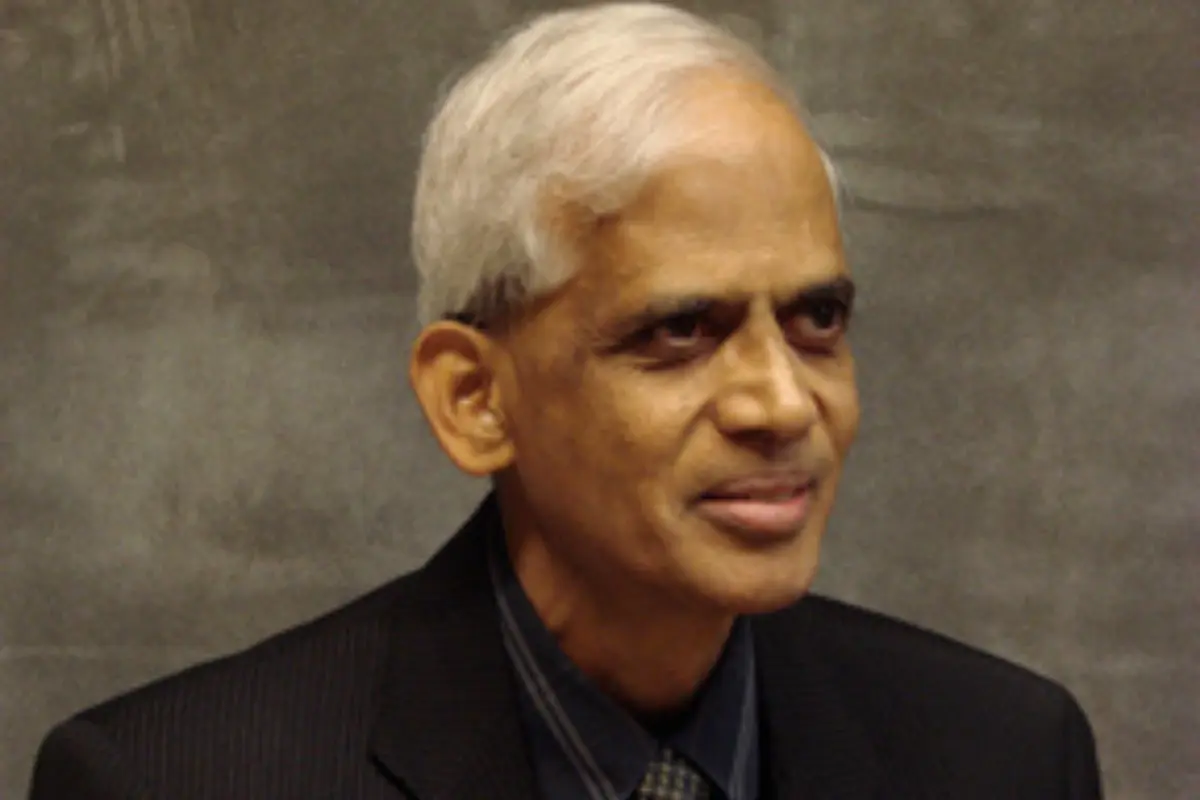
Holalkere Rangarao Chandrasekhar was born in Holalkere, a modest hamlet in Karnataka’s Chitradurga district. His father, H. V. Rangarao, served as a local auditor and Shanubhogue, earning respect within the community for his analytical abilities and traditional scholarship. His mother, D. Radhamma, nurtured a strong educational foundation that would shape Chandrasekhar’s future.
Growing up in a rural environment, he experienced a unique blend of tradition and intellectual curiosity. Exposure to ancient Indian literature, epics, and philosophical thought enriched his worldview, while the disciplined academic environment at school encouraged his passion for science. Even as a child, Chandrasekhar displayed an exceptional interest in mathematics, physics, and literature—a dual passion that would remain with him throughout life.
Holalkere Rangarao Chandrasekhar: Academic Excellence and Intellectual Formation
Holalkere Rangarao Chandrasekhar’s academic journey began at Holalkere High School, where he quickly distinguished himself as a top student. He later attended National College in Bangalore, affiliated with Bangalore University, earning first ranks and gold medals in both science and Kannada literature. His academic success reflected not only intellectual ability but also a deep commitment to learning.
He went on to pursue a Bachelor of Science degree, followed by postgraduate studies at the Indian Institute of Technology Kanpur, where he completed his Master’s degree in physics. At IIT Kanpur, Chandrasekhar encountered cutting-edge research and a vibrant academic environment that shaped his scientific outlook and introduced him to advanced concepts in solid-state physics.
Determined to expand his horizons, he pursued doctoral studies in the United States at Purdue University. Under the mentorship of A. K. Ramdas, he completed his Ph.D. in 1973. His thesis on quantitative piezospectroscopy of acceptor states in silicon laid a strong foundation for his future work in the optical properties of materials and semiconductor physics.
Building a Distinguished Academic Career
After completing his doctoral studies, Holalkere Rangarao Chandrasekhar embarked on a long and impactful academic career at the University of Missouri. Joining the faculty in the late 1970s as an Assistant Professor, he steadily rose through the ranks to become a full Professor, Department Chair, and Director of Graduate Studies.
Throughout his career, he focused on developing a robust research program in condensed matter and high-pressure physics. He played a crucial role in mentoring graduate students, fostering interdisciplinary collaboration, and enhancing the university’s research capabilities. As Department Chair, he contributed to faculty recruitment, curriculum modernization, and the strengthening of graduate programs.
Even after retiring in 2015, Chandrasekhar continued his association with the institution as Professor Emeritus, demonstrating his lifelong dedication to education and scientific advancement.
Holalkere Rangarao Chandrasekhar: Research Contributions and Scientific Impact
Holalkere Rangarao Chandrasekhar’s research primarily revolves around solid-state physics, with a special emphasis on the optical and structural properties of semiconductors and advanced materials. His work has significantly contributed to understanding how materials behave under high pressure—an area critical to both fundamental physics and technological innovation.
He utilized sophisticated techniques such as infrared spectroscopy, Raman spectroscopy, photoluminescence, and high-pressure experimentation to study materials ranging from IV-VI compounds to quantum wells and organic semiconductors. His investigations provided key insights into electronic structures, vibrational properties, and phase transitions in materials.
Among his many achievements, his early work on the infrared and Raman spectra of SnS and SnSe became highly influential in semiconductor research. Later studies on ZnO films deposited on GaAs substrates demonstrated the potential of these materials for optoelectronic devices, advancing the field of thin-film technology.
Over the course of his career, Chandrasekhar authored or co-authored more than 150 peer-reviewed publications, accumulating thousands of citations and earning recognition as a leading voice in condensed matter physics.
Leadership in Academia and Mentorship
Beyond research, Holalkere Rangarao Chandrasekhar was deeply committed to academic leadership and mentorship. As Director of Graduate Studies, he guided numerous doctoral candidates through rigorous research programs, shaping future scientists who would go on to contribute to academia and industry.
His approach to mentorship emphasized intellectual independence, ethical scholarship, and interdisciplinary thinking. Students often praised his ability to balance high expectations with genuine encouragement. He fostered a culture of curiosity, inspiring young researchers to explore complex problems with creativity and perseverance.
International Collaborations and Global Engagement
Chandrasekhar’s influence extended beyond the United States through visiting research appointments and international collaborations. He served as a Visiting Research Scholar at Purdue University and later as a Visiting Research Professor at the Optical Sciences Center of the University of Arizona, expanding his expertise and strengthening global research networks.
In 1993, he participated as a consultant to India under the Transfer of Knowledge Through Expatriate Nationals (TOKTEN) program supported by the United Nations Development Programme. Through this initiative, he shared his expertise with institutions in India, helping to bridge the gap between international research communities and developing nations.