
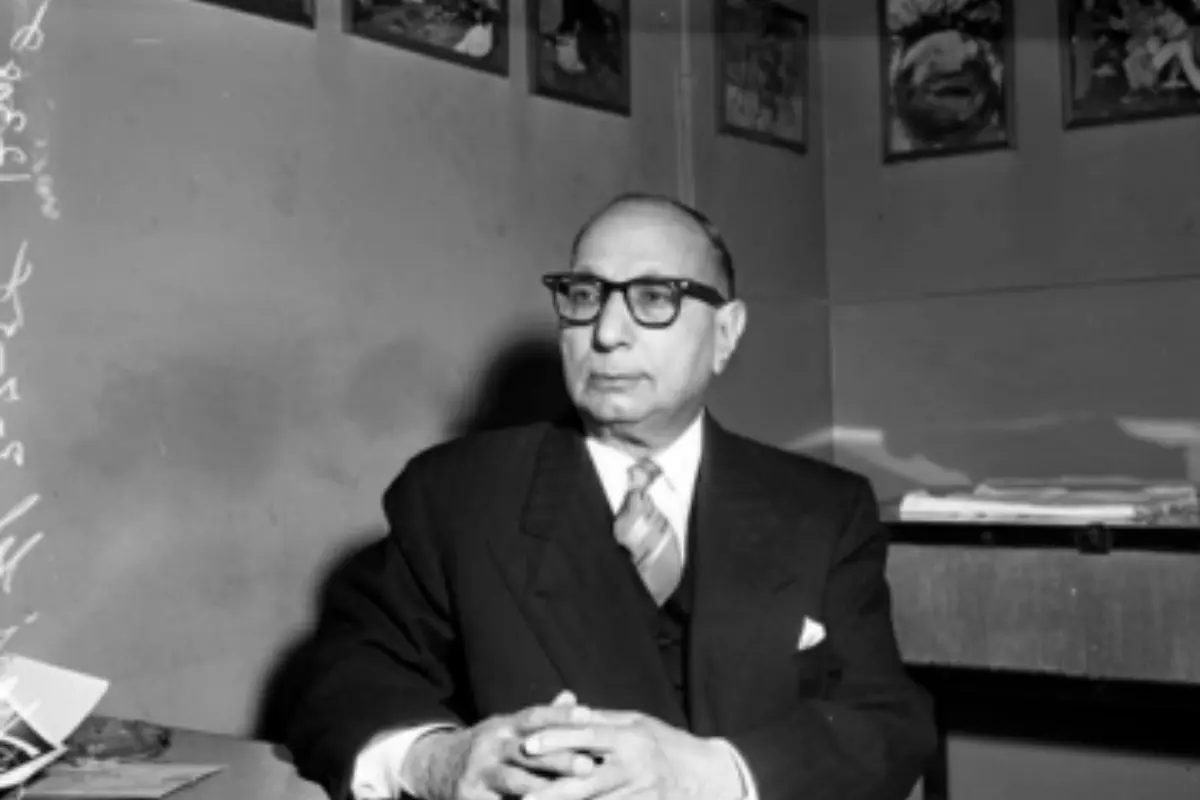
In the vast tapestry of human progress, some stories illuminate not only an individual’s achievements but also the very ideals that define the human spirit—freedom, courage, and intellectual pursuit. One such story is that of Gobind Behari Lal, a name that reverberates with quiet brilliance and historic impact.
Born on October 9, 1889, in Delhi, into a prominent family—his father, Bishan Lal, was the Governor of the princely state of Bikaner—Gobind Behari Lal had the pedigree of privilege. But rather than enjoy the comforts of aristocracy, he chose a path of revolutionary activism, journalistic excellence, and scientific enlightenment. From his early days in Lahore to his Pulitzer-winning career in the United States, Lal carved a legacy that remains inspirational for generations of journalists, activists, and dreamers worldwide.
From Punjab to Berkeley: A Quest for Knowledge and Liberty
Gobind Behari Lal earned his B.Sc. and M.A. from Punjab University, Lahore, and served as an assistant professor between 1909 and 1912. But academic achievement alone did not define his purpose. Influenced deeply by his cousin Lala Har Dayal, a prominent nationalist and intellectual, Lal was drawn into the heart of India’s fight for independence.
In 1912, thanks to a Guru Govind Singh Sahib Educational Scholarship established by Har Dayal, Lal journeyed to the University of California, Berkeley. There, his intellect flourished, and so did his conviction. At Berkeley, he immersed himself not only in postgraduate studies but also in the ideological battles of the Ghadar Party, a revolutionary group of Indian expatriates devoted to liberating India from colonial rule.
The Birth of a New Voice: Journalism as a Weapon of Truth
What set Gobind Behari Lal apart from other freedom fighters of his era was his embrace of science journalism as a tool for empowerment. He began working as the Science Editor for The San Francisco Examiner in 1925—a position that earned him a historic distinction: he was the first journalist to use “Science Writer” in a byline.
In a time when science was still cloaked in mystique for the common reader, Lal broke it down with elegance and accuracy. His words made Einstein’s theories understandable and Gandhi’s philosophies relatable. He was not just reporting facts; he was translating the future for the world to see.
Over the years, he worked for major Hearst Newspapers in San Francisco, New York, and Los Angeles. He conducted landmark interviews with Albert Einstein, Mahatma Gandhi, Enrico Fermi, Max Planck, H.L. Mencken, and Edna St. Vincent Millay—offering his readers not just news, but an intimate look into the minds that shaped the 20th century.
Pulitzer Recognition: A Dream Realised
In 1937, Gobind Behari Lal achieved what no Indian before him had—the Pulitzer Prize for Reporting. He shared this prestigious honour with four other journalists—John J. O’Neill, William L. Laurence, Howard W. Blakeslee, and David Dietz—for their insightful coverage of Harvard University’s Tercentenary celebration, a scientific milestone.
This recognition wasn’t just a personal victory. For the Indian diaspora and freedom activists, it was a moment of pride—a validation that an Indian, once considered a colonial subject, could influence global thought at the highest levels of media.
Gobind Behari Lal: Champion of Science, Soldier of Freedom
Even as Lal’s journalism career soared, his commitment to India’s independence movement never waned. He used his platform to amplify the struggles of Indian revolutionaries and to speak truth to power. For his contributions, the Government of India honoured him with the Padma Bhushan in 1969, followed by the Tamra Patra in 1973, recognising his role in the fight for freedom.
He was also a founding member and the President of the National Association of Science Writers in 1940, further cementing his role as a pioneer who elevated science writing into a respected global discipline.
An Enduring Legacy
Gobind Behari Lal’s literary contributions include “Joseph Mazzini as a Social Reformer” (1915), “Science and Polity in India” (1920), and “Chemistry of Personality” (1932)—works that underscore his intellectual versatility and his deep belief in the power of knowledge to shape societies.
He served as Editor of Universal Service from 1954 until he died in 1982, leaving behind a legacy of fearless truth-telling, mentorship, and trailblazing thought leadership. Even in his final days, battling cancer, Lal remained a torchbearer of scientific integrity, penning his last article just weeks before he passed away at the age of 92.
Gobind Behari Lal: A Name That Lives On
In honor of his immense contribution to journalism and education, the Gobind Behari Lal Scholarship in Science Journalism was instituted by the Center for South Asia Studies at UC Berkeley—a fitting tribute to a man who believed that the pen, when guided by purpose and science, can move nations.
Also Read : UK Immigration Rule Changes Spark Anxiety Among Workers and Businesses