
G20 Summit: Global Leaders’ Declaration Passes Unanimously
G20 Summit 2025: Landmark Declaration Adopted Early Amid Diplomatic Rift
G20 Summit: In a dramatic and unprecedented turn at the Johannesburg summit, the G20 Leaders’ Declaration 2025 was unanimously adopted at the very start of proceedings — a break from nearly two decades of tradition. South Africa, the host nation, pushed forward with the landmark declaration even as the United States boycotted the event, deepening diplomatic rifts between Washington and Pretoria.
The declaration, shaped under South Africa’s presidency, places climate ambition, debt relief, development justice, and multilateral reform at its core. Its adoption signals a sweeping shift in how the world’s major economies aim to respond to a rapidly transforming global order.
G20 Summit: A Declaration Pushed Through Against Opposition
According to multiple diplomatic sources, the United States objected strongly to sections of the declaration, prompting its decision to stay away. South African President Cyril Ramaphosa, however, made it clear that the document had overwhelming backing from the rest of the G20.
“There’s been overwhelming consensus and agreement that one of the first tasks we should undertake is to adopt our declaration,” Ramaphosa told world leaders during his opening remarks. He underscored that the declaration was not up for renegotiation, even in the face of US pressure.
Ramaphosa’s spokesperson, Vincent Magwenya, confirmed that Washington had asked Pretoria not to adopt any declaration in President Donald Trump’s absence. “We had an entire year of working towards this adoption, and the past week has been intense,” Magwenya noted. The strong support from members pushed the adoption to the top of the agenda — a striking departure from the tradition of adopting final communiqués only after days of negotiations.
A Strong Message on Terrorism, Conflicts, and Multilateralism
The G20 Leaders’ Declaration 2025 makes an unusually forthright political statement, reflecting the fractured international environment. It “unequivocally condemns terrorism in all its forms and manifestations”, echoing India’s long-standing demand that the world not differentiate between “good” and “bad” terrorists.
The document identifies rising geopolitical tensions, economic fragmentation, widening inequalities, and global instability as urgent concerns. It reaffirms a collective commitment to the UN Charter, urging nations to avoid threats or use of force that undermine sovereignty and territorial integrity.
The declaration also stresses the importance of reinvigorating multilateral systems. Leaders reiterated support for a fair, inclusive, rules-based multilateral trading system and backed structural reforms of the World Trade Organization to better reflect development priorities — a core demand of the Global South.
On global conflicts, the declaration calls for “just, lasting and sustainable peace” in regions including Sudan, the Democratic Republic of Congo, the Occupied Palestinian Territory, and Ukraine. Leaders stressed that peace is indispensable for achieving global prosperity, security, and sustainable development.
G20 Summit: A Bold Climate Stand Seen as a Rebuff to the US
Climate action and energy transition — two themes the US delegation reportedly opposed — feature prominently in the declaration. The explicit inclusion of “climate change” was interpreted by analysts as a pointed reaffirmation of global climate commitments, despite years of scepticism expressed by President Trump.
By placing climate ambition at the center, the G20 Leaders’ Declaration 2025 showcases a united front from participating nations determined to preserve momentum toward net-zero transitions, climate finance, and adaptation measures.
‘Solidarity, Equality, Sustainability’: A Pro–Global South Statement
South Africa shaped the declaration around the theme “Solidarity, Equality, Sustainability,” promoting a strong pro-Global South agenda. Debt relief mechanisms for vulnerable economies, sustainable development pathways, and inclusive growth models were key highlights.
The declaration’s early adoption signaled that developing nations were more aligned than ever, unwilling to let geopolitical rivalries derail the momentum built over the year.
Modi Calls for New Development Metrics
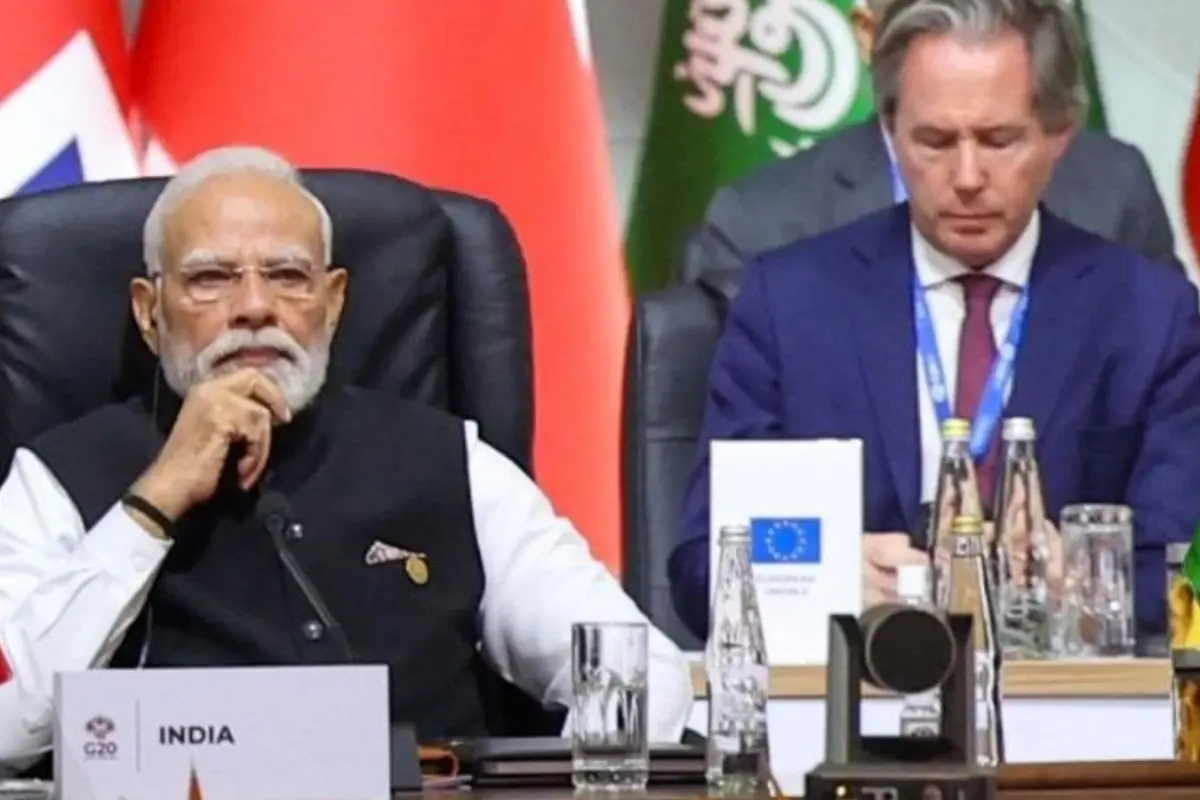
Prime Minister Narendra Modi, attending the summit during his three-day visit, emphasized the need to redefine global development frameworks. Addressing leaders, he said:
“Now is the right moment for us to revisit our development parameters and focus on growth that is inclusive and sustainable. India’s civilisational values, particularly the principle of Integral Humanism, offer a way forward.”
Modi also held bilateral meetings with UK Prime Minister Keir Starmer, Australian Prime Minister Anthony Albanese, and Canadian Prime Minister Mark Carney.