
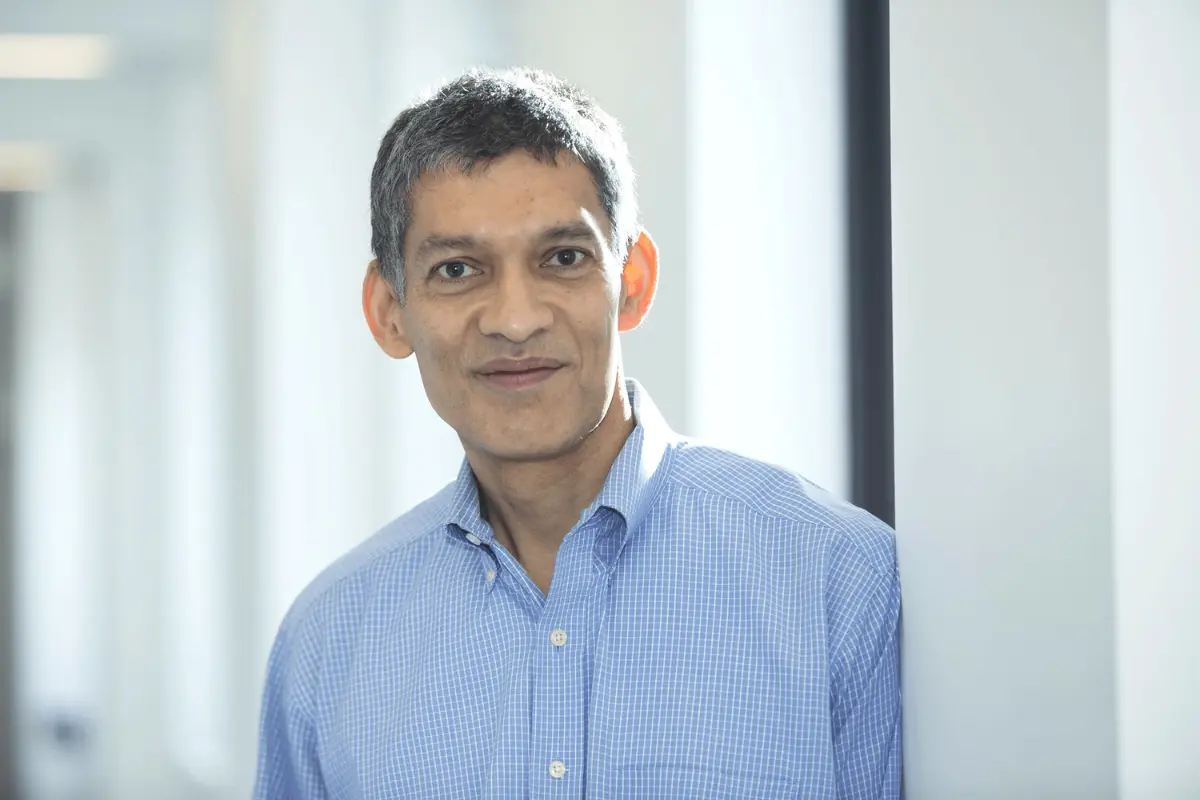
Born in 1965, Eswar Prasad began his academic journey in India at the University of Madras, earning a Bachelor of Arts degree in economics in 1985. Even at this early stage, his intellectual curiosity extended beyond textbooks. He was not merely studying economic theory; he was questioning how nations grow, why inequality persists, and how policies shape the destinies of millions.
His academic path soon took him abroad. At Brown University, he completed his Master of Arts in 1986, deepening his analytical training. He later earned his Ph.D. in economics from the University of Chicago in 1992, an institution globally renowned for producing influential economic thinkers. It was here that Prasad refined the analytical precision and empirical discipline that would define his career.
Behind the scholar is also a grounded family man. Married to Basia Kaminska, Eswar Prasad shares his life with his children, Berenika and Yuvika, and even finds companionship in Mozart, the family dog—reminding us that the architect of global monetary frameworks also values life’s quieter harmonies.
Eswar Prasad: At the Epicenter of Global Policy: The IMF Years
Before becoming a prominent academic voice, Eswar Prasad served on the frontlines of international economic policymaking. At the International Monetary Fund, he rose to become Chief of the Financial Studies Division in the Research Department and previously headed the IMF’s China Division.
These roles were far from ceremonial. They placed him at the heart of some of the most consequential economic transitions of the late 20th and early 21st centuries. As emerging markets gained momentum and China’s economic ascent redefined global trade, Prasad’s research and policy analysis helped shape international understanding of financial stability, capital flows, and macroeconomic risks.
He also contributed intellectually to the IMF’s scholarly output—serving as co-editor of IMF Staff Papers, joining the editorial board of Finance & Development, and founding the quarterly IMF Research Bulletin. Through these platforms, he encouraged rigorous debate and evidence-based policymaking at a global level.
The Cornell and Brookings Era: Bridging Academia and Policy
Today, Eswar Prasad is the Tolani Senior Professor of International Trade Policy and Professor of Economics at Cornell University. He is also a Senior Fellow at the Brookings Institution, where he holds the New Century Chair in International Economics.
This dual role—academic and policy intellectual—defines his influence. In the classroom, he mentors students who will become tomorrow’s policymakers and financial leaders. In Washington and global policy circles, he translates academic insight into practical guidance.
Eswar Prasad has testified before the U.S. Senate Finance Committee and the House Committee on Financial Services, particularly on matters concerning China and global financial stability. His research has been cited in the U.S. Congressional Record—an extraordinary testament to the real-world impact of his scholarship.
He is also a Research Associate at the National Bureau of Economic Research and a Research Fellow at the Institute for the Study of Labor in Bonn, reinforcing his global academic footprint.
Eswar Prasad: The Big Bang Debate – Rethinking Economic Transitions
In the early 2000s, Eswar Prasad collaborated with economist Michael Keane to analyze post-communist economic transitions. Their research challenged simplistic narratives.
They argued that Poland’s “Big Bang” strategy—rapid price liberalization and trade openness combined with gradual privatization and strong social transfers—produced superior growth outcomes and lower inequality compared to other transition economies.
This was classic Prasad: nuanced, data-driven, and unafraid to defy conventional wisdom. He demonstrated that economic reform is not merely about speed—it is about balance, sequencing, and institutional strength.
The Dollar Trap: Explaining Currency Power
In 2014, Eswar Prasad published The Dollar Trap, a penetrating examination of why the U.S. dollar retained its global dominance even after the 2008 financial crisis.
Rather than assuming decline, Prasad argued that the dollar’s strength lies in relative institutional trust. While the U.S. faced policy missteps, no alternative economy had built financial institutions robust enough to rival American capital markets. His argument reframed debates about reserve currencies and exposed the structural underpinnings of global trust.
Launched with discussions involving figures such as Ben Bernanke, the book established Prasad as one of the most articulate interpreters of international monetary dynamics.
Gaining Currency: China’s Renminbi Ambitions
In 2016, Eswar Prasad released Gaining Currency: The Rise of the Renminbi, analyzing China’s efforts to elevate its currency to global reserve status.
He offered a balanced view—acknowledging China’s financial progress while cautioning against overestimating its readiness to challenge the dollar. Structural fragilities, state-dominated banking systems, and limited financial transparency, he argued, would constrain the renminbi’s ascent as a “safe haven” currency.
Once again, Eswar Prasad demonstrated a rare intellectual trait: the ability to critique without sensationalism.
The Future of Money: Digital Transformation
With The Future of Money (2021), Eswar Prasad turned his focus to the digital revolution reshaping currencies and finance. As cryptocurrencies, central bank digital currencies, and fintech innovations accelerated, Prasad examined both promise and peril.
The book earned recognition from leading publications for its clarity and foresight. Rather than framing digital finance as a utopia or apocalypse, he analyzed how technology could expand financial inclusion while introducing new regulatory and stability challenges.
In doing so, Eswar Prasad positioned himself at the forefront of debates about the future of global finance.
Eswar Prasad: The Doom Loop – A Warning for 2026 and Beyond
His forthcoming book, The Doom Loop: Why the World Economic Order Is Spiraling into Disorder, scheduled for release in 2026, reflects his growing concern about geopolitical fragmentation, rising debt burdens, and institutional erosion.